Last updated: November 19, 2026
Key Takeaways
- A utility connection fee budget should cover start fees, transfer fees, deposits, installation charges, and a prorated first bill.
- Build your utility connection and transfer fees budget by listing providers, getting the full startup cost, and saving before moving day.
- Electric, gas, and internet accounts each charge differently, so your day-one cash need changes by provider.
- Set aside enough for every fee due before service starts, plus a buffer for proration and any deposit that is not waived.
Utility connection fees can hit a single-parent budget before the boxes are even unpacked. How to Budget for Utility Connection and Transfer Fees as a Single Parent means planning for connection fees, deposits, and the first prorated bill as separate costs so the move does not blow up your cash flow. The steps below show how to estimate them, schedule them, and avoid paying twice for the same service window.
What a utility connection fee budget needs to cover
A utility connection fee budget needs to cover service start fees, transfer fees, deposits, installation charges, and the first bill that may be prorated. The utility connection fee is only one line item, and treating it as the whole cost is where many budgets break; the Federal Trade Commission advises checking the full bill and fee details before you pay. FTC
Picture this: you’re moving with kids, the electric company wants a start fee, the gas company wants a transfer fee, and the internet provider wants an installation slot on a weekday. If you only set aside money for one of those bills, you’ll scramble by the second phone call.
Start with the categories that usually show up:
- Electric service start fee for turning on power at the new place
- Gas service transfer fee if service has to move from one address to another
- Internet installation or activation fee
- Utility deposit if the provider asks for one based on credit or account history
- Prorated bill for partial-month service at the old or new address
A simple budget line for each service keeps the move readable. I’d separate them into three buckets: start-up fees, deposits, and first-month operating costs. That way, a quote from the electric company does not get mixed up with a deposit hold from the gas company.
The most conservative approach is to budget for the highest likely charge you are quoted, not just the cheapest one on a website. Some providers waive one fee but keep another. Here’s the catch: the fee you don’t see on the homepage is often the one that lands on the invoice.
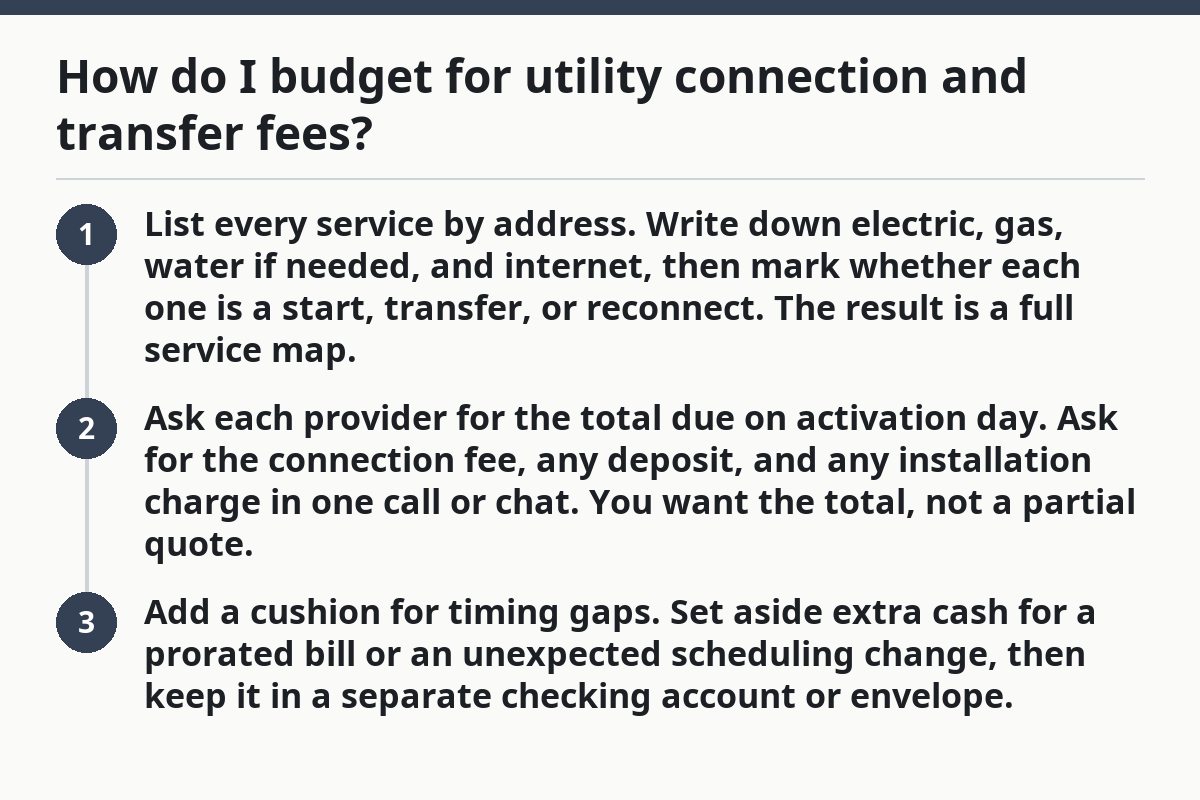
How do I budget for utility connection and transfer fees?
You budget for utility connection and transfer fees by listing each provider, asking for the full startup cost, and setting aside extra cash before the move date. A 3-step estimate is enough to keep the numbers honest without turning this into a spreadsheet project.
- List every service by address. Write down electric, gas, water if needed, and internet, then mark whether each one is a start, transfer, or reconnect. The result is a full service map.
- Ask each provider for the total due on activation day. Ask for the connection fee, any deposit, and any installation charge in one call or chat. You want the total, not a partial quote.
- Add a cushion for timing gaps. Set aside extra cash for a prorated bill or an unexpected scheduling change, then keep it in a separate checking account or envelope.
The truth is, a single-parent budget works best when the move fund is split by date, not by category alone. If the internet is installed on a Tuesday and the gas transfer clears on Friday, you need money ready before both dates, not after payday.
I also like to write down the due date beside each charge. A fee due at order time needs cash in hand. A fee billed on the next statement can still hurt, but it doesn’t need the same immediate reserve.
- Up-front due now
- Due on the first bill
- Due after installation
- Possible refund later
That last line matters. Some deposits are refundable, but the refund may come much later, so it should not be treated like money available for groceries or school fees; the Consumer Financial Protection Bureau recommends keeping billing and refund timing straight before you count that money as usable. CFPB
Which charges show up on electric, gas, and internet accounts?
Electric, gas, and internet accounts each have their own fee pattern, and that pattern changes how much cash you need on day one. The number that matters is the total due at activation, not just the posted connection fee.
Picture this: you call the electric company and hear one fee, then the gas company adds a deposit, then the internet provider books an install visit that comes with another charge. The bills are small enough to ignore one by one and large enough to wreck a thin checking balance.
For electric service, ask whether the account needs a start fee, a meter read charge, or a deposit. Some utilities bill after service begins, while others want payment before the switch is flipped. If you are moving into a place that already has power, “transfer” may still mean a new account setup fee.
For gas service, the question is often whether the service is being transferred, reconnected, or opened from scratch. Gas companies may also care about safety checks or equipment access, which can affect timing. If an appointment is needed, a weekday morning slot can mean missing work or arranging child care.
For internet service, watch for two charges: activation and installation. Activation can be billed even when a self-install kit is used, while installation usually means a technician visit. The provider may also require a deposit if you are a new customer or have limited account history.
Keep a small comparison note like this:
- Electric: fee, deposit, first bill timing
- Gas: transfer or reconnect fee, appointment date
- Internet: activation, install fee, equipment pickup or delivery
That note tells you which service is the biggest cash hit. It also shows which provider needs the earliest call.
How much should I set aside before move-in day?
You should set aside enough to cover every fee that is due before service starts, plus a buffer for a prorated bill and any deposit that is not waived. The right amount depends on the providers you choose, so the budget works best when it is built from quotes, not guesses.
Picture this: you have one payday left before move-in, and the gas company says it needs payment before the account transfer is processed. At the same time, the internet provider says installation is free only with autopay and paperless billing. That is not the moment to discover you left no room for setup costs.
Use this order:
- List each provider’s quote
- Mark the due date
- Add deposit amounts separately
- Add one extra bill cycle as a buffer
- Hold the money in cash you won’t spend
If a provider says the first bill will be prorated, plan for a smaller but still real charge at the end of the first cycle. Proration does not mean free service. It only means the bill covers part of a month or part of a billing period.
The main advantage is that you do not need to estimate this from memory. A 10-minute call with each provider can replace a lot of stress. Ask for the exact words they use—“connection fee,” “activation fee,” “transfer fee,” or “deposit”—because those terms are not always interchangeable.
A good rule is to budget high enough that you can pay the first charges without using rent money, grocery money, or school expense money. If the total feels too tight, that’s a sign to call and ask whether the fee can be waived, deferred, or paid on the next bill.
What single parents should do first to avoid late fees
Single parents should schedule utility transfers early, pay any required fee before the service date, and line up the move so there is no gap in power, heat, or internet. The practical target is 1 to 2 weeks ahead, and earlier is better for busy seasons.
Picture this: the kids need Wi‑Fi for school, the new place needs heat, and the old place still has an open account. If the transfer date slips by even a day, you can end up paying for both addresses or paying a rush fee to fix the gap.
Here is the core procedure:
- Call or use the utility portal as soon as you have the move date. You want the earliest service window the provider can offer.
- Ask what has to be paid today. Some companies take the connection fee immediately; others bill after scheduling. The goal is no surprise hold on your card.
- Confirm the service date in writing. Save the email, text, or confirmation number so you can prove the appointment if it changes.
- Check whether the old account needs a stop date. That protects you from paying for an extra week at the old address.
- Recheck the first bill. Look for proration, deposits, and any “miscellaneous” charge that does not match the quote.
The main mistake here is waiting until the keys are in hand. That can cost a rush appointment, a same-day fee, or a few days without service. None of those are great when kids need lights, hot water, and a working router.
A practical calendar note helps: put the transfer date, installer visit, and first bill date on the same page. Three dates, one glance. That is easier to manage than chasing three separate portals while packing a kitchen.
Which budget mistakes cost the most?
The most expensive mistakes are missing a deposit, ignoring the old account’s final bill, and assuming internet installation will be free. Those errors can turn a manageable move into a cash crunch fast.
Picture this: you budgeted for the electric start fee, but the provider asks for a utility deposit because there is no recent account history. Then the gas company bills a final prorated amount from the old place, and the internet provider adds an install charge you didn’t include. That is three separate hits, not one.
Common mistakes and the cost of each:
- Forgetting deposits: locks up money you needed for food or transport
- Skipping the final bill: creates a surprise charge after the move
- Leaving no buffer for proration: leaves the first month short
- Scheduling too late: can trigger rush fees or lost work hours
- Assuming every provider bills the same way: leads to underbudgeting
The fix is boring, but it works. Get each provider’s fee structure in writing, then budget for the highest likely outcome. If a provider says a deposit may be waived, do not spend that money until the account is active and the first statement shows zero due.
This is also where patience helps. A utility fee that looks small can still matter if three services bill at once. One charge is easy. Three charges on different dates are the real test.
What if the fee is higher than I expected?
If the fee is higher than expected, pause the setup, ask for the itemized charge, and separate the one-time fee from the deposit. The answer may reveal that part of the bill is refundable, billable later, or tied to installation rather than activation.
Picture this: the electric company quote was one number, but the final total includes a deposit and a same-day processing charge. That does not mean the quote was useless; it means the quote was incomplete. You need the full breakdown before you pay.
Use these questions on the phone:
- What part is refundable?
- What part is due today?
- What part appears on the first bill?
- Can the fee be lowered with autopay or paperless billing?
The goal is not to negotiate every line into nothing. It is to know what you are paying for and when. If the service date is close and you need the account active, a clear breakdown is worth more than a vague promise.
For single parents, the smartest budget move is sometimes the simplest one: keep a separate “utility start-up” envelope or bank bucket for 30 days after the move. That keeps the first bill, a deposit hold, and any final prorated charge from colliding with the rest of household spending.
If you want a broader picture of move-related costs, the housing move costs for single parents hub can help you connect this line item to the rest of the move budget.
How do I keep utility fees from breaking the rest of my budget?
You keep utility fees from breaking the rest of your budget by separating due-today charges from later charges and protecting the money in a different place than your spending account. A simple two-account system or envelope system is often enough.
Picture this: the fee is due today, but groceries, gas, and child care are also due this week. If all the money sits in one checking account, it gets hard to tell what is already spoken for. That is how a utility payment turns into an overdraft.
Use a split like this:
- Move-in utility fund for connection fees, deposits, and installations
- Everyday spending account for food, transport, and school needs
If your provider offers autopay, use it only when the due date is clear and the account has enough padding. Autopay is a tool, not a rescue plan. A bill that clears at the wrong time can drain the account before you notice.
The cleanest budget is one that gives every utility charge a home before the move starts. That includes the electric company, the gas company, and the internet provider. If one of them gives you a quote that feels too high, ask whether service can begin with a different plan or later appointment.
The aim is simple: no lights out, no missed transfer, no panic at the end of the month. That is a good budget. Solid.
Which utilities charge connection fees?
Electric, gas, and internet providers commonly charge setup-related fees, and some water or trash providers do too depending on the city or landlord arrangement. The exact name changes by company, so the bill may say connection fee, activation fee, transfer fee, or installation charge. Ask for the total due before service starts.
Do I need to pay a deposit to start utilities?
Not always, but some providers do require a utility deposit based on credit checks, account history, or prior payment issues. The deposit is often separate from the connection fee and may be refunded later if the account stays in good standing. Ask for both amounts before you schedule service.
How early should I schedule utility transfers?
Schedule utility transfers as soon as you know your move date, and aim for 1 to 2 weeks ahead when you can. Internet installs and gas appointments can book out faster than you expect, especially if a technician visit is needed. Early scheduling also gives you time to fix fee surprises before move-in day.
Drafted with AI; not yet reviewed by a person.