Last updated: November 20, 2026
Budget foreign transaction fees by treating them like a separate travel-and-shopping cost, not an afterthought. Build a small line item for card use in other countries and in other currencies, then pad it for currency conversion fees, foreign ATM charges, and cross-border purchases so the trip or online order does not throw off the rest of the month.
Key takeaways
- Foreign transaction fees can show up on card purchases, cash withdrawals, and some online orders, so one trip can create several charges.
- A separate card-use budget works better than guessing, because exchange rates can change between the day you buy and the day the charge posts.
- Debit cards, credit cards, banks, and card networks may all add their own fees, so the total cost is often higher than one posted line suggests.
- A small buffer protects essentials like rent, groceries, and school costs when a foreign charge lands later than expected.
- The safest plan is to estimate by category, track every foreign charge on the statement, and adjust the next month’s budget once the real pattern is clear.
How should I budget for foreign transaction fees?
Budget for foreign transaction fees by setting aside a monthly buffer for every card payment, cash withdrawal, and online purchase made outside your home currency. That buffer should sit next to your travel or shopping budget, because the fee is part of the cost of buying, not a surprise after the fact.
Start with the purchases you can already see. If you know you will buy a plane ticket from an international merchant, pay a school fee in another currency, or use your card while traveling, list each item before you pay. Then add a fee cushion for the card issuer, the bank, and the card network, because each one can affect the final total.
A simple rule helps: budget the base cost first, then add a separate fee line for foreign transaction and currency conversion charges. If a charge is likely to be posted in a different currency, do not use the sticker price alone. Exchange rates move, and the amount that clears your account can be higher than the number you saw at checkout.
This matters more for a single parent because a late or larger-than-expected card charge can push a tight budget off track. A grocery bill, child care payment, or utility draft can bounce if your checking balance is lower than planned. A dedicated foreign-fee line lowers that risk.
If the page you need is about the broader system of payment costs, the hub on Single-Parent Banking, Payment, and Money Transfer Costs can help place this fee in context without mixing it up with other charge types.
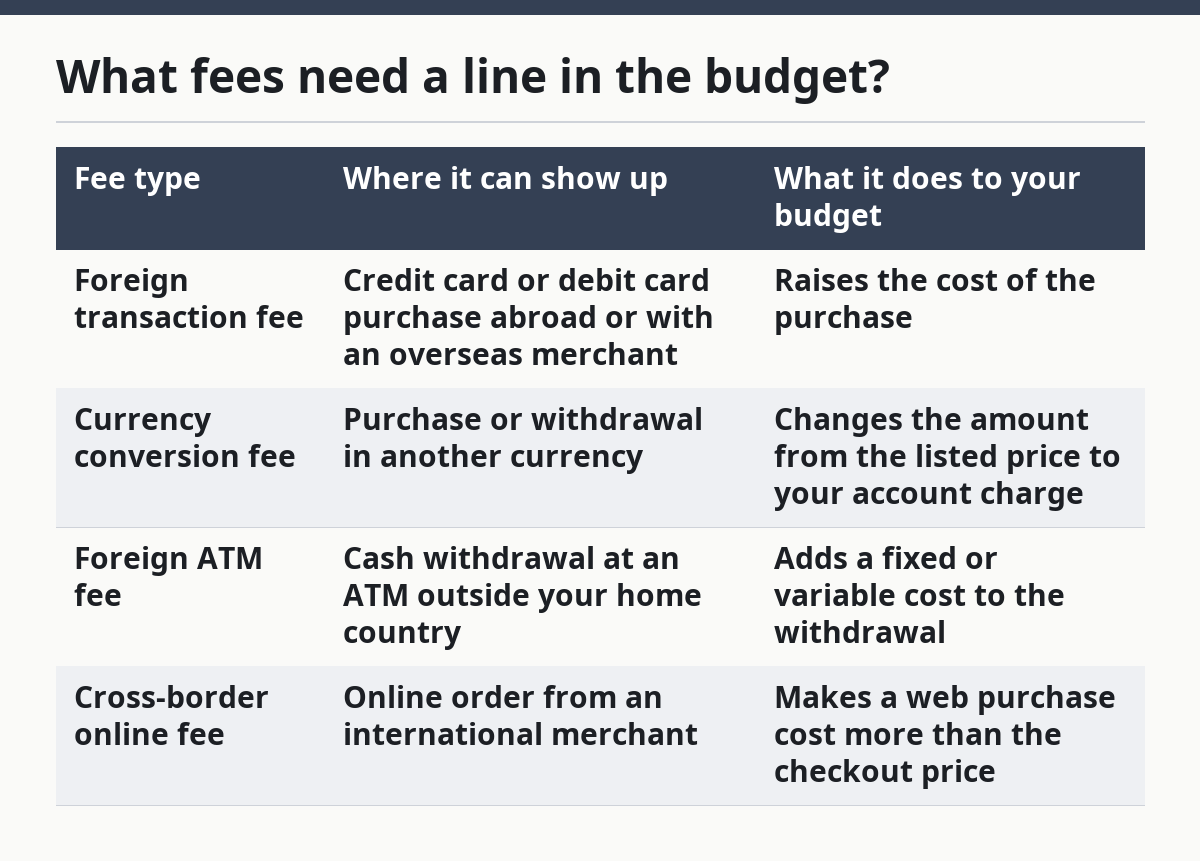
What fees need a line in the budget?
You need a line for foreign transaction fees, currency conversion fees, foreign ATM fees, and any travel-related card charges that land on the statement. That list is the part many people miss, because the cost is not always labeled with one neat name.
Foreign transaction fees are the broad category most readers mean when they ask about card use abroad. Currency conversion fees may appear when the purchase is made in a different currency and the card issuer or network handles the exchange. International debit card purchases can carry both card-network and bank charges, while cross-border online payments can trigger fees even if the store ships to your home address.
Here is the cleanest way to separate them:
| Fee type | Where it can show up | What it does to your budget |
|---|---|---|
| Foreign transaction fee | Credit card or debit card purchase abroad or with an overseas merchant | Raises the cost of the purchase |
| Currency conversion fee | Purchase or withdrawal in another currency | Changes the amount from the listed price to your account charge |
| Foreign ATM fee | Cash withdrawal at an ATM outside your home country | Adds a fixed or variable cost to the withdrawal |
| Cross-border online fee | Online order from an international merchant | Makes a web purchase cost more than the checkout price |
Debit cards and credit cards do not behave the same way, and your bank may treat them differently. A card that looks cheap for in-person travel may still be expensive for online shopping in another currency. That is why the budget needs one line for card use abroad instead of one vague “travel” bucket.
Use the fee list to sort charges before you spend. If the charge is a remittance-related bank charge, treat it as a different line from card fees, because sending money and paying by card solve different problems.
How do I build the budget step by step?
Build the budget by listing the purchase, the currency, the payment method, the likely fee type, and the expected posting date. That five-part check keeps you from undercounting the cost of a card swipe that looks small at checkout.
- List each purchase in a notes app or spreadsheet, and write the amount, currency, and date next to it.
- Mark the payment method as debit card, credit card, or ATM cash withdrawal so you know which fee rules may apply.
- Estimate the foreign transaction and currency conversion fees as a separate cost line, not inside the purchase total.
- Reserve a buffer in your checking account or travel bucket before you spend, so the later card posting does not wipe out groceries or school costs.
- Track the final statement amount after the charge clears, and compare it with the estimate.
- Adjust the next month’s buffer if the real total ran higher or lower than expected.
A spreadsheet works well because it can show both the purchase amount and the posted amount in one place. A notes app works if the trip is short and the number of charges is small. A budget envelope system can also work for a cash-heavy trip, but it is weaker for online purchases because those charges do not stay in one neat pile.
The goal is not perfect math. It is to stop foreign card use from becoming a hidden leak in a month that already has child-related costs, transport, and household bills.
Should I budget differently for cards, online orders, and ATMs?
Yes, you should budget differently for cards, online orders, and ATMs because each one can create a different fee pattern. A credit card used in a store abroad, a debit card used on an overseas website, and cash pulled from an ATM do not all land the same way on a statement.
For international merchants, the purchase may look normal at checkout and then arrive later with a fee attached. That delay matters because the statement can post after other bills have already cleared. For cross-border online payments, the charge can also move with the currency exchange rate between authorization and posting.
ATMs are the least predictable for a tight budget because they can create more than one fee at once. The card network may charge a foreign ATM fee, the bank may add its own fee, and the exchange rate can shift the amount again. If cash is necessary, budget for the withdrawal as a full event, not as a simple cash pickup.
Debit cards can be useful for direct spending, but they pull money from checking faster and can make timing harder. Credit cards can give a little more time before payment, but the bill still needs room in next month’s budget. A single parent with little spare cash may prefer credit for timing and debit for control, but neither is free.
Budgeting separately for each method helps you see which one is the expensive option in your own life. If one card keeps adding higher charges, that card may not be the right tool for foreign spending.
What mistakes raise the total the most?
The biggest mistake is budgeting only for the sticker price and ignoring the fee that follows. That choice can cost you the difference between a smooth month and a shortfall that hits rent, child care, or groceries.
Another common mistake is using the wrong exchange rate to plan. People often use the rate they saw on a travel site or phone app and assume the bank will post the same number. The real charge can move before it settles, so the budget needs a cushion rather than a single exact conversion.
A third mistake is mixing foreign card costs into the ordinary monthly budget without tagging them. When that happens, the fees vanish into “miscellaneous,” and the next month starts with no guide. A labeled line for foreign transaction fees gives you a pattern to follow after two or three statements.
A fourth mistake is using cash abroad without counting the bank and ATM charges. Cash can feel simpler, but the full price may be higher than a card charge, especially when multiple fees stack on one withdrawal. If you need cash, plan the withdrawal size before you go so you are not taking out small amounts over and over.
The fix is simple: write every foreign charge down once, then review it at the end of the month. If one fee keeps repeating, move it from surprise status to planned status.
How do I keep the fee from hurting the rest of the month?
Keep the fee from hurting the rest of the month by separating it from your core bills and treating it as a planned sinking fund. That means the money sits aside before you use the card, instead of coming from groceries after the fact.
Start with essentials first. Set rent, utilities, food, transport, and school costs before you fund international spending. Then add the foreign-fee buffer only from money that is truly free for travel, shopping, or family obligations abroad. If the buffer is not there, the purchase may need to wait.
A small emergency cushion also helps. Even a careful estimate can miss a timing shift because card charges do not always post on the same day they are authorized. If you keep a little room in checking, you reduce the chance that a foreign fee causes an overdraft or forces a later bill to be late.
This approach is not right for every reader. If you are already behind on essential bills, or if foreign card use is not necessary, the better move may be to avoid the purchase rather than stretch a tight budget. Planning for fees is useful; paying them when the household cannot absorb them is not.
For fee basics, the Consumer Financial Protection Bureau has plain-language pages on foreign transaction fees and currency conversion fees: https://www.consumerfinance.gov/ask-cfpb/what-is-a-foreign-transaction-fee-en-1791/ and https://www.consumerfinance.gov/ask-cfpb/what-is-a-currency-conversion-fee-en-1743/.
What counts as a foreign transaction fee?
A foreign transaction fee is a charge tied to using a card outside your home country or with a merchant that processes the payment abroad. It can apply to card purchases, online orders, and sometimes other card-based payments in another currency. The exact label varies by bank and card network.
How do currency conversion fees show up on a statement?
Currency conversion fees usually show up as part of the final posted amount rather than as a separate line you saw at checkout. The statement may show the purchase in local currency, the converted amount, and then the extra fee or total charge. That is why the receipt and the statement often do not match exactly.
Should I budget separately for international card use?
Yes, budget separately for international card use if you want the number to be useful. A separate line helps you see how much goes to the actual purchase and how much goes to fees, which makes the next month easier to plan. It also keeps foreign charges from getting buried inside normal household spending.
How can I reduce foreign transaction fees?
You can reduce foreign transaction fees by using a card or bank account that charges less, choosing the right card for the right purchase, and avoiding small repeated ATM withdrawals. Paying in the local currency can also help in some cases, but the final cost still depends on the card and the bank. Read the fee terms before you travel or shop.
Drafted with AI; not yet reviewed by a person.