
Last updated: November 18, 2026
Key Takeaways
- Bill negotiation can sometimes secure a due-date change, payment plan, late-fee waiver, or temporary hardship program.
- Before you call, gather your account number, exact amount due, due date, and what you can pay today.
- Ask for a payment plan by naming the bill, stating the problem briefly, and proposing one arrangement that fits your calendar.
- If the first answer is no, ask for the next option and whether a supervisor, retention team, hardship team, or billing specialist can review the account.
A bill negotiation starts before a payment is missed, and a single parent has the strongest chance of getting relief by asking early, asking clearly, and asking for one specific concession at a time. In How to Negotiate a Bill as a Single Parent, the goal is not to “win” an argument with a utility company, landlord, credit card issuer, internet provider, or medical billing department; it is to get a workable change that protects this month’s budget and avoids a late fee, shutoff notice, or collection step.
What bill negotiation can actually get you

Bill negotiation can get you a due date change, a payment arrangement, a late fee waiver, or a temporary hardship program. It usually will not erase the whole balance, and it rarely works if you call after a missed payment has already triggered collection activity.
For a single parent, that matters because the pressure is time-sensitive. If rent is due on the 1st and your paycheck lands on the 5th, a call on the 27th has more room to work than a call on the 3rd. The same is true for a utility shutoff warning, a credit card minimum payment, or a medical bill that has not yet reached collections.
The smallest change that solves the immediate problem is often the best target. A landlord may offer a one-time extension on rent. A credit card issuer may let you skip or reduce one payment through a hardship program. An internet provider may move a due date or waive a late charge. A medical billing department may split the balance into 3 or 6 monthly payments without interest, depending on policy.
The trade-off is simple: relief now can mean a longer repayment period later. That is not failure; it is the point. What makes this worth doing is preventing a cascade of fees. This page is for a person who needs to buy time without creating a bigger bill next month. It is not the right tool if you are choosing between several bills and need a full triage plan; that belongs on a different page.
Get these 4 things ready before you call
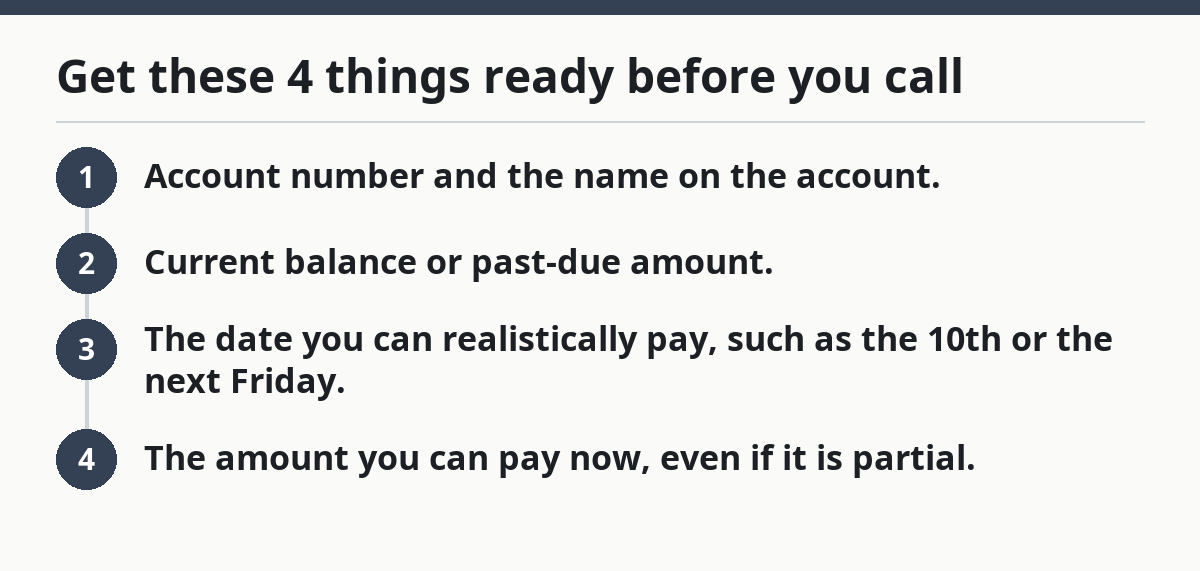
Get your account number, the exact amount due, the due date, and the amount you can pay today before you make the call. Without those 4 items, the conversation tends to drift, and the representative has less room to offer a specific arrangement.
Use a pen and paper or a notes app and write down this set in one place:
- Account number and the name on the account.
- Current balance or past-due amount.
- The date you can realistically pay, such as the 10th or the next Friday.
- The amount you can pay now, even if it is partial.
If the bill is for rent or a landlord-managed fee, have the lease or rental agreement nearby. If it is a utility, have the most recent statement open. If it is a credit card, know whether the account is current or already late. If it is a medical bill, look for the patient statement and the billing department number, not the general hospital switchboard.
This preparation does two things. First, it lets you speak in numbers instead of vague stress. Second, it helps the representative match you to the right option faster. A script like “I can pay $75 today and the rest on the 15th” is easier to use than “I’m short this month.”
If you are calling during business hours, aim for the first 30 minutes after opening or the first hour after lunch. Shorter queues can make it easier to stay calm and keep the conversation on point.
How do I ask for a payment plan?

Ask for a payment plan by naming the bill, stating the problem in one sentence, and proposing one arrangement that fits your calendar. That is the cleanest way to start, and it gives the representative a concrete option to work with.
Use this order:
- Identify yourself and the account.
- Say you are asking before missing a payment, if that is true.
- Name the exact help you want: payment plan, due date change, late fee waiver, or hardship program.
- Offer a specific date and amount.
- Ask what they need to approve it.
A useful script is: “I’m calling about account 1234. I’m a single parent and I need a temporary payment plan before I miss this payment. I can pay $60 today and $60 on the 15th. What options are available?”
That sentence works because it is direct and specific. It also frames the request as prevention, not defiance. Customer service systems often handle that distinction differently. A representative can often document “hardship” or “temporary arrangement” more easily than they can reverse a missed-payment status.
If the bill is from a landlord, keep the tone practical and brief: “I can pay half of the rent on the 1st and the rest on the 12th. I want to keep the account current and avoid any late charge.” If it is a credit card issuer, ask whether the account qualifies for a hardship program and whether the arrangement changes interest or autopay. If it is a utility company, ask about a payment extension and whether the arrangement stops a shutoff notice from moving forward.
Do not overexplain the whole month unless they ask. A long story can sound like a request for sympathy instead of a request for a specific solution. The result you want is simple: the person on the phone repeats back the plan and gives you the next step.
What to say when the representative says no
If the first answer is no, ask for the next available option and ask whether a supervisor, retention team, hardship team, or billing specialist can review the account. The first person you reach often follows a narrow script, and a different department may have authority to approve a due date change or waive a late fee.
Use these exact follow-ups:
- “What is the closest option you can offer today?”
- “Is there a hardship program on this account?”
- “Can you transfer me to someone who handles payment arrangements?”
- “If I pay $___ now, will that stop the late fee or collection step?”
- “Can you note in the account that I called before missing the payment?”
That last question matters. A documented call before the due date can help later if there is confusion about timing. It does not guarantee a favorable outcome, but it creates a record that you tried to resolve the bill early.
If the representative offers a plan you cannot sustain for 2 or 3 months, do not agree just to end the call. Say, “That payment is higher than I can keep up with. Do you have a lower temporary amount?” A payment arrangement that collapses next month is worse than a firm no, because it can add another fee.
This is where single-parent budgeting pressure shows up most clearly. A parent often has no spare buffer for a plan that assumes a second paycheck or a partner’s income. If the monthly amount offered is not realistic, ask for a shorter arrangement, a later due date, or a one-time waiver instead of pretending the bigger number will work.
The same rule applies to medical billing departments and internet providers. A plan is useful only if it fits the next 30 days, not just the moment you hang up.
Which bills are easiest to negotiate?
Medical bills, credit card accounts, and internet provider bills are often easier to negotiate than rent, and rent is often harder because landlords have fewer incentives to change terms. Utility companies usually fall somewhere in the middle because they may have hardship programs, payment extensions, or special arrangements tied to shutoff prevention.
That does not mean the easier bills should always be the first call; it means the format of the request is more likely to work. Medical billing departments may offer installment plans or a temporary hold. Credit card issuers may have hardship programs that change minimum payments or interest terms. Internet providers may offer one-time extensions or late fee waivers. A landlord may be willing to split rent for one month, but that often depends on lease terms and past history.
The main cost of negotiating a bill is that the balance may stretch across more months. A lower payment can keep the account alive, but it can also keep the obligation around longer. Ask what happens to interest, fees, and automatic payments before you agree to any plan.
For a single parent, the safest target is the bill that has the most immediate penalty. A shutoff notice from a utility company can affect school nights and work calls within days. A late rent notice can carry a lease consequence. A credit card can usually be handled with more flexibility if the minimum payment can be deferred or reduced. Medical billing departments may be the most flexible of all, but only if you contact them before the account is sent out of the normal billing cycle.
The wrong move is assuming that every bill negotiates the same way. It does not. One call may get you a 15-day extension; another may only allow a 2-payment arrangement. Ask what the account type permits, then choose the offer that creates the least damage this month.
For more on keeping income stable as a single parent, this page supports the larger Single Parent Income Stability hub and this budgeting checklist.
Common mistakes that make the answer worse
The biggest mistake is waiting until after the due date. Once a bill is late, the conversation shifts from prevention to damage control, and the room to ask for a late fee waiver or due date change gets smaller.
A second mistake is asking for “help” without naming the exact help. That costs time and usually produces a generic answer. “I need a payment arrangement for $50 today and the rest next Friday” gives the representative something concrete to approve or deny.
A third mistake is agreeing to a payment you cannot keep. A broken promise can lead to another late charge, a returned-payment fee, or loss of eligibility for future hardship options. If the offer is too high, say so immediately and ask for a lower amount or a shorter plan.
A fourth mistake is using the same script for every bill. Landlords, utility companies, credit card issuers, internet providers, and medical billing departments all work differently. A landlord may care most about lease status. A utility company may care about shutoff prevention. A credit card issuer may route you to a hardship department. A medical billing department may only need a written payment plan request.
A fifth mistake is failing to write down the outcome. Record the date, the name of the person, the new amount, the new due date, and whether late fees were waived. If the arrangement covers 3 months, put each date in your calendar right away.
These details sound small, but they protect you if the account is reviewed later. The point of bill negotiation is not just to get a yes on the phone. It is to end the month with a plan that survives real life.
When not to try to negotiate alone
Do not handle it alone if the account is already in collections, the landlord has started a formal legal process, or the bill is tied to a notice that could affect housing, utilities, or access to care. At that point, the stakes are high enough that a local housing counselor, legal aid office, or consumer-focused financial counselor may help you understand the next move.
That does not mean every hard bill requires professional help. It means formal, written, or time-limited disputes need more caution. A phone promise may not be enough if a landlord has served a notice or a creditor has moved the account out of normal billing. In those cases, ask for everything in writing and save it immediately.
You should also stop and reassess if the offer depends on a very specific future date that you do not control. For example, a payment plan that only works if child support arrives on time, a tax refund clears, or a second paycheck lands exactly as expected is fragile. A plan that breaks once is worse than no plan at all if it triggers more fees.
For most single parents, the practical rule is this: negotiate the bill yourself first, but do not wait so long that the account leaves the ordinary customer-service lane. Early action gives you more control, a better chance at a hardship program, and a cleaner record if you need to escalate later.
What do I say when I ask for a payment plan?
Say the account number, the amount you can pay now, and the date you can pay the rest. That is the fastest route to a real answer. A simple line like “I can pay $75 today and $75 on the 15th; what payment plan can you set up?” gives the representative a concrete offer to review.
Can I ask for a due date change?
Yes, and it is often worth asking before the bill is late. A due date change is more likely to be approved when you call early and can point to a regular cash-flow issue, such as paydays that fall after the bill date. Ask whether the change is permanent or temporary and whether it affects autopay.
Which bills are easiest to negotiate?
Medical bills, credit cards, and some internet or utility accounts are often easier to negotiate than rent. That said, every account has its own rules, and a landlord may still agree to a short extension. The easiest bill is usually the one you call about before a missed payment creates extra fees.
Drafted with AI; not yet reviewed by a person.