
Last updated: November 20, 2026
Quick Answer: the best single-parent budgeting by life stage and family situation plan usually starts with 4 buckets — bills, groceries and transport, children’s costs, and reserve. If your income changes from paycheck to paycheck, a paycheck-based budget usually works better than a strict monthly plan, because it tells you what to do with each dollar as it arrives. This is information, not financial advice; for your own situation, a qualified adviser should be consulted.
Key takeaways
- A single-parent budget works best when it follows cash flow, not just a calendar month.
- The right plan changes with life stage: pregnancy, infant care, school years, teen years, and post-separation recovery all bring different bills.
- Irregular income needs a buffer for bills that do not wait, like rent, power, transport, school costs, and childcare.
- A monthly budget is simpler on paper, but a paycheck budget is usually easier when pay dates move around.
- If debt, arrears, or unpaid childcare are already piling up, the first goal is to stop the damage, not to build a perfect spreadsheet.
What changes first in a single-parent budget?

The first thing that changes is timing: a single-parent budget has to match when money comes in and when fixed bills go out. One parent may be covering rent, food, transport, school costs, and childcare on one income, so the plan has less room for error than a two-income household.
That is why a good budget starts with a 3-part order of operations: keep the home going, protect work and caregiving, then plan for the next shock. For many single parents, the biggest mistake is budgeting by hope instead of by due date. A bill due on the 1st does not care that payday lands on the 12th.
Life stage matters too. A baby brings nappies, formula or feeding gear, and childcare planning; a school-age child brings uniforms, lunches, trips, and term-time costs; a teenager can bring transport, phones, larger food bills, and new school charges. The budget should change when the child’s costs change, not only when income changes.
A second shift is emotional, not just mathematical. Single parents often carry the whole “what if” list alone, so the budget needs a small emergency layer even when money is tight. It does not need to be large to matter; it just needs to exist and be protected from daily spending.
Because that emergency layer only works if it sits on top of the basics, the next question is how to build the budget around the money you actually receive. That is where the pay pattern matters most.
How do I budget as a single parent when my pay changes?
A paycheck budget works best when your income changes because it tells each paycheck what job to do. Instead of assuming the month starts with a full pot of money, you assign money in the order bills arrive, which helps when pay is weekly, fortnightly, seasonal, hourly, or otherwise irregular.
The simplest version has four buckets: bills, groceries and transport, children’s costs, and a small reserve. Bills come first because housing, utilities, and childcare are the costs most likely to create a crisis if they slip. Groceries and transport come next because they keep the household moving. Children’s costs need their own line because they are easy to underestimate when school fees, clothes, or activities arrive all at once.
A monthly budget can still help if your pay is regular, but if your pay is irregular, a paycheck budget usually fits better. The reason is practical: a month is a calendar unit, while your money lands on different days. The budget should follow cash flow, not the other way around.
A good rule is to make the budget on the lowest predictable income pattern you can rely on, then treat anything extra as a job-separation cushion, debt payment, or future bill fund; a qualified adviser can help you decide how to apply that rule in your own situation, and the CFPB’s budgeting resources explain the basic approach at https://www.consumerfinance.gov/consumer-tools/budgeting/. That reduces the risk of spending money before it has cleared the month’s fixed costs. It also gives you a way to survive a short week without redoing the whole plan.
Which budget method fits my family?

The best method depends on whether your income is steady or uneven, and on how much calendar pressure your family carries. A paycheck budget wins for irregular income, while a monthly budget wins for steady pay and simpler bill cycles.
| Criteria | Paycheck budget | Monthly budget | Winner for [condition] |
|---|---|---|---|
| Income pattern | Fits irregular or changing pay dates | Fits steady pay dates | Paycheck budget for variable income |
| Bill timing | Matches each pay period to due dates | Groups all costs into one month | Paycheck budget when bills hit at different times |
| Mental load | More tracking, but clearer next steps | Easier to picture on one page | Monthly budget when income is stable |
| Risk of overspending | Lower if money is assigned as it arrives | Higher if one large bill is forgotten | Paycheck budget when cash is tight |
| Flexibility | Easier to adjust after a short paycheck | Easier to review at month end | Paycheck budget for fluctuating hours |
| Planning for school costs | Lets you set aside money by payday | Works if costs are predictable | Paycheck budget when terms cause spikes |
| Handling debt | Makes minimum payments easier to schedule | Good for fixed repayment plans | Paycheck budget when arrears are a risk |
| Emergency planning | Builds a small reserve from each pay | Works once savings are already stable | Paycheck budget for fragile cash flow |
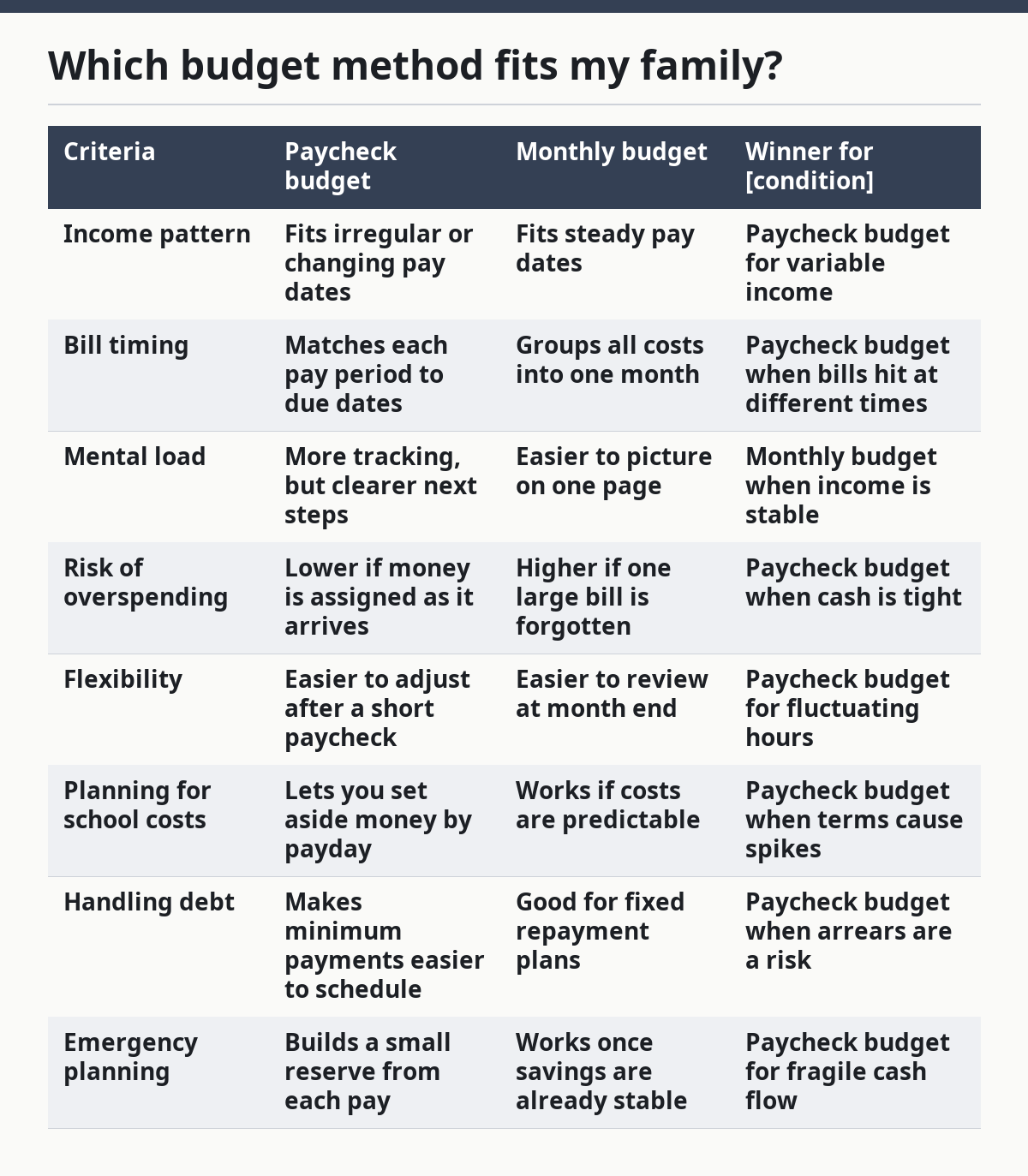
The paycheck budget wins for most single parents with irregular income because it reduces guesswork. A monthly budget is still useful if your income is stable, your bills are fixed, and your calendar is predictable. The wrong choice is the one that makes you feel “behind” every time a bill lands before payday.
A simple way to choose is to look at the last 3 months of income and ask one question: did money arrive on the same day each time, or did it move around? If the answer is “it moved around,” a paycheck budget usually fits better. If the answer is “it stayed the same,” a monthly plan may be easier to keep up with.
The drawback of the paycheck method is that it takes more attention. You have to keep track of what each paycheque is already promised to. That can feel heavy at first, but the trade-off is that the budget becomes more honest. MyMoney.gov’s budgeting guidance covers the same basic habit of assigning money before it is spent at https://www.mymoney.gov/.
What should I do by life stage?
A single parent should budget by life stage because the biggest costs change fast, sometimes within a single year. A baby, a primary school child, a teenager, and a newly separated household all have different pressure points, even if the income number stays the same.
Pregnancy and the first year
The first year usually needs the most setup money, even before the child is mobile. The budget has to account for medical costs where relevant, baby supplies, feeding gear, nappies, transport, and possible childcare decisions that affect work hours.
This stage often exposes a hidden problem: the parent’s own income may drop before the child’s costs become predictable. A reduced schedule, maternity or parental leave, or lost shifts can make the budget tighter just as expenses rise. The best move is to keep non-urgent spending low and protect housing, food, and transport first.
Who this stage is not for: a budget built on “we will figure it out later.” In the first year, later is expensive.
Ages 1 to 4
The toddler and preschool stage usually adds childcare complexity. This is the age band where care costs can become the biggest line in the budget, because care is often needed to keep work hours possible.
This stage also brings unpredictable small bills: clothing growth spurts, accidents, and supplies that have to be replaced quickly. A parent who budgets only for the obvious monthly bills may still run short because these smaller costs show up often. A separate “child extras” line can stop those costs from eating groceries or rent.
The main trade-off here is that childcare can make work possible while also consuming a large share of income. That tension is real, and the budget has to face it directly. If care costs are swallowing the paycheque, the problem is not bad spending habits alone; it may be a work-and-care mismatch that needs a different schedule or support.
Primary school years
The primary school years usually reward predictability, but only if school costs are planned across the year. Uniforms, lunches, trips, supplies, clubs, and term-related charges can bunch together even when weekly spending looks manageable.
A parent in this stage should build a school-cost fund in small amounts through the year if possible. The point is not to save a large lump sum overnight; it is to stop each term from becoming a financial emergency. A budget that ignores these seasonal costs will feel fine in one month and broken in the next.
This stage is often where a single parent can start making the budget more structured. If the child’s schedule is stable and the parent’s work hours are more settled, the budget can move from survival mode toward planning mode. Even then, it should keep a buffer for sick days and after-school changes.
Teen years
Teen years usually cost more than many parents expect because the expenses become less visible and more varied. Food, transport, school demands, clothes, phone costs, and activity fees can rise at the same time.
This stage needs a frank conversation about limits, because teens can see and feel the difference between “I forgot” and “I cannot afford that right now.” A budget here works better when the parent names what is fixed, what is flexible, and what requires notice. That reduces the chance of surprise spending.
The budget can also start teaching the teenager how household money works. That is not about turning the child into a co-earner; it is about setting expectations. When a teen understands that rent and food come first, fewer last-minute arguments follow.
After separation or divorce
The first 6 to 12 months after separation are often the hardest budget period because legal, housing, and household changes all land at once. A single-parent budget in this stage has to handle two problems at the same time: the new income level and the cost of transition.
This is the stage where the budget should be the simplest version that still covers the basics. Fancy categories and perfect tracking can wait. The priority is to know what is coming in, what is legally or contractually due where relevant, and which bills cannot be missed without causing harm.
This stage is not for blame. It is for triage. If the budget feels blunt, that is because the situation is blunt.
What if my money comes in unevenly?
Uneven money needs a budget built around the lowest reliable amount, not the best month you hope for. That rule keeps the household from spending future income too early.
One useful method is to split every incoming payment into three jobs: immediate bills, near-term bills, and reserve. Immediate bills are the ones due before the next pay. Near-term bills are the costs due later in the month or term. Reserve is the money that stops a short paycheck from causing a crisis.
A second step is to group bills by date, not by category alone. For example, rent, power, phone, and childcare may all belong to different categories, but the budget should show when each one needs cash. That makes the plan more useful than a neat spreadsheet that ignores time.
If your pay changes a lot, a “one month ahead” buffer is useful, but it takes time to build. Do not assume you can create that buffer in one turn. Start with one bill cycle, then two, then more as the reserve grows.
A common mistake is to treat extra income as disposable before the next due date. That creates a gap between the way the budget looks and the way the account behaves. The safer habit is to give extra money a job as soon as it arrives, and if you are unsure how to do that, a qualified adviser can help you sort the order of priorities.
When should I cut back, and when should I fix the structure?
Cut back on variable spending first when the shortfall is temporary, and change the structure when the shortfall is repeating. That is the cleanest split.
Variable spending means things like discretionary meals out, impulse buys, some entertainment, and non-urgent extras. Those are the fastest places to trim because they are usually easier to pause for 1 month than fixed costs are. Fixed costs include rent, essential utilities, minimum debt payments, childcare, transport to work, and basic food.
If the same shortfall keeps happening for 3 months or more, the problem is probably structural. That can mean childcare costs are too high for the work schedule, transport is too expensive for the job, or debt payments are crowding out essentials. At that point, the budget needs a redesign, not just tighter rules.
The mistake to avoid is making endless cuts that damage the household’s stability. A budget should reduce waste, not remove the basics that keep work and parenting possible. If the cuts start to threaten food, housing, or the ability to earn, the plan needs another look.
What should a single-parent emergency plan include?
A single-parent emergency plan should cover 4 things: rent or housing, food, transport, and childcare. Those are the costs that can stop work or destabilise the home fastest.
The plan does not need a large fund to start. It needs a clear order: which bill is paid first, which supplier gets called, which expense can be delayed, and where the emergency cash is kept. If the plan is written down, it is easier to use when a school closure, sick child, car repair, or reduced shift arrives.
It also helps to know the difference between a true emergency and a hard week. A hard week is when money is tight but the house is still stable. A true emergency is when a missed payment will create a deeper problem, such as losing housing or being unable to get to work.
One useful habit is to review the emergency plan at the start of each term or season. School costs, weather, transport, and childcare needs change with the calendar. A plan written once and never updated can fail at the exact moment it is needed.
What mistakes cost single parents the most?
The most expensive mistake is budgeting for a perfect month that never happens. Single-parent life often has sick days, school notices, transport changes, and work shifts that move at the last minute.
The second mistake is hiding child costs inside general spending. When school costs, clothing, lunches, or activity fees are mixed into ordinary household spending, the budget looks balanced right up until a term bill lands. A separate line makes the pattern visible.
The third mistake is ignoring the bill dates. A family can be “fine for the month” and still miss rent if the money is spent in the wrong order. That is why cash flow matters more than category totals.
The fourth mistake is trying to make the budget emotionally fair instead of financially workable. A budget is not a verdict on effort. It is a tool for deciding what gets paid first when the margin is thin.
What if I am already behind?
If you are already behind, the budget should switch to damage control for 30 days, not perfection. The first goal is to keep housing, food, transport, and childcare from getting worse.
Start by listing every bill in due-date order, then mark the ones that would cause the most harm if missed. After that, trim anything that does not protect income or the home. The point is to stop the slide before you rebuild the plan.
This is also the point where outside help can matter, even if you do not want it to. A qualified adviser, a benefits worker, a creditor, or a local support service may help with timing, hardship options, or payment plans. Because these options differ by country and provider, check your local official sources before acting.
Two official starting points that explain budgeting and money tools are the Consumer Financial Protection Bureau’s budgeting resources at https://www.consumerfinance.gov/consumer-tools/budgeting/ and its savings tools at https://www.consumerfinance.gov/consumer-tools/savings/. If you are outside the United States, look for your country’s official consumer or financial regulator instead, because rules and support systems differ.
Which budget should I choose?
Choose a paycheck budget if your income changes, your bills arrive on different dates, or you are trying to stop missed payments. Choose a monthly budget if your pay is steady, your costs are predictable, and you mainly need a simple tracking system. Neither if your housing, food, or childcare are already unstable enough that the next step is urgent help, not budget polish.
That call is plain because the wrong format can hide the real problem. A monthly budget may look neat while still failing on payday. A paycheck budget may feel more detailed, but it matches the way money actually moves in a single-parent home.
The best choice also changes by life stage. A parent with a newborn and irregular hours usually needs the paycheck version. A parent with stable salary, school-age children, and fixed bills may do better with a monthly version. The child’s age changes the cost pattern, and the income pattern changes the tool.
The one thing both methods share is discipline about due dates. If the money is not assigned before it is spent, the budget is only a wish list.
FAQ
How often should I review my budget?
Review it at least once a month, and again when pay changes, school terms begin, or a big bill lands. A single-parent budget can drift fast because childcare, food, and transport costs do not stay still for long.
Should I budget for my child’s extras even if money is tight?
Yes, because “extras” become real costs the moment they show up. School trips, clothes, birthdays, and activity fees are easier to handle when they are planned as small regular amounts instead of surprise spending.
Is it better to save first or pay debt first?
It depends on whether you are exposed to a near-term emergency. If one missed bill could damage housing, work, or childcare, a small reserve may come first; if debt is already costing you heavily, minimum payments and a structured repayment plan matter too. A qualified adviser should be consulted for your own situation, because this balance changes by country and by debt type.
What if I only get paid once a month?
A monthly pay cycle can still work well if the bills are lined up correctly. The key is to split the month into bill dates, not just spend categories, so that rent, food, transport, and child costs do not collide at the end of the month.
What is the biggest budgeting mistake for single parents?
The biggest mistake is using a plan that ignores timing. A budget can look balanced on paper and still fail if the rent is due before the next paycheque, or if school costs arrive in the same week as a utility bill.
Drafted with AI; not yet reviewed by a person.