Last updated: November 20, 2026
Quick answer: in Single-Parent Income Protection and Benefit Planning — The Complete Guide, the first number to work out is your monthly floor, and for many single parents a 30-day cash buffer plus benefit check should come before buying income protection insurance. For a single parent, the goal is not “perfect coverage”; it is keeping rent, food, childcare, and bills paid when work stops, hours change, or sickness hits.
As someone writing about household budgeting and income risk, I treat this as a cash-flow problem first and an insurance problem second; for personal decisions, consult a qualified professional and check official guidance such as GOV.UK benefits pages and MoneyHelper before you buy or claim.
Key takeaways
- A single parent usually needs a plan for three risks: illness, job loss, and unstable hours.
- Benefits can fill a gap, but they rarely replace full pay on day one.
- Income protection insurance can be valuable, but it works best when the waiting period and benefit size match your real savings.
- A practical plan is often a mix: claim every benefit you qualify for, keep a small emergency fund, and use insurance only for the gap benefits will not cover.
- The wrong plan is buying a policy before you know your fixed monthly costs and your benefit options.
What does “income protection” mean for a single parent?

Income protection means replacing part of your earnings if you cannot work, or if your income drops enough to threaten the basics. For a single parent, that usually means protecting rent or mortgage, council tax or local taxes, groceries, transport, childcare, and phone service, not trying to replace every pound of take-home pay.
The monthly amount you must cover is the starting point for Single-Parent Income Protection and Benefit Planning — The Complete Guide. If your fixed costs are £1,800 and your benefits or savings can cover £1,100, then the gap is £700. That gap is the real target, not your gross salary.
This matters because many people buy insurance that looks strong on paper but does not line up with their life. A policy that pays after 12 months does little for a parent who needs childcare this week. A benefit that helps with rent may still leave a large hole in food, school costs, and travel.
The other piece is timing. Single parents often have less slack in the budget, so the first question is not “What is the best policy?” It is “How many months can I survive if income stops?” If the answer is one month, the priority is a benefit plan and a cash buffer. Insurance comes after that.
For official benefit information, I would start with your national government’s social security pages. In the UK, GOV.UK’s benefits and financial support guidance is a useful starting point: https://www.gov.uk/browse/benefits
Which risks matter most?
The biggest risks are sickness, reduced hours, and sudden childcare costs, and each one hits a single-parent budget in a different way. One risk can last days; another can last years. Treating them as separate risks, rather than the same problem, helps you choose the right cover with professional advice and official sources such as GOV.UK and the Social Security Administration.
Sickness is the cleanest case for income protection. If you are too ill to work and the earnings stop, a policy may pay a monthly amount after a waiting period. Short-term benefit support may cover part of the gap, but the size and timing depend on where you live and what you qualify for.
Reduced hours are trickier. Many single parents do not face a total stop; they face fewer shifts, a cut in overtime, or a role change that lowers pay. Some policies only pay if you meet a defined level of incapacity. That means a policy can look helpful and still miss the kind of income drop that happens most often.
Childcare shocks are the least obvious and the most common planning mistake. If a child is sick, a school closes early, or after-school care falls through, a parent may lose paid time even if they are healthy. Insurance usually does not pay for that type of disruption. Benefits may help with living costs, but they do not create childcare on demand.
That is why I would split planning into two layers. First, ask what stops your pay. Second, ask which cash sources still work when that happens. Benefits are about eligibility. Insurance is about contract terms. Savings are about speed.
If you want an official overview of how public support is usually assessed, the U.S. Social Security Administration’s disability benefits pages are a useful reference point for the logic of eligibility, even if you do not live in the U.S.: https://www.ssa.gov/benefits/disability/
Income protection or benefits support: what should come first?

Benefits support should come first if your budget is already tight, because benefits can start the moment you qualify, while insurance only helps after you buy it and meet its waiting period. That does not mean benefits are better than insurance; it means they are the first line of defense.
Here is the practical difference:
| Criteria | Income protection insurance | Benefit planning | Winner for this condition |
|---|---|---|---|
| Speed of setup | Needs application, underwriting, and policy terms | Depends on local rules, but can be checked now | Benefit planning |
| Monthly certainty | Can offer a set monthly payout | Often varies by eligibility and household status | Income protection insurance |
| Flexibility if income drops a little | Often limited to serious illness or incapacity | Can sometimes support partial loss better | Benefit planning |
| Best for long absence from work | Strong if the policy is well matched | Public support may be lower than full income | Income protection insurance |
| Best for very low savings | Helpful only after a claim triggers | Can be the first source of help | Benefit planning |
| Protects against illness | Usually yes, if policy conditions are met | Sometimes, depending on the benefit | Income protection insurance |
| Protects against job loss | Usually no | Sometimes, depending on the system | Benefit planning |
| Ongoing cost | Requires regular premiums | No premium, but may require paperwork and rechecks | Benefit planning |
| Fit for unstable hours | Often poor unless the policy is tailored | Better if the system considers household need | Benefit planning |
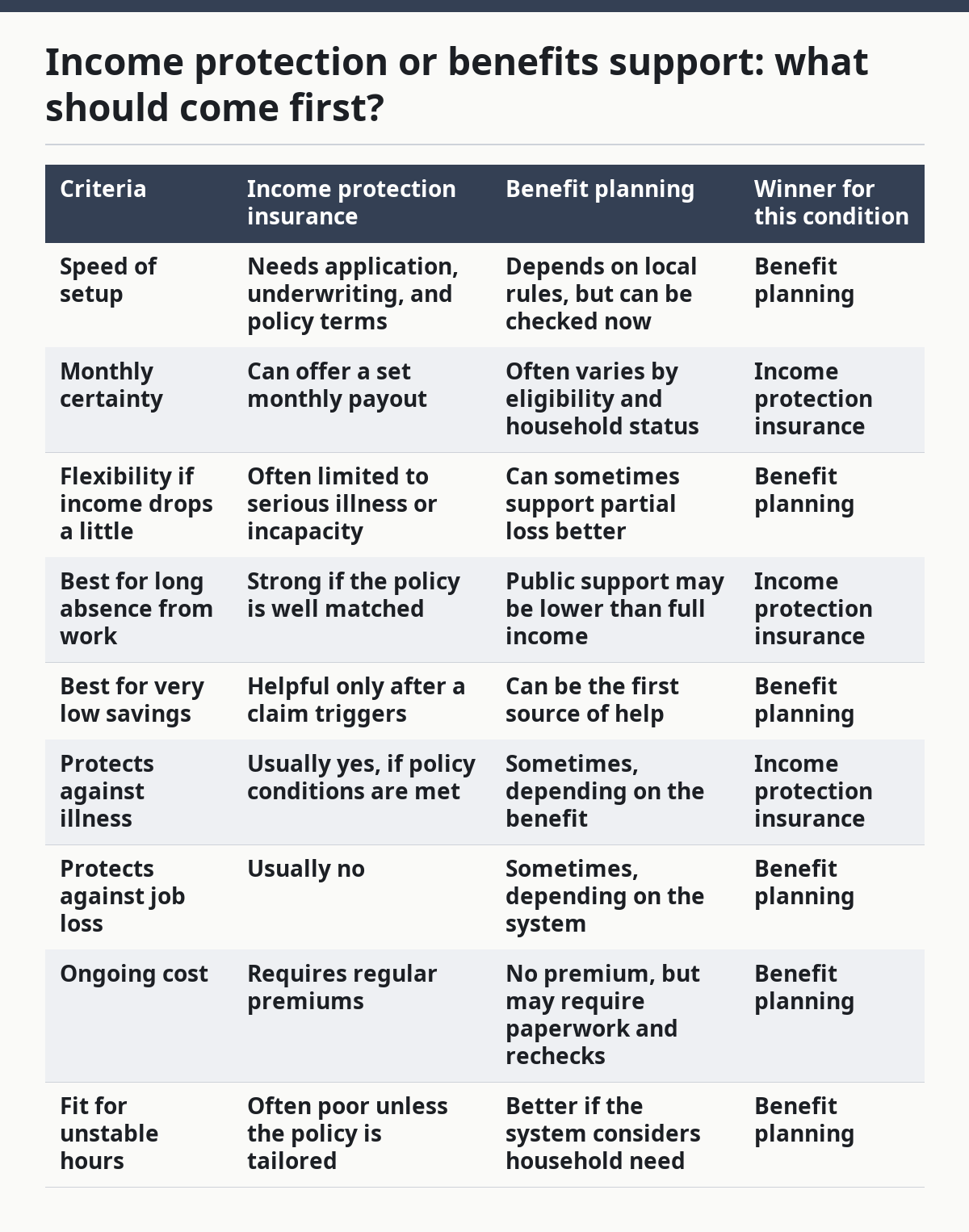
The table points to a clear rule: if your issue is “I need help staying afloat this month,” benefit planning wins. If your issue is “I need a known monthly payment if I cannot work for a long stretch,” income protection insurance wins.
The hidden trap is thinking you must choose only one. That is wrong for most single parents. A small public benefit, a short emergency fund, and a policy that covers the major gap can work together better than any single tool.
If you are comparing help inside the welfare system in the UK, MoneyHelper has a useful benefits and budgeting starting point: https://www.moneyhelper.org.uk/en/benefits
What should a single parent do before buying any policy?
A single parent should write down fixed costs, savings, and the likely benefit gap before buying a policy, because the policy amount and waiting period only make sense against real numbers. This step sounds dull, but it stops expensive mistakes.
Start with a one-page list of monthly essentials. Include rent or mortgage, utilities, food, transport, childcare, insurance, debt payments that must be kept current, and school costs you cannot skip. Then mark each item as “must pay now,” “can pause,” or “can cut.”
Next, list your current fallback money. That includes any savings, child maintenance that usually arrives on time, public benefits you already receive, help from family that is reliable rather than hopeful, and any employer sick pay. Do not count money that might appear “if things go well.” Count only what you can reasonably expect.
Then check the waiting period on any policy you are considering. A 4-week waiting period, for example, is very different from a 6-month waiting period. The longer the wait, the more savings you need. If you have almost no savings, a long waiting period can leave you exposed right when the bills keep coming.
This is also where many people get the wrong policy shape. A policy that replaces a large share of income may sound safe, but if the premium strains the monthly budget, the policy itself becomes a risk. A smaller policy that you can keep in force is better than a big one you will cancel in 6 months.
I would also check whether your employer already gives any sick pay or short-term support. If it does, that may reduce the insurance amount you need. Do not pay twice for the same gap.
How do benefits fit into the plan?
Benefits fit into the plan as the first cash layer after income drops, not as a backup you think about later. If you wait until the budget is already broken, the paperwork can become harder and the stress can make people miss deadlines.
The most useful benefit question is simple: “What am I eligible for if my earnings fall, my hours drop, or I cannot work for a while?” The exact answer depends on country, job type, household income, housing cost, disability rules, child age, and whether you rent or own. That is why benefit planning is not a single search; it is a checklist.
A good benefit plan has four parts. First, know the names of the benefits that might matter in your area. Second, know what documents they ask for. Third, know whether they are means-tested, contribution-based, or tied to disability or caring status. Fourth, know how long the claim process usually takes in practice, because speed matters as much as approval.
The hard truth is that benefits often reduce the damage but do not solve the whole bill stack. A housing payment may protect rent, but food, transport, and childcare can still hurt. That is why benefit planning should be paired with a “bare-bones budget” that tells you what can be cut for 30, 60, or 90 days.
If your current income is already very low, benefit planning can matter more than insurance. If your income is higher but volatile, insurance starts to matter more. That split is the cleanest way to decide where to put effort first.
For general pension and benefits literacy in the UK, The Pension Service and GOV.UK pages are the safest public references to check: https://www.gov.uk/browse/working-state-pension
What kind of income protection fits a single parent?
The right income protection for a single parent is the policy that covers the gap between your essential costs and your real fallback money, with a waiting period you can survive. That usually means avoiding a policy that sounds generous but takes too long to pay.
There are three design choices that matter most.
The first is the waiting period. Shorter waiting periods usually cost more, but they reduce the time you must self-fund. If your savings are thin, a long waiting period can be a bad fit even when the premium looks lower.
The second is the payout size. You do not need to replace every pound. You need enough to keep the household stable. A smaller, workable monthly payment is often better than a larger one that pushes the budget too hard.
The third is the trigger. Some cover is aimed at being unable to work at all. Some is aimed at certain illnesses or disabilities. Some is tied to occupation. Read that language carefully, because the trigger decides whether the policy helps when you need it most.
A single parent who works in a job with no sick pay, no savings, and high fixed childcare costs is usually the strongest case for income protection. A single parent with strong employer support, several months of savings, and low fixed costs may need less insurance and more cash reserve planning.
The drawback is plain: insurance is not a fix for unstable childcare, temporary reduced hours, or every kind of income wobble. It is narrow by design. That narrowness is useful only if the policy matches the risk you are most likely to face.
When is income protection the wrong choice?
Income protection is the wrong choice when the premium would force you to miss essentials, when your waiting period is longer than your savings can cover, or when your income problem is not a qualifying illness or incapacity. In those cases, the policy can look safe and still fail in the real world.
It is also the wrong choice if you have not checked the public benefits you may qualify for. A lot of people buy cover first because it feels active and decisive. But if a state benefit, disability payment, or housing support could stabilize the budget faster, that is the first layer to examine.
Another poor fit is the parent who needs help with unstable hours rather than total loss of work. If your earnings swing by shifts or childcare interruptions, a standard policy may not pay at all. That mismatch is one of the most common reasons insurance disappoints.
Finally, it is the wrong choice if you have no idea what your actual monthly floor is. A policy amount chosen by guesswork is nearly useless. You need a number based on rent, food, utilities, transport, childcare, and debt that truly cannot be skipped.
The honest rule is simple: if the policy would save less than it costs you in stress, paperwork, and premium, skip it for now and put the money into a cash buffer and benefit planning.
What are the exception scenarios?
The overall advice flips in a few clear cases, and those cases matter because they change the order of priorities. In these situations, I would not follow the default “benefits first, insurance second” rule.
First, if your employer already covers a strong amount of sick pay for a meaningful period, income protection may be less urgent. The employer benefit changes the gap, and the gap is what the policy is supposed to fill. A parent with that setup can often use a smaller policy or none at all.
Second, if your fixed monthly costs are very low and you already have several months of savings, a benefits-first plan may be enough. In that case, the problem is not immediate survival; it is preserving savings during a longer setback. Insurance can still help, but the need is weaker.
Third, if you have a health condition or job risk that makes a long absence from work more likely, insurance moves up the list. The more likely the income stop, the more valuable the monthly payout becomes. That is especially true if the policy trigger matches your occupation and health history.
Fourth, if your country’s benefit system gives fast, substantial support for your exact situation, public support may do most of the work. In that case, insurance should be sized around the leftover gap, not around a theoretical full-income replacement.
These exceptions are not loopholes. They are the reason a one-size answer fails. Single-parent planning works best when the policy, the benefit system, and the household budget are all checked against the same monthly number.
How do I build the plan step by step?
Build the plan in this order: calculate your monthly floor, list every benefit you may qualify for, check employer support, then decide whether insurance is still needed. That sequence keeps you from paying for cover before you know what it must do.
Step 1 is the monthly floor. Write down the bills that must be paid to keep the household stable for 30 days. Do not include wish-list spending. Include the costs that would cause the biggest damage if unpaid.
Step 2 is the benefit scan. Check your national benefits pages, housing support rules, and any disability or sickness support that could apply. If the process is complex, gather the documents now, while life is calm.
Step 3 is the employer check. Read the sick pay policy, contract terms, and any short-term disability benefit if one exists. One paragraph in an employee handbook can change the whole plan.
Step 4 is the gap. Subtract benefits, employer pay, and savings you can actually use from your monthly floor. The gap is the number insurance must cover, not your entire salary.
Step 5 is the decision. If the gap is small and your savings are decent, insurance may be optional. If the gap is large and your savings are thin, a policy can be worth serious attention.
This is also the right moment to think about maintenance. A plan that sits in a drawer is not a plan. Recheck it when childcare changes, work hours change, a child starts or leaves school, or your rent and fixed bills move.
The verdict: which one should you choose?
Choose benefit planning if your income is already tight, your savings are small, or you need help that can start before a long insurance waiting period ends. Choose income protection insurance if you can keep paying the premium, your job would leave a big gap during illness, and your policy trigger matches the risk you actually face. Neither if you have not yet worked out your monthly floor, because guessing at the number makes every other choice weaker.
The more realistic answer for many single parents is not one tool but a sequence. First, claim every benefit you can reasonably qualify for. Second, hold a small cash reserve if possible. Third, buy only the insurance that fills the real gap after those two layers.
That call is blunt on purpose. A single parent does not need more financial jargon. A single parent needs the rent covered, the fridge full, and the bills paid when income is interrupted.
What should I ask before I apply?
I should ask whether the policy pays for the kind of income loss I actually face, because a policy for total inability to work may not help with reduced shifts or childcare gaps. I should also ask how long I can survive before the policy pays, since a 6-month wait can be useless if savings last only a few weeks.
I should ask what benefits I could claim first, because public support may reduce the amount of insurance I need. If a benefit already covers part of rent or basic living costs, the policy can be smaller and cheaper to keep.
I should ask whether the premium still fits after I include childcare, food, and transport in the budget. If the premium pushes me into monthly shortfall, the policy is doing harm instead of good.
What documents should I gather now?
I should gather pay slips, benefit letters, tenancy or mortgage papers, childcare invoices, and recent bank statements, because these are the papers that usually prove income, costs, and eligibility. Having them ready cuts down the delay when a claim or application starts.
I should also keep a list of regular bills and due dates, because a single missed payment can snowball fast when income changes. That list helps with both benefit forms and emergency budgeting.
If I have employer sick pay, I should save the policy or handbook page that explains it. If I have child maintenance or another regular support payment, I should keep proof that it is usually received on time.
What if my income changes every month?
If my income changes every month, I need a plan built around averages and worst months, not best months. That means using the lowest realistic income period as the baseline for bills and support decisions.
A variable income makes benefit planning more important, because some systems look at household need and current earnings rather than a single salary figure. It also makes long waiting periods harder to manage, since the rainy-day fund has to cover both normal volatility and a true crisis.
Income protection can still help, but only if the policy treats your work pattern fairly. If the contract is written for stable salaries, a fluctuating income can create gaps in coverage. That is why variable earners need to read the trigger language closely and get professional advice before buying anything with a long lock-in.
For one more official reference point, the UK’s independent MoneyHelper service has guidance on benefits and budgeting that can help frame the questions before you apply: https://www.moneyhelper.org.uk/en/benefits-and-state-pension/benefits-and-tax-credits
Drafted with AI; not yet reviewed by a person.