Last updated: November 19, 2026
Key Takeaways
- A low-cash week is easiest to spot when your balance, due dates, and spending categories all point to the same week.
- A cash crunch can start when your calendar has more bills than breathing room.
- You’re nearing a cash shortage when fixed bills and one normal spending week would leave you below zero before the next deposit.
- You can forecast a low-cash week in 10 minutes by lining up income, due dates, and categories in order.
A low-cash week in How to Predict a Low-Cash Week Before It Happens as a Single Parent usually shows up first in your cash flow warning signs, not in your wallet. The fix is to watch your bank balance, due dates, and calendar together before the week starts. The steps below show how to spot the dip early and plan around it.
The quickest way to spot a low-cash week

A low-cash week is easiest to predict when your bank balance, due dates, and spending categories all point to the same week. If one of those three looks off, that week needs a closer look before Monday hits.
Picture this: you’ve got groceries, school lunch money, a gas refill, and two bills lined up in the same 7-day stretch. The balance looks fine today, but the calendar says otherwise. That’s the moment to slow down. The warning signs are already there.
- Check your current bank balance and write it down.
- Mark every bill due date for the next 30 days.
- Circle any week with 2 or more fixed costs, such as rent, utilities, or childcare.
- Add seasonal spending spikes, like school supplies, birthdays, sports fees, or holiday travel.
- Compare that total with your expected income date, not just your income amount.
The goal is not a perfect forecast. It’s a simple one that catches a bad week before it starts. If the balance on payday has to cover a pile of due dates before the next deposit, that week is a risk.
What cash flow warning signs look like in a single-parent calendar
Cash flow warning signs show up when your calendar has more bills than breathing room. A week with three due dates and one big child-related cost is not “busy”; it is a week that can turn tight fast.
Picture this: your rent is due on the 1st, daycare pulls payment on the 3rd, and your electric bill lands on the 5th. The month may look fine on paper, but the first week is doing all the damage. That timing matters more than the total.
Look for these red flags in your calendar:
- Two or more bills land within 5 days of each other.
- A bill falls 1 to 3 days before your paycheck.
- A variable cost, like gas or groceries, arrives right after a fixed bill.
- Your balance after the biggest bill would not cover a normal week of spending.
- A due date keeps sneaking earlier because of weekends or bank processing.
You do not need a fancy app to see this. A paper calendar, phone calendar, or spreadsheet works if you can read it at a glance. Color-coding helps too: one color for bills, one for income, one for child-related costs.
However, a due date is not always the same day money leaves your account. Some bills pull the same day, while others clear a day or two later. That gap can trick you into thinking you still have money. On a tight week, that delay can matter. See the Consumer Financial Protection Bureau’s guidance on payment timing and account monitoring for more on how timing affects balances: https://www.consumerfinance.gov/consumer-tools/bank-accounts/
How do I know if I’m heading for a cash shortage?

You’re heading for a cash shortage when your balance after fixed bills and one normal week of spending would dip below zero before the next deposit. That’s the cleanest early warning, and it shows up before the shortage hits.
Picture this: you open your banking app on Thursday and see enough for groceries today. But next week still has a utility payment, a school fee, and gas for work rides. The account looks okay for 24 hours, not for 7 days. That is a shortage signal.
Use this check:
| Check | What to look for | What it means |
|---|---|---|
| Current balance | Money available now | Starting point only |
| Next income date | Payday or benefit date | When relief arrives |
| Fixed bills due before then | Rent, utilities, childcare | Guaranteed outflow |
| Weekly spending needs | Food, gas, meds, school costs | Flexible, but real |
| Buffer left over | Money still in the account | Your safety margin |
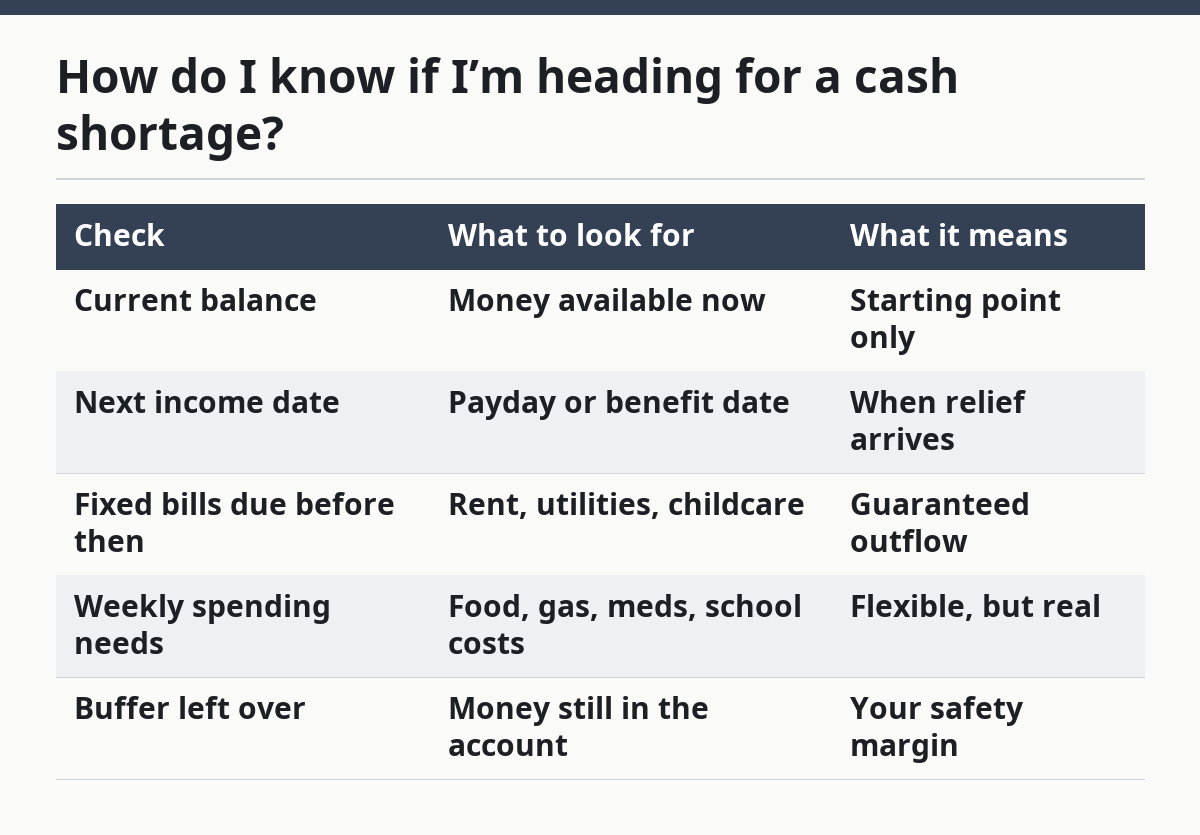
If the buffer is small enough that one grocery trip or one copay would wipe it out, the week is at risk. That does not mean you are behind for the month. It means the timing is tight.
Use bank balance + due dates + calendar together, not one alone. A balance on its own can look safe even when the next four days are packed with withdrawals. For budgeting basics and timing-aware planning, see the Federal Trade Commission’s consumer budgeting advice: https://consumer.ftc.gov/articles/creating-budget and the CFPB’s budgeting resources: https://www.consumerfinance.gov/consumer-tools/budgeting/
A simple 10-minute forecast you can do every Sunday
You can forecast a low-cash week in 10 minutes by lining up income, due dates, and categories in order. This is the fastest method I know for catching a cash squeeze before it shows up in the account.
Picture this: it’s Sunday night, and you have one quiet stretch at the kitchen table. You are not rebuilding a whole budget. You are checking for a trap week. Ten minutes is enough.
- Open your bank app and note the current balance.
- Write down the next payday and any other deposit date.
- List every bill due before that deposit.
- Add one expected spending amount for groceries, gas, and school or childcare.
- Put a line under the week where the balance would fall too low.
That last line matters. If you can see the balance dipping under your comfort point before payday, that is your low-cash week. The exact comfort point is personal, but it should be a number you can explain in one sentence.
Use this format:
- Starting balance: $___
- Bills before payday: $___
- Weekly needs: $___
- Left before next deposit: $___
If the “left” number is thin, the week needs a change. That might mean moving a non-urgent purchase, delaying a subscription, or tightening spending in one category. You do not need to fix the whole month to spot the weak spot.
Which spending categories tell you a week will go bad?
The categories that usually expose a low-cash week are groceries, gas, childcare, school costs, and irregular household purchases. These are the places where a normal week can turn expensive without much warning.
Picture this: you planned for rent and phone service, but then your child needs a field trip fee, sneakers, and an emergency prescription refill. None of those feels huge by itself. Together, they can wipe out a week. That is why categories matter.
Watch these buckets first:
- Groceries: A week with holiday cooking, guests, or packed lunches can cost more than usual.
- Gas or transit: Extra drives for school, work, or appointments stack up fast.
- Childcare: Schedule changes, late pickup fees, or backup care hit hard.
- School and activities: Forms, uniforms, fees, and snacks show up in clusters.
- Household repairs: A broken charger, tire, or fridge part can blow up the week.
Seasonal spending spikes belong here too. August, December, and the start of spring sports often bring costs that do not fit a normal week. If you only track the average, you miss the spike.
The truth is, the category that hurts most is often the one that looks “small.” A $20 school fee can be the thing that tips a week over if your balance is already thin. That is why a category forecast beats a vague feeling.
What to do when the red flags pile up
You should change the timing of spending when the red flags pile up, because waiting for the balance to fix itself only works if the calendar cooperates. If the week already looks tight, the win is to reduce strain before money leaves.
Picture this: your due dates, card charges, and child costs all land inside the same 5-day window. You do not need a perfect fix. You need a buffer. That is the target.
Use this order:
- Protect the bills that can trigger fees first.
- Delay any non-urgent purchase by 7 days.
- Separate variable spending into daily amounts.
- Cut one category for the week, not the whole month.
- Recheck the balance after each scheduled payment clears.
A simple daily cap can help. For example, if the week has to cover groceries, gas, and lunch money, divide the leftover cash by the number of days left. That gives you a real ceiling, not a guess.
Do not ignore a red-flag week because the month “usually works out.” A week can still fail even when the month ends okay. That is the mistake many people make: they trust the monthly total and miss the short stretch that causes the overdraft.
This is also where the hub on income stability and cash flow timing for single parents fits. That page handles the bigger pattern; this one is about spotting the bad week before it lands.
The mistakes that make low-cash weeks hard to see
The biggest mistake is checking the balance without checking the calendar, because a healthy balance on Monday can still fail by Friday. A second mistake is treating every bill as if it hits on the due date only; if you are unsure how your bills post, check with the biller or a qualified financial professional. Banks and billers do not always work that neatly.
Picture this: you think you have a full week left, then an autopay clears overnight and drops the account below what you planned. The number changed while you were sleeping. That is why timing beats guesswork.
Watch for these common errors:
- Using one balance snapshot: It misses scheduled payments.
- Ignoring weekends and bank delays: A Friday due date may pull earlier.
- Counting irregular income too soon: A deposit that usually lands on Tuesday might not help a Monday bill.
- Forgetting seasonal spikes: Back-to-school costs can hide in a “normal” month.
- Spreading small costs across the month in your head: A few small charges can stack into one bad week.
The fix is plain: build the forecast from dates first, amounts second. If you know the due dates and the next deposit date, the weak week usually shows itself.
If your balance is always close to zero, the issue may be timing, not spending alone. That does not solve itself by accident. It needs a repeatable check.
The weekly warning-sign checklist I’d trust
The clearest warning sign is a week where your balance, due dates, and spending categories all point to the same short stretch. If that happens, treat the week as risky before the first bill clears.
Picture this: you want one fast check that tells you yes or no. You do not want a spreadsheet that takes an hour. You want a simple filter you can use every Sunday night. This is that filter.
Use this checklist:
- Does the week have 2 or more bill due dates?
- Does one bill land within 3 days of payday?
- Does the current balance cover the bills plus a normal week of groceries and gas?
- Do school, childcare, or seasonal costs show up this week?
- Would one surprise charge push the account too low?
If you answer yes to two or more, the week deserves a closer look. If you answer yes to three or more, it is probably already a low-cash week in slow motion.
That is the real point of forecasting: not panic, not perfection, just early notice. Once you can see the pattern, you can plan around it before the account takes the hit.
How do I know if I’m heading for a cash shortage?
You’re heading for a cash shortage when the money left after fixed bills and expected spending will not make it to the next deposit. That is the warning line. If the next week depends on nothing going wrong, the week is already too tight.
Check three things: current balance, next income date, and the bills due before then. If those numbers leave almost no room for groceries, gas, or child costs, the shortage is close.
What should I check every week to avoid overdrafting?
You should check your bank balance, due dates, and the next 7 days on your calendar every week to avoid overdrafting. Those three checks show whether money leaves before money arrives.
Then scan spending categories that move fast: groceries, gas, childcare, and school costs. If one of those is larger than usual, the week can turn tight even when the month looks fine.
Drafted with AI; not yet reviewed by a person.