
Last updated: November 19, 2026
A sick day with no paid time off means lost wages, a childcare gap, and a tighter month for a single parent. How to Budget for a Sick Day With No Paid Time Off as a Single Parent starts by treating the day as a short income shock, trimming only the nonessentials, and protecting the next 7–14 days of bills. The steps below show how to do that without turning one unpaid absence into a month of missed payments.
What this plan assumes and who it helps
How to Budget for a Sick Day With No Paid Time Off as a Single Parent applies if you are a single parent, you miss work, and your pay drops because there is no paid time off. It assumes you already know your usual bills, your pay schedule, and which payments can move by a few days. It does not assume you have savings. It does assume you can make one fast budget decision before, during, or right after the absence.
If your income is hourly, gig-based, shift-based, or tipped, the math matters even more because one work absence can hit both the current check and the next one. If your job has attendance rules, a sick day can also bring a separate penalty, so read your employee handbook or local labor guidance before you guess at the cost.
This is information, not financial advice. A qualified adviser can help with your own situation, especially if your rent, debt, or benefits are already behind.
Key takeaways
- Treat the sick day like a short cash-flow problem, not a full-month disaster, and consult a qualified professional if your situation is complicated.
- Protect rent, utilities, food, medicine, and childcare before trimming anything else.
- Build a tiny budget buffer around bill dates, not just around paydays.
- If the loss will spill into the next 2 weeks, the plan needs a backup step, not just cutbacks.
- A missed shift is expensive; a missed bill can snowball faster.
How do I budget for unpaid sick days?

You budget for unpaid sick days by mapping the lost wages, moving the least flexible bills first, and shrinking the next 7 days of spending to the bare minimum. Start with the exact shift or day you will miss, then protect the bills that can trigger fees or service loss.
- List the work absence, the pay rate, and the hours lost. Write the shift length, the hourly rate, and the day you will miss. Verify the total lost wages before taxes or after taxes, whichever you use for budgeting; a mismatch here makes every next step too loose.
- Mark the next 14 days of bills by due date. Include rent, utilities, transit, phone, childcare, and any medicine refill. Verify which bills have a grace period, because a bill due on the 3rd and a bill due on the 5th are not the same problem.
- Sort spending into must-pay, can-move, and can-skip. Must-pay items are the ones tied to housing, heat, water, work access, food, and caregiving. Verify that each item has a real consequence if unpaid; if not, it belongs in the middle or last group.
- Cut the next 7 days of flexible spending first. Pause takeout, extra rides, convenience store stops, and nonurgent online orders. Verify the cut is enough to cover the lost wages; if it is not, you need a second layer, not a deeper guess.
- Move any bill that allows a date change. Call, log in online, or use the payment portal to shift the due date by a few days if the creditor permits it. Verify the new date in writing or in your account history; a phone promise without a record can fail.
- Use your budget buffer only for the gap that the missed wages create. A buffer is a small cash cushion set aside for timing problems, not extra money for new spending. Verify that you are not draining the whole cushion for one bill if another bill lands next week.
- Plan childcare backup before you spend on work absences, not after. If a sick child means you miss work too, compare the cost of the backup caregiver with the wage you would lose. Verify that the backup is reachable on short notice and fits the child’s needs.
- Review the next paycheck before the month rolls on. Look for a second shortfall from the same absence, such as fewer hours, shift change, or an attendance penalty. Verify that the next paycheck still covers the fixed bills; if not, the problem is bigger than one day.
Here’s the catch: the point is not to make the budget look neat. The point is to keep the month from breaking at the exact spots where late fees, shutoff notices, and missed rent start to stack.
What should I pay first after a sick day?
You should pay housing, utilities, food, transport to work, and medicine first, because those costs protect the rest of the month’s budget. A sick day often creates a small cash hole, and the wrong payment order can turn it into a second unpaid absence or a service cutoff.
Use this order when money is tight:
- Housing: rent or mortgage, because falling behind here can be hard to fix.
- Utilities: electricity, gas, water, and internet if you need it for work or school forms.
- Work access: bus fare, gas, tolls, phone service, and childcare tied to getting to work.
- Food and medicine: groceries, prescription fills, and basic over-the-counter supplies.
- Other bills: minimum debt payments, subscriptions, and nonessential services.
If one bill is due in 3 days and another in 12 days, the earlier one is not automatically the priority. The real test is the consequence of missing it. A credit card minimum can usually be less urgent than rent, but a utility with shutoff risk can outrank a later rent payment if the timing is tighter.
The best part is that you do not need a perfect budget to do this well. You need a clear payment order and a fast record of what got moved, what got cut, and what still must clear before the next paycheck.
How do I protect the rest of the month’s budget?

You protect the rest of the month by building a short work absence buffer around the next 2 pay periods and by shrinking variable spending before the fixed bills start to slip. That buffer is not a large savings goal; it is a timing shield.
Start with the numbers you already have:
- Expected paycheck after the unpaid sick day
- Fixed bills due before the next paycheck
- Variable spending you can cut for 7 days
- Any extra costs from illness, like medicine or childcare
Then check for bill timing problems. If two large bills land on the same week, ask whether one can move by a few days. Many lenders and service providers will not change everything, but even one shift can keep the month afloat.
If you get paid weekly, the buffer can be tiny and still useful because the gap is short. If you get paid every 2 weeks or monthly, timing matters more because one absence can hit a larger part of the cycle. That is why the same missed day hurts less in a weekly cycle than in a monthly one.
For a deeper planning system, the single-parent health and family care budget hub can help you build the broader structure without mixing it up with this sick-day plan.
What if childcare breaks the budget too?
Childcare can cost as much as the missed shift itself, so the right move is to compare both costs before you say yes to any backup. If the backup caregiver costs less than the wages you lose, it may keep the rest of the month steadier. If not, the backup may still be worth it if it prevents a second missed day; consult a qualified professional if you are unsure how that trade-off affects your budget.
Use a simple check:
- Cost of backup care for the sick day
- Lost wages from missing work
- Extra transport or medicine costs
- Risk of a second missed day if you stay home
If the sick child needs close supervision, not every backup is usable. A neighbor who can watch a healthy child for 2 hours may not be enough for a child with fever, vomiting, or medicine timing. In that case, the budget problem and the care problem are linked, and the plan has to cover both.
The truth is, childcare backup is often the hidden bill in an unpaid sick day. If you ignore it, you can end up paying twice: once in lost wages and once in last-minute care.
When should I stop using this plan and ask for help?
You should stop using this plan alone when the sick day causes a gap you cannot close before the next due date, or when work rules, rent rules, or benefit rules change the cost of the absence. At that point, the issue is no longer just budgeting.
Rent will be late by more than a few days: The housing bill is now the anchor problem — contact the landlord or housing office right away and ask about timing options.
Utility shutoff is already close: The consequence is service loss — call the utility before the due date and ask for a payment plan or hardship option.
The same illness causes more than one missed shift: The first-day plan is not enough — shift to a longer cash-flow plan and check whether your leave rights or workplace rules give any protection.
Childcare is unavailable for the full workday: The consequence is a second work absence — compare backup care, emergency leave, and any family support you already trust.
You are choosing between medicine and food: That is a sign the month is already strained — review fixed costs first and ask a local aid office, benefits worker, or qualified adviser for options.
Your pay is irregular this month: A single-day budget may miss the real damage — use a wider 2-pay-period view instead.
This is where a generic “cut coffee” answer fails. The problem is not coffee. The problem is timing, lost wages, and which bill gets to hit first.
The mistakes people make after an unpaid sick day
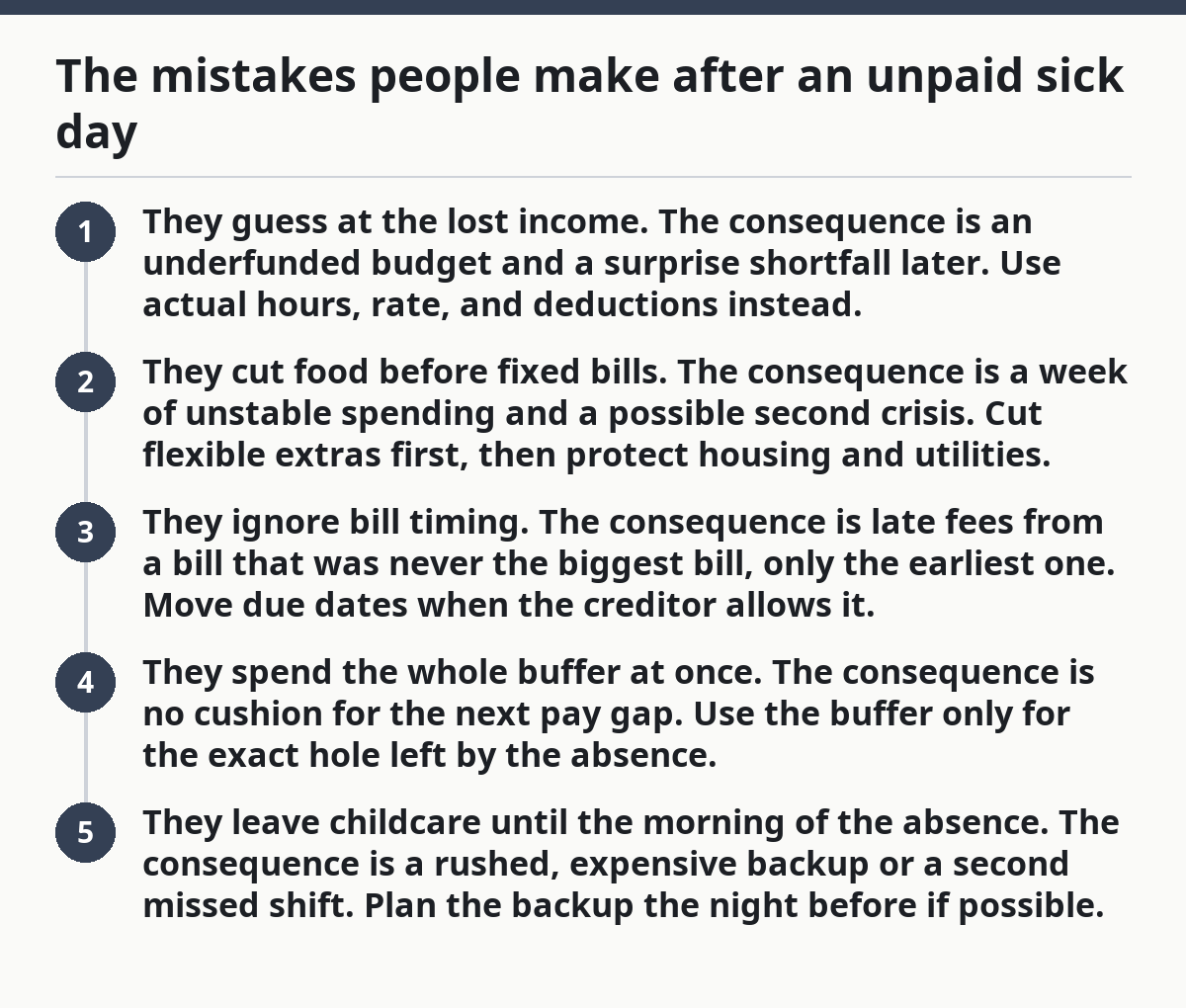
People usually make the same 5 errors after a sick day, and each one costs them more than the original missed shift. The fix is usually boring, fast, and specific.
- They guess at the lost income. The consequence is an underfunded budget and a surprise shortfall later. Use actual hours, rate, and deductions instead.
- They cut food before fixed bills. The consequence is a week of unstable spending and a possible second crisis. Cut flexible extras first, then protect housing and utilities.
- They ignore bill timing. The consequence is late fees from a bill that was never the biggest bill, only the earliest one. Move due dates when the creditor allows it.
- They spend the whole buffer at once. The consequence is no cushion for the next pay gap. Use the buffer only for the exact hole left by the absence.
- They leave childcare until the morning of the absence. The consequence is a rushed, expensive backup or a second missed shift. Plan the backup the night before if possible.
A better alternative is simple: build the sick-day plan around dates, not feelings. A bill due Tuesday does not care that you feel behind on Friday.
What if the unpaid sick day turns into a second one?
A second unpaid sick day means you need to stop treating the problem as a one-day event and start treating it as a rolling cash-flow gap. The first day is a simple lost-wages problem; the second day can change the whole month.
Adjust the plan in 3 ways:
- Recheck the next 2 paychecks, not just the current one.
- Move only the bills that actually need moving; do not keep changing every due date.
- Reduce variable spending for 7–14 days, not just 1 day.
If you are dealing with recurring illness, child illness, or a string of school closures, the “sick day budget” should become a standing category in your monthly plan. That category does not need to be big to matter. Even a small, regular reserve can smooth out a 1-day or 2-day absence much better than an after-the-fact scramble.
Frequently asked questions
How do I budget for unpaid sick days?
Budget for unpaid sick days by calculating the lost wages first, then protecting the bills that keep your home, work, and caregiving stable. Start with the next 7 to 14 days, not the whole month, and trim only flexible spending until the gap closes.
What happens to my budget when I miss work?
Your budget usually takes a hit in two places: lower income now and less room in the next paycheck cycle. If your pay is hourly or shift-based, one absence can also change childcare, transport, and bill timing at the same time. That is why the payment order matters so much.
How can I prepare for illness-related income loss?
Prepare by building a small budget buffer, tracking bill due dates, and naming a backup caregiver before you need one. It also helps to know which bills can move by a few days and which ones cannot. For your own situation, a qualified adviser can help you sort out the hardest trade-offs.
Drafted with AI; not yet reviewed by a person.