Last updated: November 19, 2026
Key Takeaways
- A moving estimate is the starting point, but only if you know which type you have.
- Movers usually charge for labor, time, travel, and job complexity, and those charges can stack fast.
- Compare moving estimates by matching the same job on every quote, line by line.
- A move budget works best when it protects both cash and time during a move.
Professional movers can fit a single-parent budget if you price the moving estimate, the hourly moving rate, the travel fee, and any packing service before you book. In this guide to How to Budget for Professional Movers as a Single Parent, you will compare a moving company, spot extra charges, and keep the total from drifting.
According to the U.S. Census Bureau, 27.3% of children in the United States lived with one parent in 2023, so budget pressure is common for this household type.
Start with the moving estimate, not the final bill

A moving estimate is your starting point, and it only helps if you know which type you have. A binding estimate should hold the price to the stated amount if your inventory stays the same, while a nonbinding estimate can rise when the crew sees more boxes, stairs, or heavier pieces. The Federal Motor Carrier Safety Administration says interstate movers must offer written estimates, which makes the paper trail important.
Because of that, picture this: you’re trying to book a moving company between school pickup and work, and you need a number that won’t blow up later. Ask for the estimate in writing, and make sure it lists labor, truck time, and any fee that can change the total.
- Ask whether the estimate is binding or nonbinding.
- Make the inventory match the home exactly: beds, dressers, crib, freezer, desk, and boxes.
- Ask what happens if the crew arrives and the job is bigger than expected.
- Save the estimate with the date and the company name.
The truth is, a cheap estimate that leaves out 2 or 3 common fees is not cheap at all. It just moves the surprise to moving day.
What fees movers charge?
Movers usually charge for labor, time, travel, and the shape of the job, and those charges can stack fast. A single-parent budget needs to include the hourly moving rate, travel fee, stairs and elevator fees, and any packing labor you do not want to handle yourself. The FMCSA also warns that nonbinding estimates can increase if the shipment weighs more than expected or the job takes longer.
Since the fee list can grow quickly, picture this: your building has no elevator, the parking space is across the lot, and the crew has to carry a sofa up 3 flights. That one setup can cost more than a simple curb-to-curb move, even if the house is small.
Here’s the catch: the quote may look low until the mover adds the extras.
- Hourly moving rate: good for short local moves, but the clock keeps running during loading, unloading, and delays.
- Travel fee: often covers the crew’s drive to you and back to base.
- Stairs or elevator fee: common when access is harder than a ground-floor walk-in.
- Packing service: useful when time is tight, but it adds labor hours and supply costs.
- Long carry fee: can appear when the truck can’t park close to the door.
A good quote names each fee in plain language. A bad one hides them in “miscellaneous.”
How do i compare moving estimates?

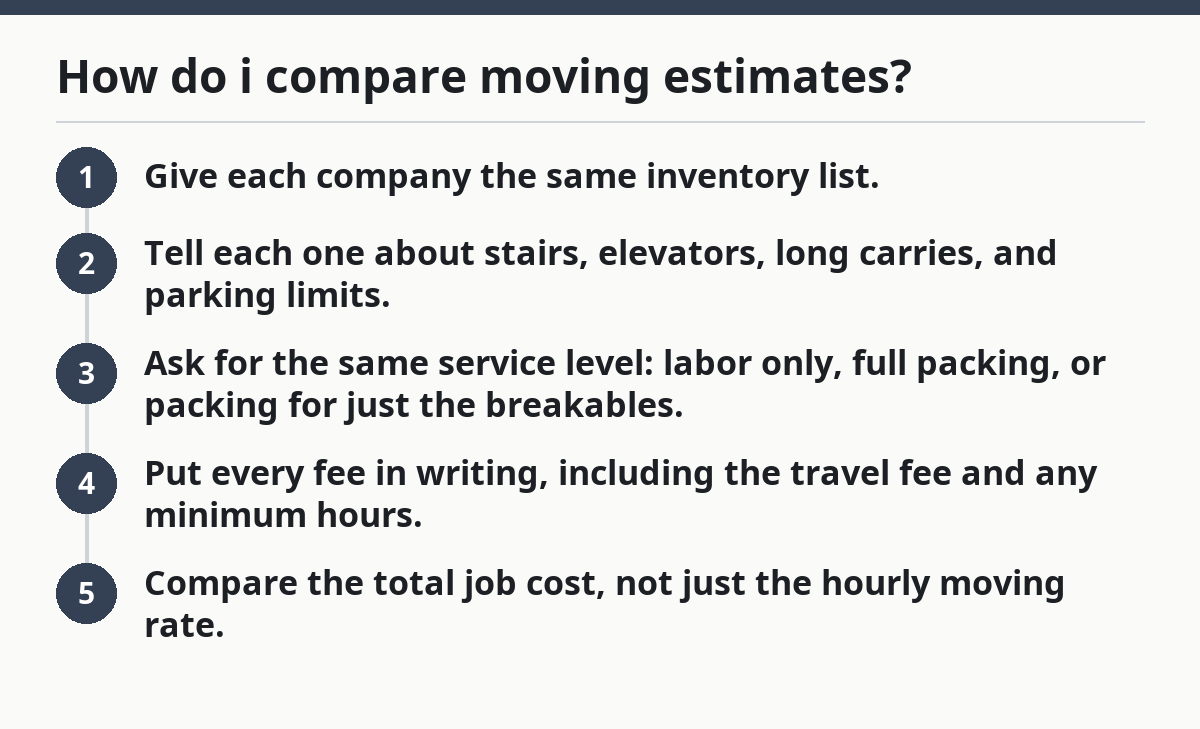
You compare moving estimates by matching the same job on every quote, line by line. That means the same move date, the same room count, the same services, and the same access notes, or the numbers will lie to you. The Consumer Financial Protection Bureau recommends comparing written offers before you sign, and that advice fits moving estimates too.
Therefore, picture this: one company quotes a 2-hour job and another quotes a flat total, but only one includes packing labor and stair fees. Those are not equal offers. They are two different jobs wearing the same label.
- Give each company the same inventory list.
- Tell each one about stairs, elevators, long carries, and parking limits.
- Ask for the same service level: labor only, full packing, or packing for just the breakables.
- Put every fee in writing, including the travel fee and any minimum hours.
- Compare the total job cost, not just the hourly moving rate.
A quote that leaves out 30 minutes of truck time can look better on paper and cost more in the end. Don’t compare promises; compare the same service.
Build a move budget that fits a single-parent schedule
A move budget fits when it protects both cash and time, because time is money during a move. To keep How to Budget for Professional Movers as a Single Parent manageable, set a moving cap, pick the services you truly need, and leave room for one surprise charge that shows up on the final invoice. The Bureau of Labor Statistics reported that the average U.S. worker spent 8.0 hours a day working in 2023, which is why lost time matters too.
After that, picture this: you’re juggling after-school pickup, a job shift, and a move that has to happen on one weekend. You do not need a perfect spreadsheet. You need a simple budget with room for the things movers charge most often.
- Start with the written estimate from the moving company.
- Add a cushion for access problems, extra boxes, or a longer-than-planned loading window.
- Decide whether you will pack everything yourself or hire a packing service for fragile rooms only.
- Set aside cash or card room for a tip if you plan to tip the movers.
- Keep a separate note for school gear, lunch, and the first night’s supplies.
A clean budget has three buckets: base move, add-ons, and surprise room.
That is enough.
If money is tight, cut services before you cut safety or access. Packing your own books and clothes usually costs less than paying a crew to do every box. The heavy, awkward, or fragile pieces are the ones to price first.
What should you pack yourself?
You should pack the low-risk, time-consuming items yourself and pay movers for the heavy or awkward ones. Books, pantry items, folded clothes, and spare linens are often the easiest DIY targets, while beds, dressers, and large appliances are harder on your back and your schedule.
Since the packing split affects both time and cost, picture this: you’ve got 14 boxes of toys, school papers, and kitchen odds and ends, and the mover says a full packing service will save time. It might. It will also raise the bill.
You can split the job.
- Pack the easy rooms first: closets, shelves, and seasonal items.
- Leave fragile dishes, wall art, and oddly shaped pieces for professional packing if you want less breakage risk.
- Label each box by room so the crew can unload faster.
- Keep one overnight bag out of the move so you are not hunting for pajamas at 10 p.m.
Packing yourself is not free, though. It costs your own hours, and those hours matter when you are parenting alone. If you have a child care gap on moving day, paying for more packing labor may be the better trade.
What tips and extras should you budget for?
You should budget for tips, supplies, and small add-ons that do not always appear in the first quote. A lot of families remember the truck and forget the human part of the move, which is how the final total feels bigger than expected. The U.S. Department of Transportation advises consumers to get pricing details in writing, and that helps with these extras too.
Because those extras are easy to miss, picture this: the crew finishes in less time than planned, but you still need cash for a tip, tape, and one more box run. Those little expenses are real.
No magic here.
- Set aside a small amount for tips if you plan to give them.
- Keep cash handy in case the building only takes it for access or parking.
- Budget for tape, markers, mattress covers, and basic labels if they are not included.
- Save room for one extra trip to move daycare items, school bags, or a folded crib.
Not every move needs every add-on, but every move seems to find one. A little cushion keeps the day from turning into a scramble.
How to keep the moving company bill from creeping up
You keep the bill down by reducing wait time, access problems, and last-minute changes. Those are the three things that make an hourly moving rate climb faster than the quote suggests.
So, picture this: the truck arrives, but the elevator is busy, the keys are late, and half the boxes are still open. The crew is still working, and the clock is still running.
That is where money leaks out.
- Reserve the elevator if your building allows it.
- Clear hallways, stair landings, and the path to the truck before the crew arrives.
- Pack every box fully so movers don’t waste time re-taping.
- Confirm the address, parking plan, and contact number the day before.
- Keep children and pets in one room or with a sitter if possible.
A move that starts on time usually costs less than one that starts with delays. If the estimate assumes a 2-hour load and your prep turns it into 3, the difference lands on your card.
For a broader family move checklist, the hub on housing move costs for single parents gives the full picture. This page stays with the moving company side of the budget.
When a cheaper quote is the wrong quote
A cheaper quote is the wrong quote when it hides fees, skips access details, or leaves you without a binding estimate. Low prices look friendly until stairs, travel time, or packing labor get added at the door.
Since the lowest number can mislead, picture this: one mover gives you a low number over the phone and another gives you a written estimate after asking about your building, furniture, and packing needs. The second one may cost more on paper, but it is easier to trust.
Choose caution over the lowest number when:
- The estimate is vague about labor hours or minimum charges.
- The company will not explain the travel fee.
- The crew has not asked about stairs, elevators, or long carries.
- The quote changes every time you ask a follow-up question.
A fair moving company should be able to explain its pricing in plain language. If the numbers only make sense after the truck is loaded, the bill is already working against you.
FAQ
What fees do movers charge?
Movers often charge for labor, travel, stairs or elevator access, packing help, and sometimes long carries or minimum hours. The exact mix depends on the moving company and the size of the job, so ask for each fee in writing before you book. A clear estimate should show what is included and what can change the total.
How do i compare moving estimates?
You compare moving estimates by making sure each company priced the same job. Use the same inventory, the same addresses, the same move date, and the same services, then compare the written total and the fee list side by side. A binding estimate is easier to compare than a loose verbal quote.
Should i pack myself or hire movers?
Pack yourself if you want to save on labor and you can spare the time. Hire movers for packing when you are short on hours, have fragile items, or need help with the rooms that take the longest. A mixed plan often works best for single parents: pack clothes and books yourself, and let the crew handle the heavy or breakable pieces.
Drafted with AI; not yet reviewed by a person.