Last updated: November 19, 2026
Quick Answer: Set a single cap, add a small amount for wrapping, and keep the total under the school limit; for many families, that means planning for about $5 to $15 per exchange, plus extras if the school requires them. Holiday gift exchanges at school can strain a single-parent budget fast. Set a simple price cap, plan for the exact school gift exchange items ahead of time, and cap your total before the month starts. The steps below show how to keep Secret Santa, class gifts, and teacher gifts from turning into a surprise bill.
Start with the school gift exchange amount you can actually spare
Picture this: you get a flyer home on a Tuesday, the exchange is next week, and your child says everyone is “doing gifts this year.” You need a number now, not a perfect plan, and the right budget is the one you can cover without shifting rent, food, or utilities.
Start with one real amount for the whole season. If the school asks for a price cap like $5, $10, or $15, use that as your ceiling and do not round up “just a little.” If no cap is listed, choose your own cap and tell your child the limit in plain words.
A good starting rule is simple:
- Put a dollar limit on the exchange gift.
- Add a small extra line for wrapping or a card.
- Keep the total tied to one child, one event, one month.
For example, if the exchange cap is $10, your full cost may be closer to $12 after tissue paper or a gift bag. That small add-on matters when there are two kids in the same school or more than one classroom event. The truth is, the exchange cost is rarely just the gift.
If the school also has a holiday class event with snacks, ornaments, or a class present, list that separately. A class cookie tray is not the same thing as a Secret Santa item, and mixing them is how budgets slip. Write each item on paper or in your phone, then assign one number to each.
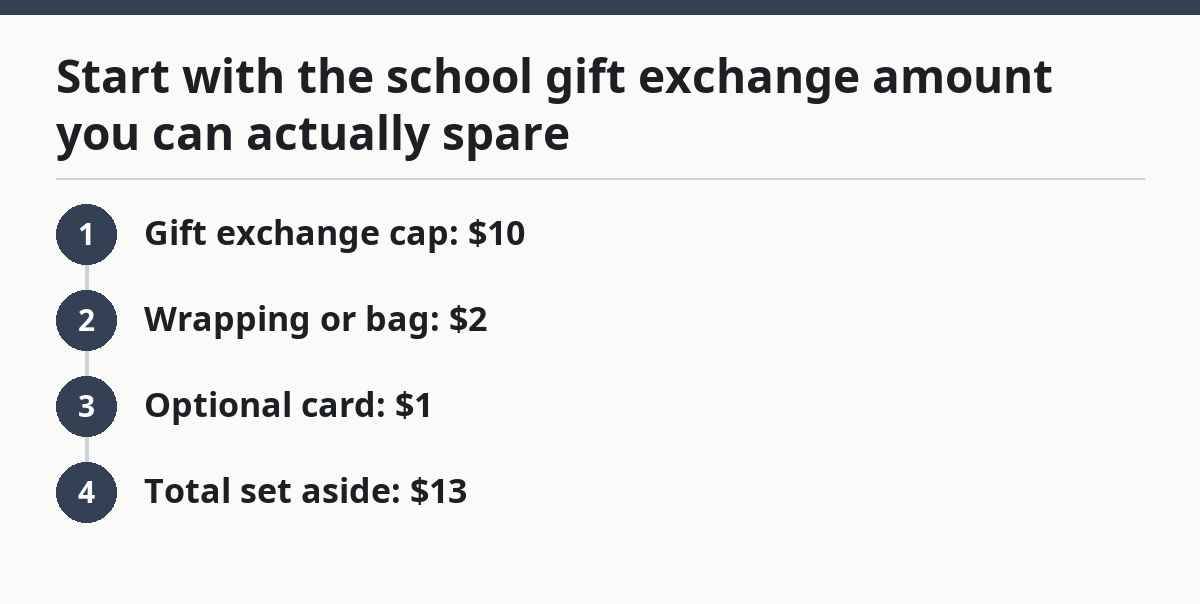
A simple budget note can look like this:
- Gift exchange cap: $10
- Wrapping or bag: $2
- Optional card: $1
- Total set aside: $13
That one note gives you a ceiling.
How do I budget for Secret Santa at school?

Picture this: your child comes home excited about Secret Santa, and the class agreed on a price cap that sounds small until you add everything else. You can handle it by planning the gift first and the extras second.
Secret Santa works best when you treat it like one fixed event, not a flexible shopping trip, and sources such as the Federal Trade Commission’s budgeting guidance support setting firm limits before you spend. If the cap is $10, buy one item that fits the number, then stop. If you wait to “see what else you can add,” the budget tends to drift.
Use this order:
- Read the school note and write down the cap.
- Decide whether the child needs to bring the gift wrapped, bagged, or unwrapped.
- Pick one gift that fits the age group and the cap.
- Add only one low-cost finishing item, like a tag or tissue paper.
- Put the receipt in a folder or phone note so you know the real total.
A class of younger kids may do better with simple items like stickers, pencils, small books, or art supplies. Older kids often need something that feels useful, not tiny junk that gets tossed by lunch. That does not mean expensive. It means useful enough to stay in the game.
Here’s the catch: a low sticker price is not always the lowest overall cost. A $4 item that breaks or gets rejected may send you back to the store for a second purchase. That turns a one-trip plan into a two-trip bill.
If your child is worried about being embarrassed, keep the conversation plain. Say the school set a cap and the gift needs to stay within it. That’s not a failure. That’s the rule.
What belongs in the budget besides the gift?
Picture this: you’ve already bought the present, and then the class asks for a tag, a bag, a card, or a small treat. Those extras are where many single-parent budgets get squeezed, because each one feels minor on its own. The National Retail Federation also notes that gift packaging and add-ons can change the real total.
Your budget should include the gift plus the parts around it. A $10 exchange item can easily become a $15 expense when you add a gift bag, tissue paper, ribbon, or a handwritten card. If the school requests homemade packaging or a specific label, that belongs in the total too.
Build the cost in layers:
- Gift itself
- Wrapping or bag
- Card or tag
- School-required extras
- Travel or delivery cost if you must stop at a second store
A homemade tag might cost almost nothing. A last-minute store bag may cost more than the present’s difference between “nice” and “needed.” That is why a budget should track both the object and the way it gets delivered.
If the school says the exchange should be “festive,” ask what that means before you spend. Sometimes it means a simple bow or note. Sometimes it means a full wrapped item. The wording matters.
A clean paper bag and a plain card are enough for many school exchanges. The goal is to meet the rule, not win a holiday display contest.
If your child also needs a teacher gift, keep that in a separate line. Teacher gifts and class exchanges are different expenses, even if they happen in the same week.
How can I keep teacher gifts and class gifts separate?
Picture this: the school calendar stacks a class exchange, a teacher gift, and a holiday party into the same five-day stretch. If you lump them together, the spending blurs fast, and you lose track of what each item is for.
Keep teacher gifts in their own envelope, note, or phone category. That way, a $10 Secret Santa limit does not quietly become a $25 holiday school total because you added a mug, a candle, and a card. Separate buckets make hard choices easier.
A clean split looks like this:
- School gift exchange: one set cap
- Teacher gift: a different limit
- Holiday class event: one shared amount if requested
- Backup fund: a tiny cushion for last-minute paper goods
That cushion does not need to be large. Even a few dollars helps cover tape, markers, or a bag when the teacher gift or class exchange changes at the last minute. If your budget is tight, the cushion can be zero. But then the cap has to stay firm.
This is where a lot of generic advice misses the point. A single parent is not just “budgeting for gifts.” You are timing gifts around payday, meals, and the week’s other school needs. If your money runs close to the edge, choose one kind of school gift that month and skip the rest unless the school requires it.
A teacher gift does not have to be large. A note from your child often carries more weight than a store-bought item. If you do buy something, let it stay modest and on purpose.
Homemade options that do not wreck the budget
Picture this: your child wants to join the exchange, but the store shelf prices do not fit the money left in your account. Homemade gifts can help if they stay simple, age-appropriate, and approved by the school.
Homemade works best when it saves cash without creating extra stress. A decorated bookmark, a simple treat, a handmade card, or a paper ornament may fit a low price cap better than a store trip, but check school rules or ask the teacher if you are unsure. The catch is time. If the project takes two hours and three supply runs, it can cost more than buying one small item.
Use homemade gifts when:
- The school allows them
- The project uses materials you already have
- The child can help without a mess that needs more supplies
- The result looks neat enough to send to class
Use caution with food gifts. Some schools and families have allergy rules, and a baked item can create a problem if ingredients are unclear. If food is allowed, label it plainly. If the note home is vague, choose a non-food item instead.
A homemade gift also works better when you keep the design simple. A folded card with a kind message is enough for many school exchanges. A glitter-heavy project that needs glue, beads, and drying time is not.
Do not turn homemade into a guilt test. If you are exhausted, broke, or short on supplies, buying one low-cost item is still a valid answer. Homemade is a tool, not a rule.
What if the suggested amount is too high?
Picture this: the school suggests a number that feels easy for some families and impossible for yours. That does not mean you have failed. It means the budget needs a different plan.
If the suggested amount is too high, use one of three moves. First, buy at the lower end of the cap if the school allows a range. Second, ask the teacher or organizer whether a handmade or low-cost item is acceptable. Third, speak up early if the amount is out of reach so you are not scrambling the night before.
A direct, quiet message works best:
- “Can the exchange stay at the stated cap?”
- “Is a homemade item okay?”
- “Is there a school-approved lower-cost option?”
That keeps the conversation about the event, not your personal finances. Most school organizers would rather know early than get a late scramble or a child left out.
If the exchange is optional and the cost is still too much, skip it. That is a hard sentence, but it matters. A school holiday exchange should not force a single parent into unpaid debt for a one-day event.
Now, you might be wondering whether your child will feel left out. Maybe. But a calm explanation at home helps more than a stretched budget. Tell your child the school set a limit, and the family is sticking to it. Clear beats ashamed.
For broader planning around school and family costs, the hub on annual school and family event costs for single parents can help connect this expense to the rest of the year.
A simple budget plan you can repeat each year
Picture this: next year the same flyer shows up, and you do not want to start from zero again. A repeatable plan saves time, money, and a lot of December stress.
Use the same 10-minute method every year:
- Read the school note the day it arrives.
- Write the cap, date, and any extras in one place.
- Set a hard total for the gift, wrapping, and tag.
- Buy or make one item that fits the limit.
- Stop when you hit the number.
Keep the plan in a notes app or on paper with last year’s amount beside it. If the school repeats a $10 or $15 cap, you already know what fits and what does not. That saves you from last-minute browsing, which is where budgets often die.
If you have more than one child, list each exchange separately. One child’s class event can’t absorb another child’s teacher gift. That is how a “small” holiday cost becomes a pile of unrelated charges.
The budget is plain: no drama, no guessing, no shopping to make yourself feel better. Just a cap, a list, and a stop point.
Key Takeaways
- Use the school’s cap as your ceiling, not a starting point.
- Count wrapping, tags, and cards in the total from the start.
- Keep Secret Santa, teacher gifts, and class events in separate buckets.
- Homemade gifts can help, but only if the school allows them and the materials stay simple.
- If the amount is too high, ask early or choose the lower-cost option; do not let the budget drift into debt.
How much should I spend on a school gift exchange?
Spend the amount the school set, or less if your budget needs it. If no amount was given, choose a number you can cover without cutting essentials. A $5 to $15 cap is common in many school settings, but the right number is the one your household can handle.
What if I can’t afford the suggested amount?
Use the lowest allowed option, ask whether a homemade gift is okay, or tell the teacher early that the amount is too high. The goal is to stay included without creating debt. If the exchange is optional, it is fine to skip it.
Are homemade gifts okay for school exchanges?
Homemade gifts are okay when the school allows them and the project stays simple. A card, bookmark, ornament, or another low-cost item often works well. Avoid anything messy, allergen-heavy, or hard to finish on time unless the school has already approved it.
Drafted with AI; not yet reviewed by a person.