
Last updated: November 19, 2026
A childcare contract change can hit a single-parent budget hard, especially when notice periods, schedule changes, and fee adjustments all land at once. Budget for the change before you sign it so the new weekly total, late pickup risk, and any tuition increase don’t surprise you. The steps below show how to price the change, spot the fee traps, and protect your cash flow.
Key Takeaways
- Treat the contract change like a new monthly bill, and consult a financial or legal professional if you are unsure.
- The biggest budget shifts usually come from days per week, notice clauses, and late pickup rules.
- Ask for the new tuition total in writing before the change starts.
- A shorter notice window can help flexibility, but it can also leave you paying for unused care.
- Leave room in the budget for an extra week of care and, if your situation calls for it, a late fee.
What should I price first in a childcare contract change?

Price the new weekly tuition first, because that number drives everything else. If the contract changes from 3 days a week to 4, or from part-time to full-time, the tuition agreement may jump more than you expect, and a fee increase can apply on top of that.
If you are holding a new draft of your childcare contract and trying to decide if you can keep your job hours stable, start with the cost in plain numbers. One extra day per week can change the whole month. Start with the amount you will pay every billing cycle.
-
Find the base tuition in the contract change or tuition agreement.
Use the weekly, biweekly, or monthly figure written on the page, not a verbal estimate. That gives you the real starting point. -
Check the schedule change line.
Look for how many days per week you are actually buying now. A change from 2 days to 3 days is not just one more day; it can push you into a different rate band. -
Add any fee increase in the same document.
Some providers raise tuition at the same time they revise schedules. If the new rate starts on a set date, mark that date on your calendar. -
List extra charges separately.
Late pickup fee, holiday closures, supply fees, and sibling discounts all belong on the same worksheet. If they are not written into the contract change, they should not be treated as fixed without checking the agreement or a qualified adviser. -
Convert the total to a monthly number.
Multiply the weekly amount by 4.33 if your billing is weekly, or use the actual billing cycle in the contract. That gives you a number you can compare against your take-home pay.
Use a simple change budget
- Current tuition
- New tuition after the schedule change
- Late pickup fee risk
- One-time admin charge, if any
- A small cushion for an extra day or two of care
Many people budget only for the new base rate and miss the rest. That leaves the first month tight. A childcare contract change should be treated like a bill revision, not a guess, but you may want to confirm the numbers with the provider or a professional if the terms are unclear.
How do notice clauses change the budget?
A notice clause changes the budget by deciding how long you may have to pay for care you no longer use. If your childcare provider requires 2 weeks’ notice, you may owe for both the old schedule and the new one during that window, which can strain a single-parent budget fast.
If you are trying to reduce care days because your work shift changed, but the contract says you need written notice before the new schedule starts, the budget can feel squeezed immediately. If the provider bills by the week, even a short delay can cost you an extra cycle.
Look for these notice terms:
- Written notice only: email may count, but a text may not.
- Fixed notice period: 1 week, 2 weeks, or a full month.
- Effective date rules: the change starts on the first Monday after notice, or on the next billing cycle.
- Penalty language: some contracts charge for missed notice or hold your spot until the period ends.
A notice clause affects cash flow in two ways. First, it can delay the savings from fewer days. Second, it can overlap two schedules if the provider bills ahead. That means you may need money for the old rate and the new rate at the same time.
Budget for the overlap
- Keep enough cash to cover 1 billing cycle of the old rate.
- Set aside the new rate starting on the date you give notice.
- If you are unsure, budget for both schedules for 2 weeks.
That overlap is the part people miss. It is also where late payments start. A missed notice can cost more than a changed schedule, because you may lose the savings you planned to get.
The safest move is to get the provider’s notice rule in writing before you change anything, or to confirm it with a professional if the wording is unclear. If the contract is unclear, ask for the exact start date and the billing date in one email.
How do late pickup rules affect my childcare budget?

Late pickup rules affect your childcare budget because one unexpected pickup delay can cost more than a week of small savings. A late pickup fee is not a rare edge case; for a single parent, it can become a real line item if work shifts run long or transit breaks down.
If the daycare clock keeps moving while you are stuck in traffic and your phone battery is low, the late pickup fee can matter quickly. If the contract change also shortens your pickup window, the risk goes up.
Budget for the late pickup fee in advance:
- Find the exact fee in the childcare contract.
- Check whether it is charged by the minute, the 15-minute block, or a flat amount.
- See whether it starts right at closing time or after a grace period.
- Ask if repeated late pickups can trigger a contract change or spot loss.
If the provider uses a late pickup fee that stacks by block, one delay can snowball. A 10-minute delay may not sound like much, but if the fee is charged in 15-minute chunks, you may pay for the full block. That is why the rule matters as much as the price.
Build a late-pickup buffer
- Put aside a small monthly cushion just for timing problems.
- Keep an emergency pickup contact in writing.
- Arrange backup transport for days when meetings, overtime, or school events run late.
This is one of the places where budgeting is really about risk, not averages. If your work schedule is unstable, the late pickup rule deserves the same attention as tuition. A cheaper contract that punishes delays can cost more than a pricier one with more flexibility.
What should I ask before I sign the change?
You should ask for the exact money terms before you sign, because a childcare contract change can hide extra charges in short clauses. The key questions are simple: what changes, when it starts, how much it costs, and what happens if your schedule shifts again.
If you are sitting with a draft in front of you and the provider wants a quick answer, slow down. A clear answer now can save you from a fee increase later, especially if your hours change again in the next month or two.
- What is the new tuition amount?
- Does the rate change with days per week?
- Is there a separate tuition agreement for the new schedule?
- How much written notice do I need to give?
- When does the new rate start?
- Are late pickup fees changing too?
- Can I switch back if my work hours change again?
- Is there a penalty if I drop a day before the notice period ends?
Use the answers to build your budget, not just your calendar. If the provider says the change starts immediately, your cash flow changes immediately. If the provider says the notice period is 2 weeks, budget for 2 weeks of overlap before you see any savings.
For contract terms, the National Association for the Education of Young Children and the Consumer Financial Protection Bureau both publish useful plain-language guidance on family costs and payment planning. The Federal Trade Commission also has consumer information that can help you compare written terms before you sign.
How do I turn the contract change into a monthly budget?
You turn the contract change into a monthly budget by listing the new charge, the one-time overlap, and the late fee risk on the same page. That gives you the real monthly cost, not just the rate in the contract.
If you are looking at your pay schedule and the childcare invoice at the same time, one is steady and the other may shift after a contract change. Your budget needs to show both so you can see whether the new amount fits without guesswork.
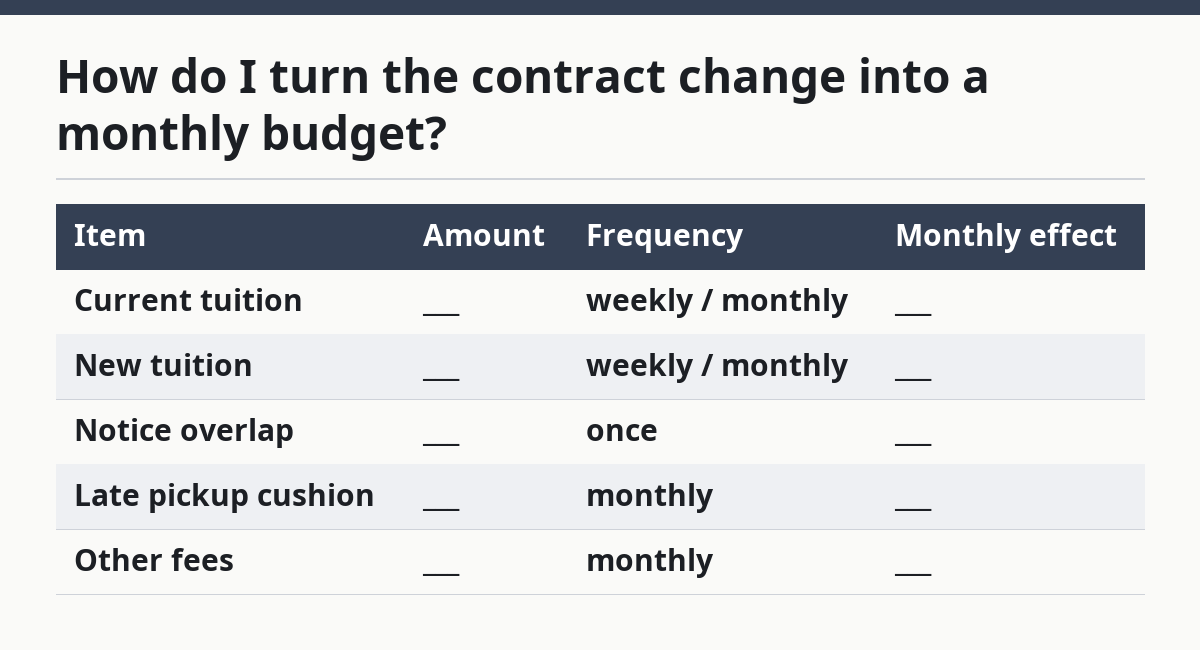
Use this simple worksheet:
| Item | Amount | Frequency | Monthly effect |
|---|---|---|---|
| Current tuition | ___ | weekly / monthly | ___ |
| New tuition | ___ | weekly / monthly | ___ |
| Notice overlap | ___ | once | ___ |
| Late pickup cushion | ___ | monthly | ___ |
| Other fees | ___ | monthly | ___ |
Then do three checks:
- Best case: you pay only the new tuition.
- Likely case: you pay the overlap plus the new tuition.
- Worst case: you also get one late pickup fee.
If the worst case breaks your budget, the contract change is not affordable yet. That means you need a smaller schedule change, a later start date, or a different care arrangement.
The point is not to build a perfect spreadsheet. The point is to see the gap before the bill arrives. A single parent does not get much room for surprise charges, so the budget has to carry the surprise for you.
What mistakes make a childcare contract change more expensive?
The biggest mistake is treating a schedule change like a simple edit instead of a new cost structure. That can leave you paying for unused days, missing the notice window, or getting hit with a late pickup fee you never budgeted for.
If you are relieved the provider said yes to a change, it is easy to stop reading after the first page. That is where the budget slips. The fine print usually lives in the line about notice, billing cycle, or cancellation timing.
Common mistakes and what they cost:
-
Not checking the billing cycle
You may pay for a full week even if your change starts midweek. Ask whether the provider prorates or charges the full period. -
Ignoring the notice clause
You may lose 1 to 4 weeks of savings if the new schedule starts later than you thought. Always ask for the effective date. -
Forgetting late pickup rules
One delayed pickup can wipe out the savings from a reduced schedule. Put the fee in your monthly plan. -
Assuming the new rate is final
A fee increase can apply after the contract change, so get the number in writing. -
Not planning for a second change
If your work hours are unstable, a new contract may need to be revised again in a few months.
A better move is to keep a short written record of the current schedule, the new schedule, the notice date, and the first bill date. That record helps if the invoice doesn’t match the contract.
On the flip side, a clean contract change can save money if your provider bills clearly and gives fair notice. The budget works best when the paperwork is plain, the dates are exact, and the late pickup rule is understood before the first new invoice lands.
FAQ
What happens when my childcare schedule changes?
Your childcare contract usually changes the tuition amount, the days per week, or both. If the provider needs notice, the new schedule may not start right away, and you may pay for the old rate during the notice period. Ask for the change in writing so the first new bill matches the agreement.
How much notice do providers need for a schedule change?
Providers often require notice in writing, and the notice period may be 1 week, 2 weeks, or longer depending on the contract. The exact rule should be in the tuition agreement or notice clause. If the contract is unclear, ask when the change becomes effective and whether billing still follows the old schedule until then.
Can childcare fees change mid-contract?
Yes, childcare fees can change mid-contract if the agreement allows a tuition increase or if the provider updates the terms with proper notice. The budget risk is that the new rate may start before you planned for it. Read the fee language carefully and ask for the new amount and start date in writing.
How do I avoid a surprise late pickup fee?
You avoid a surprise late pickup fee by checking how the contract counts time and where the grace period ends. Some providers charge by the minute, others by the 15-minute block. Set a backup pickup plan, because one delay can cost more than a small schedule change saves.
Drafted with AI; not yet reviewed by a person.