
Last updated: November 18, 2026
Quick Answer: a crisis-proofing a single-parent budget usually starts with a starter buffer of $500 to $1,000, then grows toward one month of bare-bones expenses and beyond if income is unstable. In Crisis-Proofing a Single-Parent Budget — The Complete Guide, the goal is to keep housing, child care, transportation, and food covered when life changes fast.
Key Takeaways
- A crisis-proof budget protects essentials when income or timing changes.
- A single parent should build a starter buffer first, then move toward three to six months of essentials if income is unstable.
- Split bills into “must pay,” “can delay,” and “can cut,” then test the month against lower income.
- Housing and child-related essentials come first, followed by utilities, transportation, food, insurance, and minimum debt payments.
A crisis-proof single-parent budget is a budget that can survive a missed paycheck, a surprise car repair, or a sick child without turning into a debt spiral. The core move is simple: cover essentials first, build a small cash buffer as fast as possible, and make the budget flexible enough to cut back in 24 hours if income drops.
A single parent usually has less slack than a two-income household, so the goal is not perfection. The goal is a plan that still works when life breaks its own schedule.
I write about household budgets and consumer finance, and the patterns are the same across the strongest plans: stable bills, fast access to cash, and clear rules for what gets cut first. This guide to Crisis-Proofing a Single-Parent Budget — The Complete Guide keeps that focus on the practical decisions that matter most.
What makes a single-parent budget “crisis-proof”?

A crisis-proof budget keeps the lights on when the calendar goes wrong. It is built around four layers: bare essentials, a small emergency fund, a backup plan for income gaps, and a list of expenses to pause without thinking.
The first layer is the survival budget. This should cover housing, utilities, groceries, transportation, minimum debt payments, child care that protects your job, and any medicine or insurance premiums that cannot slip. If you cannot pay for all of that for one month, the budget is not crisis-proof yet.
The second layer is cash. A fully funded emergency fund is ideal, but that is not the starting point for most single parents. A more realistic early target is a first buffer of $500 to $1,000, then one month of bare-bones expenses, then more if income is unstable. The Consumer Financial Protection Bureau’s guidance on emergency savings and the Federal Reserve’s SHED reports both support the idea that even modest cash reserves can reduce reliance on high-cost debt and help households absorb small shocks.
The third layer is timing. Bills should be arranged so the largest ones do not cluster right before payday. If your income arrives on the 1st and 15th, ask whether rent, utilities, and child care can be spread across the month instead of hitting one week.
The fourth layer is decision rules. In a crisis, you should not be deciding from scratch whether to cancel subscriptions, skip restaurant meals, or delay nonessential shopping. The answer should already be written down.
What makes this approach different from a generic budget article is that it assumes interruption. A generic budget often focuses on tracking every dollar. A crisis-proof budget focuses on what happens when tracking is not enough because the paycheck itself shrinks.
How much emergency money does a single parent need?
A single parent should aim for a starter buffer first, then build toward three to six months of essential expenses if income is unpredictable or support is inconsistent. That range is a planning target, not a promise, and it is more useful than a vague “save more” rule.
The right number depends on three things: how steady your income is, how easily you can cut expenses, and whether you have backup support for child care or transportation. If you are a salaried worker with stable hours, a one-month cushion may keep a short disruption from becoming a crisis. If you are paid hourly, rely on commissions, or get inconsistent child support, a larger reserve matters more because your income risk is higher.
A common mistake is aiming only for a textbook emergency fund while ignoring the first $300 or $500 that prevents a bounced payment. That smaller amount matters because it buys time. Consult a financial professional if you are unsure how to balance cash savings with debt payoff, and note that the Federal Reserve’s annual SHED reports have repeatedly shown that many households would struggle with a modest emergency expense; that is exactly why the first buffer should be small enough to reach quickly.
This is where single-parent budgeting differs from some other households. Two adults may be able to absorb a temporary shortfall by shifting work hours or splitting costs. One adult usually has to carry both the money problem and the logistics problem. That makes cash on hand more important than a perfectly optimized monthly spreadsheet.
The trade-off is obvious: money sitting in savings is money not being used to pay down debt or invest. If you have high-interest debt, that tension is real. Still, a modest buffer usually comes first because the cost of borrowing in an emergency can be much worse than the return on extra debt payments. For most single parents, the safer sequence is: starter emergency fund, then aggressive debt payoff, then larger savings.
How do I build a budget that still works if my income drops?

You build it by splitting every bill into “must pay,” “can delay,” and “can cut,” then stress-testing the month against a smaller paycheck. That is a practical way to check whether the budget can survive a real crisis.
Start with your net income after taxes. Then list your fixed essentials: rent or mortgage, utilities, food, transport, insurance, minimum debt payments, child care, and medication. If a bill does not protect housing, safety, access to work, or your child’s basic needs, it does not get treated as essential, and you should consult a financial professional if you are unsure where a particular bill belongs.
Next, separate true fixed costs from flexible costs. Groceries are essential, but the amount can change. Child care may be essential, but after-school add-ons might not be. Gas or transit is necessary, but extra driving is not. The point is not to live miserably; it is to know what can shrink fast.
Then run a general “what if I lose 20% of income?” check. If the budget breaks immediately, you need a stronger buffer and more adjustable spending. If you can absorb a 20% hit by cutting nonessentials, delaying sinking-fund contributions, and pausing extras, the budget is in much better shape.
A useful rule is the 24-hour cut list. Write down the first five things you would cancel if income dropped tomorrow: streaming services, app subscriptions, takeout, impulse shopping, and nonurgent personal spending are common examples. The exact list depends on your life, but the discipline matters more than the category names.
The downside of this method is that it can feel harsh if you already feel stretched. It can also expose costs that are not really optional, like an expensive commute or child care schedule that cannot flex. That is not a failure of budgeting; it is a sign that the budget needs structural changes, not just better tracking.
Where should the money go first when the month gets tight?
Housing and child-related essentials go first, then utilities, transportation, food, insurance, and minimum debt payments. Anything outside that stack gets reviewed before the bill is due.
This order matters because not all unpaid bills have the same consequence. Missing a streaming payment is annoying. Missing rent can end a housing situation. Missing a car payment can remove your ability to get to work. For a single parent, that chain reaction is what turns a small cash problem into a family crisis.
A practical prioritization order looks like this:
- Housing
- Utilities needed to keep the home livable
- Transportation required for work and child care
- Food and formula if relevant
- Child care needed to keep income coming in
- Insurance and medicine
- Minimum debt payments
- Everything else
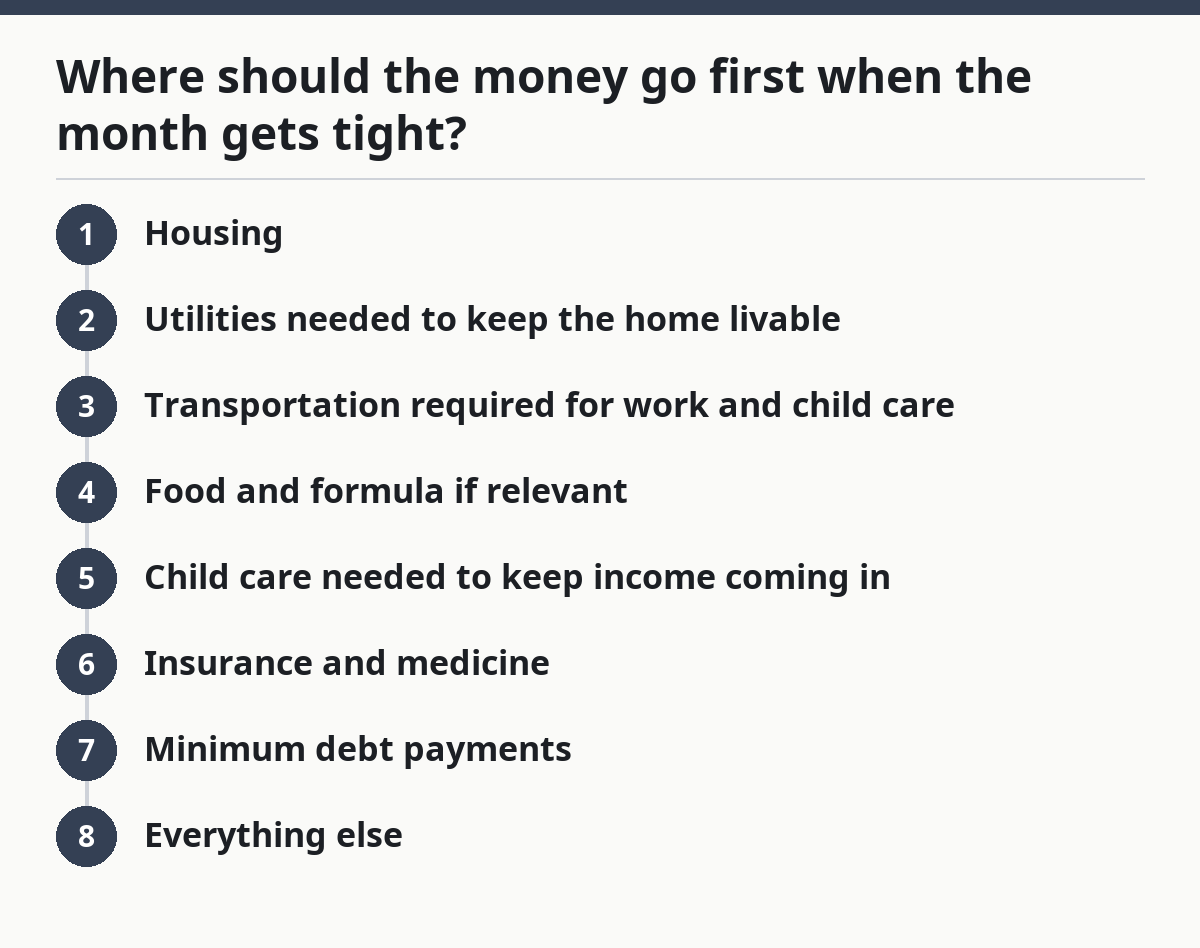
The exact order can change if, for example, a car is unnecessary because you live in a city with reliable transit or if a health plan premium protects access to medicine. The principle stays the same: protect the systems that keep income, shelter, and child care intact.
A generic budgeting article may tell you to pay off high-interest debt first. That advice is incomplete in a crisis. Late housing, transport, or child-care consequences can be immediate and severe, while some debt can usually be negotiated. That does not make debt unimportant. It means survival order comes before optimization.
This section also exposes the biggest hidden risk for single parents: one bill can affect several others. A missed utility payment can make remote work harder. A missed car repair can cause late child-care pickup. That is why the budget needs a priority stack, not just a monthly total.
Can debt be part of a crisis-proof plan?
Yes, but only if debt service does not crowd out the emergency buffer or the essentials. In a crisis-proof budget, debt is managed as a risk, not as a status symbol.
The most dangerous debt for a fragile budget is high-interest revolving debt, especially credit cards that encourage carrying balances month to month. A balance at a high annual percentage rate can trap cash that should be going to groceries or savings. If you are using one card to cover regular bills, the budget is already under strain.
There are two sensible approaches. The first is the debt avalanche: pay extra on the highest-interest debt after minimums are covered. The second is the debt snowball: pay extra on the smallest balance first for motivational wins. Either can work, but in a crisis-proof framework, the choice depends on what keeps you from slipping back into overdraft or new borrowing.
If income is unstable, the best debt strategy is often not a dramatic payoff plan. It is a stabilization plan. That means making minimums on time, calling creditors before you miss payments, and protecting cash reserves first. Many lenders and utility companies offer hardship arrangements, deferred payments, or revised due dates, but they usually help more when you contact them early.
The trade-off is real. Slowing debt payoff can feel frustrating, especially if you are trying hard to “catch up.” But if every extra dollar goes to debt while you have no cushion, one car repair can undo months of progress. In that sense, a small emergency fund is not a luxury; it is part of debt management.
What this is not for: if your debt is already in collections, you may need a broader credit counseling or legal debt solution, not just a stricter budget. In that case, a nonprofit credit counselor or attorney can help you understand your options before you make payments that may not be the best use of cash.
What should a single parent cut first in a money emergency?
Cut nonessential spending, then pause sinking funds and discretionary goals, and only after that look at larger structural changes. The first cuts should protect the household’s ability to function, not punish the family.
Start with anything that does not affect housing, safety, work, or child care. Typical first cuts include subscriptions, takeout, entertainment, new clothes that are not needed for school or work, and extra convenience purchases. If you have multiple streaming services, one can go. If you have a gym membership but no time to use it, that may be a candidate too.
Next, pause savings categories that are not the emergency fund itself. Holiday sinking funds, vacation savings, and elective home goals can usually wait until the crisis passes. That is not ideal, but a temporary pause is better than borrowing at a high cost.
Then look at larger fixed costs that might be renegotiated rather than cut. A mobile plan could be downgraded. Insurance might have a different deductible structure. A car loan may need refinancing, though that depends on credit and rates. Child care may have another schedule or subsidy option if you qualify.
The danger here is “false savings.” Cutting groceries too hard can create a later crisis. Skipping a needed car repair can strand you at work. Canceling child care without a backup can cost you income. A crisis-proof budget cuts the right things, not just the easiest things.
This is also where the single-parent reality matters most. There is often no second adult to absorb the inconvenience. If a cut creates a logistical chain reaction, it is probably the wrong cut.
What if the crisis is not just money?
Then the budget needs a safety layer, not just a spreadsheet. A crisis-proof plan for a single parent should also cover child care backup, document access, and a short list of emergency contacts.
Money problems often arrive with another problem attached. A child gets sick. A school closes unexpectedly. A car breaks down. A roommate situation changes. The budget only works if the practical backup plan exists.
At minimum, keep these three things ready:
- A backup child-care contact list
- Copies of essential documents, including insurance cards and IDs
- A one-page list of monthly bills, due dates, and account logins stored securely
That may sound basic, but when time is short, basic is useful. A missed due date can cost late fees. A lost insurance card can delay care. A forgotten password can block a bill payment or a benefits application.
If your crisis includes domestic violence, housing instability, or a legal issue, the budgeting question changes fast. The immediate task may be safe housing or legal help rather than budget optimization. In that situation, the right move is to contact local emergency services, a trusted support organization, or a legal aid group as soon as possible. Financial planning still matters, but it is not the first layer.
The biggest mistake generic budget advice makes is pretending every crisis is a math problem. For a single parent, the crisis may also be a logistics problem, a safety problem, or a time problem. The budget must account for all three.
What should the finished plan look like on paper?
It should fit on one page and show exactly what happens if income falls, not just what happens in a good month. A crisis-proof single-parent budget is easier to follow when the rules are visible.
A strong one-page plan has these parts:
- Net monthly income
- Bare essentials total
- Minimum debt payments
- Emergency fund target
- 24-hour cut list
- Bill due dates
- Backup income options or side-income limits
- Child-care fallback contacts
If you want a quick test, compare your bare essentials total to one month of take-home pay. If essentials use almost all your income, you need either lower fixed costs or a stronger savings buffer. If essentials leave room, direct the leftover money to the first emergency target until you reach it.
This format is better than a long, detailed spreadsheet for most single parents because it is usable under stress. Under stress, people do not follow elegant systems. They follow the system they can read in two minutes.
The one-page plan also makes trade-offs obvious. If you are trying to save for a vacation, pay down debt aggressively, and build an emergency fund all at once, the page will show whether the math is realistic. Often, one of those goals has to slow down.
That honesty is the point. A crisis-proof budget is not a promise that nothing bad will happen. It is a structure that keeps one bad month from becoming six.
What if my situation is too tight to save much at all?
Then the right goal is a tiny, repeatable buffer and a lower-cost month, not a perfect budget. Even $10 to $25 per payday, saved consistently, can be a start if it is the only amount that sticks.
This is where the advice has to be practical rather than aspirational. If your budget is already absorbing every dollar, telling you to save a huge emergency fund is useless. Start with the smallest amount you can set aside automatically without causing overdrafts or missed essentials. The first success is consistency, not size.
You may also need to reduce structural pressure, not just spending. That can mean checking eligibility for child care assistance, utility support, nutrition programs, tax credits, or local hardship funds. Program rules change, and eligibility depends on location and income, so a local community action agency or benefits screener may be worth the time.
If your job hours are variable, ask whether pay timing can be changed or whether direct deposit can be split between checking and savings. If a landlord allows payment scheduling or your utility offers a level-pay plan, that can smooth cash flow. Small timing changes sometimes do more than a new budget app.
The drawback is that these fixes take effort, and single parents already have limited time. That is why the budget should prioritize the few changes that move the needle most: one small savings transfer, one bill-date adjustment, one expense cut, one backup contact list.
The honest verdict: which approach works best?
Choose the survival-first budget if income is unstable, child care is fragile, or a single missed paycheck would put housing or transportation at risk. Choose the debt-acceleration budget if you already have a starter emergency fund and your essentials are covered with room to spare. Neither works well if the budget has no spare cash, no backup child care, and no way to absorb a surprise expense.
That is the call. For most single parents, the best crisis-proof plan is survival first, then savings, then faster debt payoff. It is not the most exciting order, but it is the one that prevents one broken month from becoming a financial collapse.
The survival-first approach is the right default because it protects the things that keep income alive: housing, transport, food, and child care. The debt-acceleration approach wins only after the household has enough cushion to avoid new borrowing when something breaks. If there is no cushion yet, debt payoff alone is too brittle.
That does not mean giving up on progress. It means choosing the sequence that matches the reality of single-parent life. A plan that survives a crisis is better than a plan that looks efficient on paper and falls apart in the first hard month.
FAQ
How much should I save first if I can only start small?
Start with a starter buffer of $500 to $1,000 if that is realistic, or a smaller amount that you can actually hold onto. The first goal is to stop emergencies from going straight to a credit card or overdraft fee. Once that small buffer is stable, keep building toward one month of essential expenses.
Should I pay off debt or build savings first?
Build a small emergency fund first if you have no cushion at all. Once you can cover a minor surprise, shift extra money toward high-interest debt while keeping the buffer intact. If your income is unstable, a bigger cash cushion matters more than aggressive payoff.
What bills should I never skip in a crisis?
Protect housing, essential utilities, transportation needed for work, child care that lets you keep earning, food, insurance, and minimum debt payments. Some other bills can often be paused or renegotiated, but those core costs are the ones that keep the whole household functioning.
Is a budget app necessary?
No, a budget app is optional. A simple one-page plan, a notebook, or a spreadsheet can work if it clearly shows income, essentials, due dates, and your first cuts. The best system is the one you can use quickly when money gets tight.
What if I keep falling behind even after cutting back?
If the budget still breaks after cutting nonessentials, the issue may be income, not spending. Check for hardship programs, benefit eligibility, payment-date changes, or help from a nonprofit credit counselor. If the problem is housing, safety, or legal trouble, get local support fast because the budget alone may not solve it.
Drafted with AI; not yet reviewed by a person.