Last updated: November 19, 2026
Quick answer: Start with $25 to $100 per paycheck in checking, then build toward one pay cycle of essentials without dipping into savings. How to Build a Paycheck Buffer Without Touching Savings as a Single Parent is about keeping bills on time when paydays and due dates do not line up. The steps below show how to size it, stage it by pay period, and stop shortfalls before they hit.
What a paycheck buffer does for a single parent
A paycheck buffer keeps your checking account from hitting zero when a pay period ends and the next deposit is late. The fix is to park one small layer of cash in checking, then refill it every payday without raiding savings. The steps below show how to size it, stage it by pay period, and stop shortfalls before they hit.
For a single parent, that matters because one missed shift, one sick kid, or one delayed payroll run can throw off the whole month. A buffer is not an emergency fund and it is not a sinking fund. It is a cash flow tool for the gap between one paycheck and the next.
Since pay can land weekly, every two weeks, or on an irregular schedule, the buffer should match that rhythm. If you get paid weekly or every two weeks, this is probably you. If your cash comes in irregularly, the buffer still helps, but you may need a bigger one.
Key Takeaways
- Keep the money in checking, not in savings.
- Size it around your pay rhythm, not your wish list.
- Refill it on payday before discretionary spending.
- Use it to cover timing gaps, not big surprises.
- Treat it like a working balance, not spare cash.
How much should your paycheck buffer be?
Your paycheck buffer should cover the bills that can hit before your next paycheck, plus a small cushion for delays. A practical starting point is half to one pay cycle of essential outflow, not your whole budget. That means rent, utilities, childcare, gas, and minimum debt payments that must clear on time.
Here’s the catch: the right amount depends on your pay period. If you’re paid weekly, a one-week buffer may be enough to keep the account from dipping. If you’re paid every two weeks, you may need a full pay cycle’s worth of essentials sitting in checking. If your paycheck date moves around, build a little extra padding.
According to the Consumer Financial Protection Bureau, aligning your cash flow with bills and due dates can reduce account stress and fee risk. A clean rule:
- Weekly pay: aim for 1 week of essentials in checking.
- Biweekly pay: aim for 1 full pay period of essentials.
- Irregular pay: aim for the largest likely gap between deposits.
Don’t mix this with your emergency fund target. The buffer is for timing, not loss. If your buffer keeps getting raided for real emergencies, the problem is not the buffer size alone. It’s that the account is doing two jobs at once. That usually leads to overdrafts.
How do you build a paycheck buffer without touching savings?
You build it by moving a small amount from each paycheck into checking until the balance reaches your target, then keeping it there. Not from savings. Not from a credit card. From income as it arrives. That keeps the buffer tied to your real cash flow instead of your long-term reserves.
Start small if you need to. A buffer can begin with $25, $50, or $100 per paycheck, depending on what your bills and balance can handle. The exact number matters less than the habit: every payday, add to the buffer first, then pay the rest of the month’s needs.
The Consumer Financial Protection Bureau says to plan with your actual deposits and bill due dates, not with a hoped-for balance.
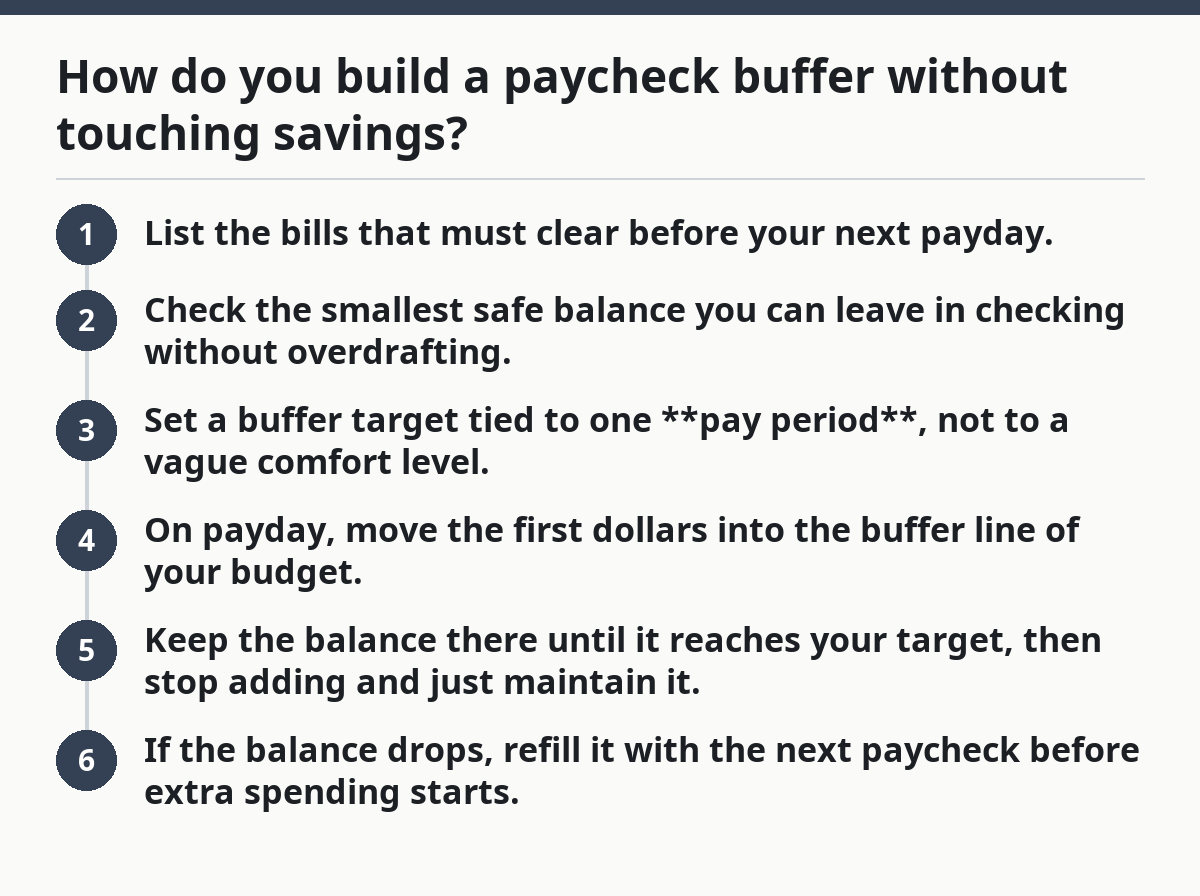
- List the bills that must clear before your next payday.
- Check the smallest safe balance you can leave in checking without overdrafting.
- Set a buffer target tied to one **pay period**, not to a vague comfort level.
- On payday, move the first dollars into the buffer line of your budget.
- Keep the balance there until it reaches your target, then stop adding and just maintain it.
- If the balance drops, refill it with the next paycheck before extra spending starts.
The truth is, the buffer often grows faster when you stop treating every paycheck as spendable, but it is worth checking that approach against your own budget and, if needed, a financial professional. It is a holding lane. If you wait until the end of the month to “see what’s left,” there is usually nothing left.
Do this instead:
- Split each paycheck the same day it lands.
- Put buffer money in the account you already use for bills.
- Label it in your budget as “do not spend unless next paycheck is at risk.”
- Use automatic transfer if your bank lets you schedule one for payday morning.
Stage your money by pay period so bills stop ambushing you
You stage your money by assigning each paycheck to the next set of bills it must cover. Picture this: your rent, school lunch money, and electric bill are all due in the same 10-day stretch, but your income comes in on a 14-day cycle. The buffer bridges that gap so the calendar stops bossing you around.
This works best when you stop thinking in calendar months and start thinking in pay periods. A monthly bill does not care that your payday landed on the 3rd instead of the 1st. Your buffer lets you pay the bill on time anyway.
A simple staging method:
- Paycheck 1 covers bills due before Paycheck 2.
- Paycheck 2 covers bills due before Paycheck 3.
- The buffer sits in checking so one bill can clear early without breaking the rest.
If your pay is twice a month, use the first paycheck to cover the first half of the month’s fixed bills and the second paycheck to cover the second half. If that still leaves too much pressure on one check, move one or two due dates with the biller so the timing fits your actual deposits. Many companies will let you shift due dates by a few days. According to the Federal Trade Commission, it is reasonable to ask billers about billing date changes when timing is tight.
Be careful here: if you try to stage money without a buffer, you are living too close to the edge. One late deposit can trigger a fee chain. A buffer fund in checking reduces that risk because it gives each bill a little room to breathe.
The fastest way to protect the next paycheck
The fastest way to protect the next paycheck is to keep a one-check “floor” in checking and stop spending below it. That floor should be high enough to cover the bills that land before the next deposit, plus a small gap for timing slips.
Now, you might be wondering what to do when the account is already low. The answer is to protect the next deposit before you fix anything else. Do not chase old gaps with the next paycheck unless the next paycheck is already spoken for. That is how shortfalls repeat.
Try this order on payday:
- Leave the buffer untouched.
- Cover the bills due before the next payday.
- Restore any amount the buffer lost last cycle.
- Only then handle flexible spending like takeout, school extras, or extra debt payments.
If you get paid and the account still feels tight, pause debit-card spending for 24 hours. That delay helps you see the whole picture. A lot of overdrafts happen because the money is technically there for a bill, but gets spent on a small swipe first. That costs fees and headaches.
This is also where a separate debit card for discretionary spending can help. Keep the bill account boring. The more your checking account does one job, the easier it is to guard the buffer.
Common mistakes that drain a paycheck buffer
The biggest mistake is treating the buffer like extra money, but a financial coach or bank planner can help you judge the right balance for your situation. That turns a working balance into a shopping fund, and the next bill pays for it. A paycheck buffer only works when the money stays boring.
Another mistake is aiming too high too fast. If you try to build a full month of bills in checking before you have the habit in place, you may keep stealing from it to cover ordinary spending. That makes the balance bounce around and defeats the purpose. A smaller, steady buffer is better than a perfect plan you can’t keep.
A third mistake is hiding the buffer in the wrong account. If the money sits in savings, you have to move it back every time a bill comes due. If it sits in checking, it is already in the right place for the job.
Common traps and what they cost:
- Using the buffer for groceries: the next bill may bounce.
- Leaving it unlabeled: it gets absorbed into “available” money.
- Waiting for a perfect month: the buffer never gets built.
- Ignoring overdraft timing: one late ACH pull can break the week.
On the flip side, if your bank offers sub-accounts or simple labels inside checking, use them. A label can stop you from spending the wrong dollars without moving the money out of the account. That is cleaner than shifting cash back and forth.
How to keep the buffer from getting wiped out again
You keep the buffer intact by making payday a reset point, not a spending spree. Every deposit should restore the account before it funds anything optional. That simple rule keeps one rough week from becoming three.
Set one recurring review every 7 days or every payday. Check three things: current balance, bills due before the next check, and whether the buffer still covers the gap. If the answer is no, refill first and cut discretionary spending for that cycle.
Use a cash-flow check like this:
- What is the next paycheck date?
- What bills hit before then?
- What is the lowest safe balance in checking?
- What spending can wait 48 hours?
If your income changes from week to week, the buffer needs a little more room. If your income is stable, the buffer can stay tighter and still do its job. Either way, the point is the same: stop the account from dipping below the line that triggers fees and stress.
Once the habit sticks, the buffer starts doing quiet work. You stop checking your balance five times a day. Bills clear on time more often. And savings stays where it belongs.
What if your paycheck buffer keeps falling apart?
Your paycheck buffer keeps falling apart because the target is either too small, the bills are hitting too early, or the spending plan is built on hope. That is fixable, but not by touching savings.
Start with the bill timing. If two large withdrawals land within 48 hours of each other, ask the biller about date changes. Then check your target size against your actual pay period. A buffer that works on paper but fails every month is too thin for your real life.
If the numbers still don’t work, trim the pressure on checking by moving one recurring bill to a different date or by splitting a large expense into a weekly transfer inside the month. That is not the same as raiding savings. It is matching due dates to pay dates so the account can breathe.
For more on the broader timing problem, the hub on income stability and cash flow timing for single parents should sit beside this guide. This page is just the buffer piece.
The truth is, a paycheck buffer is a small tool with a narrow job. It will not fix a budget that is structurally upside down. But it can stop the most expensive timing mistakes while you get the rest sorted out.
What is a paycheck buffer?
A paycheck buffer is money left in your checking account so bills can clear before the next paycheck arrives. It is not long-term savings and it is not money set aside for one named expense. The point is to cover timing gaps between income and bills.
For a single parent, that usually means rent, utilities, childcare, gas, and other fixed costs that can’t wait. A buffer reduces overdrafts when paydays and due dates don’t match. It works best when it stays in checking and gets refilled on each payday.
How is a paycheck buffer different from an emergency fund?
A paycheck buffer handles timing; an emergency fund handles surprises. The buffer keeps your account from going empty between paydays, while an emergency fund is for bigger hits like job loss, major repairs, or medical bills.
That difference matters because using savings as a buffer can leave you exposed when a real emergency shows up. Keep the jobs separate if you can. The buffer lives in checking, and the emergency fund lives elsewhere.
Drafted with AI; not yet reviewed by a person.