Last updated: November 19, 2026
Quick Answer: How to Budget for Childcare Deposit and Registration Fees as a Single Parent
The quick answer is to save for the full upfront total, plus a small cushion, before you enroll. In How to Budget for Childcare Deposit and Registration Fees as a Single Parent, that means planning for the deposit, registration fee, waitlist fee, or hold fee before the monthly bill. According to the U.S. Department of Health and Human Services, child care affordability and access can change quickly, so confirm the fee rules in writing and, if needed, consult a financial or legal professional before you pay. The steps below show what to save, what to ask for, and when your plan is ready.
Start with the exact upfront fees the childcare center asks for
Picture this: you’ve found a childcare center with a waitlist, and now the front desk hands you an enrollment packet with three separate charges. You need the exact deposit, registration fee, and any hold fee before you can map the rest. Write down every upfront charge on one page.
-
Ask for the enrollment packet in writing.
Get the registration form, deposit policy, waitlist rules, and start-date terms. When this works, you can point to the fee names instead of guessing. -
Separate the charges into buckets.
Put each fee in one of three groups: deposit, registration fee, and hold fee or waitlist fee. If the center uses an annual registration charge, list that too. The result should be a clean list, not one lump number. -
Ask what each fee does.
A deposit may hold a spot, while a registration fee may pay for paperwork or admin work. A hold fee may buy time before your child starts. If the center cannot explain the purpose, that fee is a bad sign. -
Ask what is refundable.
Some deposits may be credited later, and some are not. Registration fees are often not refundable. Your budget should treat every upfront dollar as gone until you see the refund rule in writing, and you may want to consult a professional if the policy is unclear. -
Note the deadline for each charge.
A waitlist fee may be due right away, while the deposit may be due after a spot opens. When this works, the date is clear enough that you can match it to your next paycheck.
A childcare center should never make you guess at the cash due before care begins. If it does, keep asking until the fee list is plain. That saves you from a surprise at the front desk.
How much should I save before I apply?
You should save for the highest upfront total the center can charge before your child starts, plus a small cushion for copies or forms. That means you plan for the deposit, registration fee, and any waitlist or hold fee before you think about toys, lunches, or the first monthly bill.
Here’s the catch: you don’t need a perfect number to start the search. You need a working target. A single parent can build that target from the enrollment packet and then divide it into weekly pieces.
Use this simple method:
- Add the known upfront fees.
- If the center says some charges are due on different dates, still plan for all of them.
- Keep a small extra amount for paperwork costs, a late form, or a payment transfer fee.
- Treat the budget as “ready to enroll” only when you can pay the full upfront amount without touching rent or groceries, and consult a professional if you are unsure how that affects the rest of your budget.
If you’re comparing two centers, compare the upfront cash needed, not just the monthly price. One place may have a lower monthly bill but a heavier start-up hit. That can matter more when you’re trying to secure care in 7 to 14 days, so confirm the timing with the center before you commit.
Once you know the upfront total, the number stops moving. You can split it into savings goals instead of reacting to each new fee one at a time.
Build a savings plan that fits a single paycheck
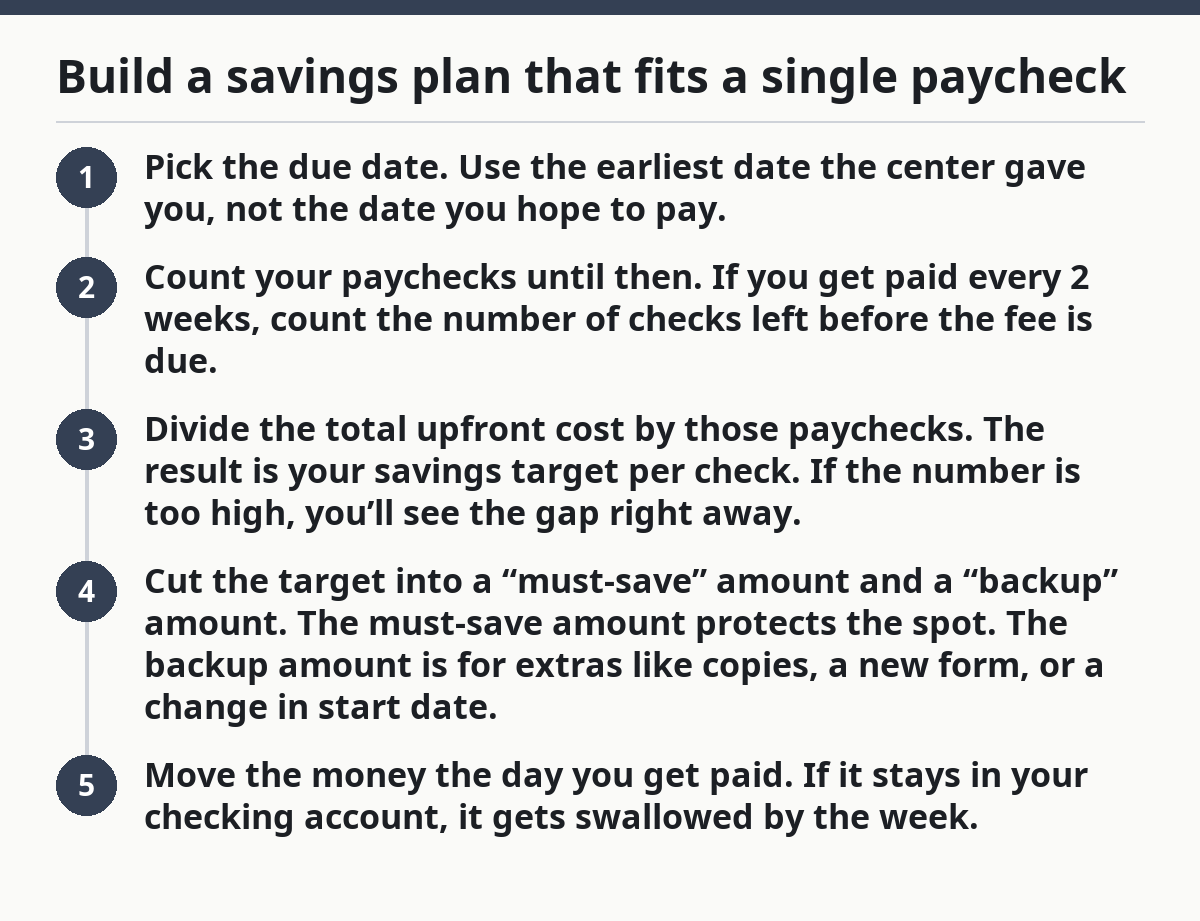
You build this plan by turning the upfront total into a deadline-based savings goal. Start with the date you need the deposit and registration fee, then divide the amount by the number of paychecks you have left. That gives you a weekly or biweekly target you can actually follow.
Picture this: you know the start date is three weeks away, and the center wants the enrollment packet back before then. You do not need a fancy spreadsheet. You need a simple line for childcare fees that stays separate from food, gas, and bills.
Next, use this order:
-
Pick the due date.
Use the earliest date the center gave you, not the date you hope to pay. -
Count your paychecks until then.
If you get paid every 2 weeks, count the number of checks left before the fee is due. -
Divide the total upfront cost by those paychecks.
The result is your savings target per check. If the number is too high, you’ll see the gap right away. -
Cut the target into a “must-save” amount and a “backup” amount.
The must-save amount protects the spot. The backup amount is for extras like copies, a new form, or a change in start date. -
Move the money the day you get paid.
If it stays in your checking account, it gets swallowed by the week.
A 26-week year or a 52-week year does not matter here. The timing does. This budget works best when the fee is due within the next 30 days and you can save in small chunks.
What if the childcare center has a waitlist or hold fee?
You should budget for a waitlist or hold fee as its own line item, because it can be due before you get a real spot. Some centers use a fee to keep your name on the list, and some use a hold fee to reserve a place for a short time. That money buys time, not certainty.
The truth is, a waitlist fee can feel cheap until you realize it does not guarantee enrollment. A hold fee can be worse if you still need the full registration fee later. Budget for both as separate events.
Watch for these common mistakes:
- Paying a waitlist fee and forgetting that the deposit is still coming.
- Treating a hold fee like the final fee when it is only a placeholder, and consider checking the policy in writing or with a professional if it is unclear.
- Missing the start-date deadline and losing the spot anyway.
- Assuming the fee is refundable without reading the packet.
If the center offers a choice between paying now to hold the spot or waiting for the next opening, compare the timing, not just the amount. A fee that protects a start date next month may be worth more than a smaller fee with no real timeline. If you need care to begin on a specific date, ask whether the spot is truly reserved or only “pending paperwork.”
A hold fee is useful only when the start date is firm and the paper trail is clear. If both are fuzzy, skip the guesswork and keep looking.
Which fees do childcare centers charge before care starts?
Childcare centers usually charge a mix of upfront fees before the first day, and each one serves a different purpose. The main ones are the registration fee, deposit, waitlist fee, hold fee, and sometimes an annual registration charge. In general, these should not be treated as the same thing, and you may want to confirm the differences with the center or a professional.
Here’s how they differ:
- Registration fee: often covers setup, files, and enrollment processing.
- Deposit: may hold the spot and may or may not be refundable.
- Waitlist fee: may keep your child on the list until a place opens.
- Hold fee: may reserve a space for a short time before the start date.
- Annual registration charge: may come back each year to keep the file active.
The amount matters, but the rules matter more. A small registration fee that is nonrefundable can hurt more than a larger deposit that gets credited later. That is why the enrollment packet matters more than the number on its own.
Some centers also ask for forms, immunization records, or a signed agreement before they will accept payment. Those items may not cost much, but they can delay the date if you don’t have them ready. If the center needs paperwork within 48 hours, your budget should include printing or notarizing if that applies.
This is where many parents get caught. They save for one upfront fee, then learn there are two more. The fix is simple: ask for the full list before you send any money.
How do I keep the budget from breaking when the start date moves?
You keep the budget from breaking by setting a backup line for delays and by refusing to spend the fee money on anything else. Start-date changes happen. A room may not open, a staff schedule may shift, or the center may ask for one more form before the child can begin.
Here’s the catch: a moved start date can trigger another fee. That might be another hold fee, an annual charge if the date crosses the center’s cycle, or a new deadline for the deposit. If you have no cushion, the budget breaks fast.
Use three protections:
-
Keep the childcare money in a separate place.
A separate savings account or envelope keeps it off-limits. -
Hold a small backup amount.
Even a little extra helps when the center wants a reprint, a form, or a new transfer. -
Confirm every change in writing.
If the start date changes, ask whether the deposit still applies or whether the spot needs to be held again.
A single parent budget should be simple enough to survive a bad week. If the plan only works when nothing changes, it is too fragile. A good plan still works when the daycare opens a few days later than expected.
Once your backup line exists, the stress drops. You stop raiding the grocery fund to keep the enrollment alive.
Where can a single parent trim costs without risking the spot?
You trim costs by asking for fee rules, not by guessing at discounts. Some centers will apply a deposit to the first month, while others will not. Some may waive a waitlist fee if you move quickly, and some may let you pay in two parts if the start date is close.
Use this checklist before you pay:
- Ask whether the deposit is credited later.
- Ask whether the registration fee is one-time or annual.
- Ask whether the center accepts split payments for upfront fees.
- Ask whether any part of the fee is waived if you enroll by a certain date.
- Ask whether the spot is still yours after a partial payment.
Do not assume a cheaper fee means a better deal. A low waitlist fee can hide a nonrefundable deposit that comes later. A center with a higher upfront charge may be easier to budget for if it clearly says what each dollar buys.
This article sits alongside the hub on childcare and school-cost planning for single parents, but this page stays focused on the money due before care starts. That matters because start-up fees behave differently from the monthly bill.
A good budget here is not about winning a bargain. It is about getting the spot, keeping the spot, and not wrecking the rest of the month to do it.
Key Takeaways
- Save for the full upfront amount, not just one fee.
- Read the enrollment packet before you pay anything.
- Put deposits, registration fees, waitlist fees, and hold fees on separate lines.
- Treat refund rules as part of the budget, not fine print.
- Protect the money in a separate place until the start date is locked in.
FAQ
When are childcare deposits due?
Childcare deposits are usually due when the center confirms the spot or before the enrollment packet is finalized. Some centers want the money right away, while others give a short deadline tied to the start date. Always ask for the due date in writing so you can match it to your paycheck schedule.
How do I save for registration fees in advance?
Save for registration fees by turning the fee into a dated savings goal. Divide the amount by the number of paychecks before the due date, then move that amount aside every payday. If the center charges annual registration, treat it as a future bill so it does not surprise you later.
What fees do childcare centers charge before care starts?
Childcare centers often charge a registration fee, a deposit, a waitlist fee, a hold fee, and sometimes an annual registration charge before care begins. Some also ask for paperwork-related costs, like copies or form printing. Read the enrollment packet so you know which charges are due now and which ones come later.
Drafted with AI; not yet reviewed by a person.