
Last updated: November 19, 2026
Quick answer: In about 30 minutes to 1 hour, you can rebuild a monthly budget around a rent increase and see whether staying still works. A rent increase can disrupt a monthly budget fast, especially when you’re the only income in the house. The fix is to recast your monthly budget around the new rent before the lease renewal deadline hits. The steps below show how to judge the notice, cut the right categories, and decide whether staying still makes sense.
Who this applies to, and what you need on hand
This applies if you’ve gotten a rent notice, your lease renewal is coming up, and you need to protect rent, food, transport, and child costs without guessing. It assumes you already know your current rent, your pay schedule, and the bills that hit each month.
This is information, not financial advice. Your situation may need a qualified adviser, especially if you’re dealing with arrears, benefits changes, or a lease clause you don’t fully understand. A small mistake in a housing budget can spill into every other bill.
Have these in front of you before you start:
- your current lease and the renewal date
- the new rent amount in the notice
- your last 2 to 3 months of bank statements
- a list of fixed costs such as child care, transport, insurance, and phone
- your monthly budget or spending tracker, even if it’s messy
Picture this: you’re staring at a landlord notice that changes one number, but that number affects school lunches, gas, and the money left after payday. The job here is to turn that notice into a new plan, not a panic decision.
If you need the bigger picture on housing costs, the hub on housing and utilities budgeting for single parents sits above this page.
How to budget for rent increases as a single parent
You adjust it by making rent the first fixed line in the budget, then trimming every flexible category until the month balances. The point is not to find money everywhere; it is to decide where the money stops going.
Picture this: you’ve got one pay cheque, one child, and a rent notice that leaves less room for everything else. Start with the new rent figure and work outward in plain steps.
- Write down the new rent amount from the notice. Use the exact figure on the landlord letter or email and the date it starts. Verify that it matches the lease renewal terms. If the number is unclear or the start date is missing, the notice needs checking before the budget changes.
- List your fixed costs for the same month. Include rent, utilities, child care, transport passes, insurance, minimum debt payments, and phone. Verify each bill against the last statement, not memory. If a bill changes by season or usage, mark it as variable rather than fixed.
- Subtract those fixed costs from net income. Use take-home pay, not gross pay, and include only money you can actually spend that month. Verify that the result still covers food, school costs, and basic household spending. If the balance is negative, the budget already fails on paper.
- Cut variable spending in 3 layers. Start with dining out, subscriptions, impulse shopping, and high-cost extras before touching groceries or child-related essentials. Verify that each cut has a specific dollar target. If the cut is vague, it won’t hold past 2 weeks.
- Set a cap for groceries and household supplies. Give that category a weekly or monthly ceiling and track it line by line. Verify that the cap still leaves enough for toiletries, laundry, and school lunch items. If the cap forces skipped meals, the budget has gone too far.
- Build a 1-month buffer for irregular spending. Put aside small amounts for school trips, medicine, uniforms, or car repairs when possible. Verify whether the buffer exists in cash or in a separate account. If you keep raiding it for rent, the budget has no shock absorber.
- Check the gap after the rent increase. Compare the new monthly total with your income again. Verify whether the plan closes the gap without pushing another bill unpaid. If you can only make it work by ignoring a real expense, the budget is not balanced.
- Decide whether the stay-and-cut plan still fits. If the numbers work only by removing every small joy and every reserve, the tradeoff may be too steep. Verify whether staying leaves you with any margin at all. If not, the next question is whether moving is cheaper overall.
That process is simple on purpose, and it keeps the focus on the real numbers. It also makes the rent increase visible instead of emotional.
What should I check before I agree to the lease renewal?
You should check the notice date, the lease terms, and the full cost of staying before you sign anything. A rent increase is not just a higher rent line; it can change how much room the whole household has left.
Picture this: the renewal sheet arrives with a higher number and a short deadline. The landlord may want an answer fast, but the budget needs a full review first.
Before agreeing, check these items:
- Notice timing: Does the rent notice arrive in line with your lease and local rules? Timing rules vary by country, state, and city, so check the deadline rather than assuming it is automatic.
- New total housing cost: Add rent, parking, pet fees, trash, water, and any other charge tied to the unit.
- Income timing: If your pay is weekly, biweekly, or irregular, look at the exact dates money lands versus the rent due date.
- Benefits or support changes: If you receive housing help or child-related support, confirm whether a higher rent changes anything else.
- Child care and travel: A closer unit can be worth more than a cheaper one if it cuts fuel, bus fares, or pickup stress.
Here’s the catch: a low rent number can hide a bad fit. A unit that needs more driving, higher utilities, or extra child care can cost more in the end.
If the notice feels off, ask for the rent increase in writing and save every message. A vague verbal promise is not a budget plan. A clear paper trail helps you compare the landlord’s offer with your numbers, not your memory.
How do I decide whether staying or moving is cheaper?
You decide by comparing the full monthly cost of staying with the full monthly cost of moving, not by rent alone. That means the choice is about total housing cost, commute cost, and the money needed to switch homes.
Picture this: one apartment looks cheaper on paper, but the school run gets longer and the utilities run hotter. That tradeoff matters when your budget already runs tight.
Use a side-by-side list:
- current rent after the increase
- utilities in the current place
- travel cost to work, school, or child care
- parking, storage, or laundry fees
- deposit, application fees, and moving costs if you move
- any overlap where you pay two places at once
A lower rent can still be more expensive for a single parent if it adds transport, child care, or a longer commute. A move also carries timing risk, because one month can include rent on the old place, deposit on the new one, and moving costs together.
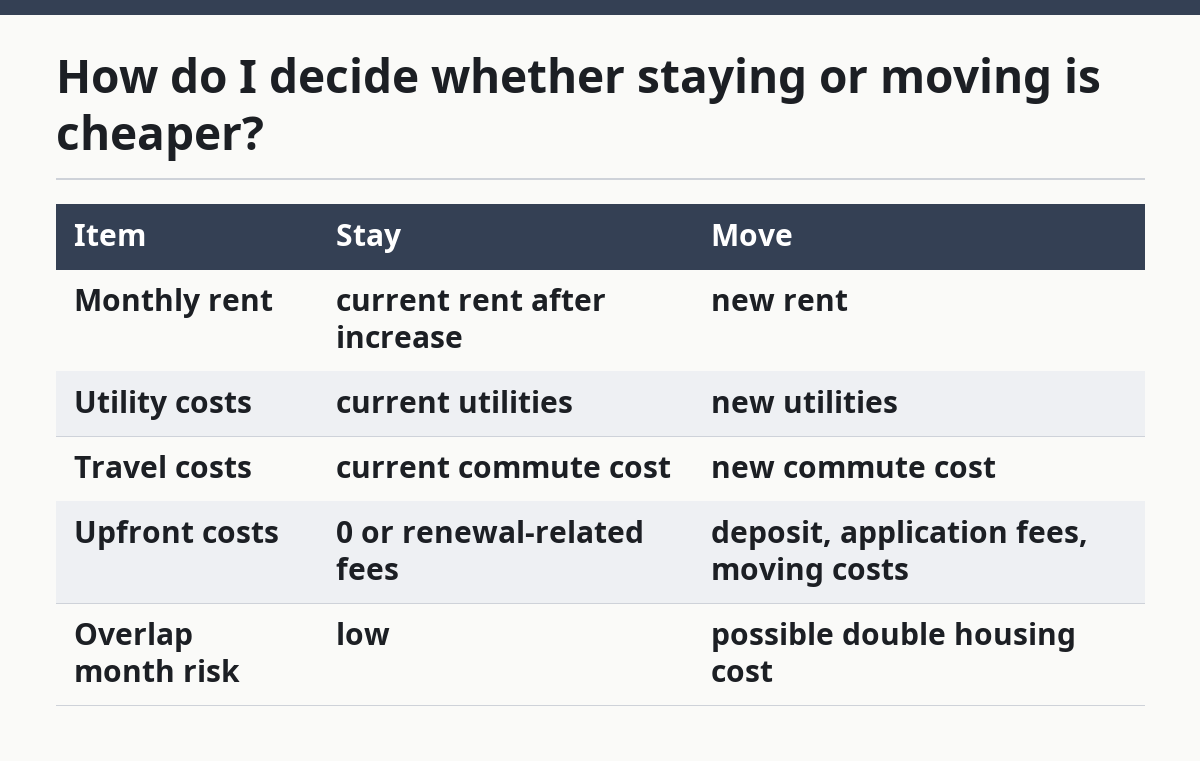
Use this quick comparison to keep the numbers visible:
| Item | Stay | Move |
|---|---|---|
| Monthly rent | current rent after increase | new rent |
| Utility costs | current utilities | new utilities |
| Travel costs | current commute cost | new commute cost |
| Upfront costs | 0 or renewal-related fees | deposit, application fees, moving costs |
| Overlap month risk | low | possible double housing cost |
Ask these two questions:
- Can the current place still fit inside the monthly budget after the increase?
- If not, can a new place reduce total monthly housing cost enough to make the switch worth it?
If the answer to both is no, the stay-versus-move decision is already made by the numbers. That’s not failure. It’s information.
The mistakes that make a rent increase harder than it has to be
The biggest mistake is treating the new rent as the only change. It usually isn’t. A higher rent can also shift transport, child care, food, and savings in ways that don’t show up on the notice.
Picture this: you cover the new rent by trimming groceries, then the week goes long and the overdraft shows up anyway. That is how a budget breaks in real life.
Here are common errors:
- Ignoring fixed costs. If rent rises and you only cut entertainment, the budget may still fail. The better move is to rank every fixed bill before you touch variable spending.
- Using gross pay instead of take-home pay. That creates a fake surplus. Budget from money that actually lands in your account.
- Cutting food too far. A grocery cut that turns into skipped meals is not a budget win. Keep food realistic, then look elsewhere.
- Forgetting timing. If rent is due before payday, a monthly budget can look fine and still blow up. The fix is to map dates, not just totals.
- Not counting move costs. Moving to escape a rent increase can cost more in the short run, especially if deposits and overlap hit in the same month. Compare full cost, not rent alone.
- Waiting for the last day. A late response can remove your room to negotiate, adjust, or plan. Start when the notice arrives.
The correct alternative is plain: build the budget around the new rent early, then test whether it still leaves room for the rest of the month.
When should I stop forcing the budget to work?
You should stop forcing it when the rent increase leaves the budget unable to cover basic living costs without new debt, skipped necessities, or constant late payments. At that point, the budget is not “tight”; it is broken.
Picture this: every month ends with the same scramble, and the new rent only makes the squeeze worse. That is the point to change the plan, not to keep squeezing harder.
The new rent wipes out essentials: If rent leaves no room for food, child care, transport, or utilities, the plan does not balance — review whether staying is still realistic.
You need debt to pay regular bills: If you would cover rent with cards or loans every month, the gap is structural — look at the total housing cost again before signing a renewal.
Your notice timing is unclear: If you can’t tell when the increase starts or what the landlord is charging for, the budget rests on bad data — get the figure in writing.
Your income changes month to month: If hours or shifts move around, a fixed rent increase can hit harder than expected — build the budget from your lowest reliable month, not your best one.
The move math favors leaving: If a different place cuts total monthly housing cost enough to offset moving costs over time, the stay plan may be the wrong tool — compare both paths side by side.
The lease terms conflict with the notice: If the renewal sheet doesn’t match the lease language, the issue is no longer just budgeting — check the documents before you commit.
When the standard approach stops working, the answer is not to pretend the numbers changed. It is to use the information you have and choose the path that leaves the household least exposed.
What does a workable plan look like after the rent goes up?
A workable plan leaves rent paid, the other fixed bills current, and at least a small margin for food and child needs. It does not look glamorous. It looks steady.
Picture this: you’ve redone the math and the month finally makes sense on paper. That’s the sign the plan is usable.
A decent result usually has these features:
- rent is covered first, on time
- the biggest fixed bills are listed and tracked
- flexible spending has clear limits
- the budget includes at least a little room for surprise costs
- the move-or-stay decision is based on totals, not fear
The real goal is not “nothing changed.” The goal is that the higher rent no longer ambushes the rest of the month. That’s the real goal for a single parent managing housing costs on a tight timeline.
For a broader framework, the housing and utilities budget hub gives the surrounding categories that sit next to rent. This page handles the rent increase itself and the stay-versus-move decision.
What should I do when my rent goes up?
Start by checking the notice, the lease renewal date, and your monthly budget. Then rebuild the numbers around the new rent and see what has to give. If the increase makes the budget fail, compare the full cost of staying with the full cost of moving.
How do I adjust my budget for a higher rent payment?
Put the new rent at the top of the budget and subtract it before you assign money to flexible spending. After that, review every fixed cost, trim non-essentials, and test whether the month still closes. If it doesn’t, the budget needs a bigger change than small cuts.
Can I negotiate a rent increase?
Yes, you can ask, but the result depends on your local market, lease terms, and the landlord’s position. Keep the request in writing and be specific about what you’re asking for, such as a smaller increase or more time. If the answer is no, use that answer in your stay-versus-move decision.
Drafted with AI; not yet reviewed by a person.