Last updated: November 18, 2026
Quick Answer: Building a resilient budget system as a single parent means choosing a plan that protects essentials, absorbs timing gaps, and still works in a rough week. For most households, that starts with a zero-based budget, a small checking buffer, and a savings target you can build over time, not all at once.
Key Takeaways
- A resilient budget handles income swings, timing gaps, and surprise costs.
- A zero-based budget with a small buffer is often the best fit for single parents.
- Start with a checking cushion first, then build savings as you can.
- The detailed budget is strongest when precision matters.
A resilient budget system for a single parent is one that keeps the bills paid, the fridge stocked, and the account from collapsing when a shift is cut, a child gets sick, or a car repair lands in the same week as rent. In Building a resilient budget system as a single parent, the goal is not a perfect monthly plan; it is a budget that can absorb disruption and still work.
I write about household finance and budgeting systems for real-life cash flow, including variable income, emergency buffers, and debt trade-offs.
What “resilient” actually means for a single-parent budget

A resilient budget survives three common shocks: income changes, timing mismatches, and surprise expenses. That means the system needs cushions at the category level, not just good intentions at the end of the month.
For a single parent, the usual “spend less than you earn” advice is too thin. Two expenses matter more than they do in a dual-income home: child care and time. If the budget depends on constant manual correction, it will fail the first time a child has a fever at 7 a.m. or a paycheck lands two days late.
The right budget system usually has four parts:
- A bare-minimum monthly spending plan.
- A cash buffer for the next 7 to 30 days.
- Sinking funds for predictable but irregular bills.
- A rule for what gets cut first when money tightens.
That last point matters. A resilient system is not the one with the prettiest spreadsheet. It is the one that tells you, in 30 seconds, what happens when the utility bill is higher than expected or a school trip shows up with a one-week deadline.
The core trade-off is control versus effort. A highly detailed line-item budget can be precise, but it takes more upkeep. A simpler system can be easier to maintain, but it may hide waste unless you review it monthly. The best choice depends on how variable your income is and how much time you can realistically spend tracking money each week.
The budget system that works best for most single parents
A zero-based budget with a small buffer wins for most single parents because it gives every dollar a job without pretending every month will look the same. It is the clearest way to stay ahead of tight cash flow when your pay cycle, child expenses, and bills do not line up neatly.
Zero-based budgeting means assigning all incoming money to categories before you spend it. That does not mean spending every dollar on the day it arrives. It means deciding in advance what each dollar is for: rent, groceries, gas, school fees, co-pays, debt, savings, and a small “unknowns” line item.
Why this works better than a loose “keep track and hope” system:
- It exposes shortfalls early.
- It forces decisions before money disappears into small purchases.
- It makes uneven months easier to handle because the plan already exists.
- It helps you separate true emergencies from predictable irregular costs.
The buffer is what makes it resilient. Without a buffer, a zero-based budget can feel brittle: every surprise becomes a crisis. A modest cushion inside checking, even one month of smaller protection, can reduce the number of times you have to reshuffle the entire month on a Wednesday night.
This system is not for someone who hates planning and will never check a budget app or spreadsheet. It also is not ideal if income is wildly unstable and there is no room at all to cover essentials before the next payment arrives. In that case, the first job is cash-flow triage, not strict category control.
The downside is real: zero-based budgeting can become tedious if every receipt is entered by hand. It can also feel punishing if the categories are unrealistic. If the grocery number is too low because it was copied from a fantasy month, the system breaks quickly. A resilient budget must reflect actual life, not wishful arithmetic.
How much buffer a single parent actually needs
The answer is as much as you can build without starving the essentials, but the starting target should be one small cushion in checking and a second one in savings. A lot of generic advice jumps straight to a full emergency fund, which is useful in theory and hard to do when child costs are immediate.
A practical sequence is:
- First, avoid overdrafts and late fees.
- Second, build a checking buffer that can absorb timing gaps.
- Third, start a separate savings reserve for true emergencies.
For many single parents, the checking buffer matters more than a large savings account at the start. Why? Because many budget failures are timing failures, not total-income failures. A paycheck that arrives on Friday does not help if childcare is due on Tuesday and the account is near zero. A short buffer can keep the budget from breaking over a 3-day gap.
A common mistake is to keep the buffer too big in checking and too vague in purpose. Money without a label is easy to spend. The better move is to give the buffer a job: “this covers the week the schedule slips.” Keep it separate from the grocery money and from the emergency fund.
The downside is opportunity cost. Money sitting in checking earns little and can tempt overspending. A savings account is better for discipline, but if transfers are too slow or too many, the buffer may not help when you need it. The system has to match how fast your bills hit.
This approach is not for someone who already has high-interest debt and no cash margin at all? Actually, it still can be used, but with a smaller starting buffer and a faster debt payoff plan. The trade-off is that debt payments can wait only if the alternative is repeated overdrafts or late fees. For many households, eliminating fee spirals first is the smarter move.
The honest side-by-side: detailed budget vs simpler cash-flow plan
The detailed budget wins when you need precision. The simpler cash-flow plan wins when you need consistency. The right choice depends on whether your money problem is “too much leakage” or “too much complexity.”
| Criteria | Detailed zero-based budget | Simple cash-flow plan | Winner for [condition] |
|---|---|---|---|
| Best use case | Families with many categories and irregular spending | Families who need a plan they can keep up with in under 15 minutes a week | Simplicity for busy schedules |
| Setup time | Higher; can take several hours to map categories | Lower; can be built around bills, income dates, and 5–8 buckets | Quick start |
| Weekly upkeep | More review, more entries, more correction | Less maintenance, easier to keep alive during chaos | Single parents with limited time |
| Visibility into leaks | Strong; small spending is easier to spot | Moderate; easier to miss category drift | Tight margins |
| Handling irregular income | Strong if categories are updated every pay cycle | Strong if cash-flow dates are tracked carefully | Variable income |
| Handling child-related surprise costs | Better if there is a dedicated “kids” or “miscellaneous” line | Better if the system includes a flexible overflow bucket | Frequent school or care surprises |
| Risk of burnout | Higher if the budget is too granular | Lower, because the rules are simpler | Low-energy seasons |
| Debt payoff integration | Easy to direct every extra dollar | Also works, but less precise | Aggressive debt payoff |
| Best for digital tools | Budgeting apps or spreadsheets with category tracking | Calendar + bills list + basic spreadsheet | Minimal-tool users |
| Main weakness | Can become a second job | Can hide overspending until month-end | Simplicity with weak tracking |
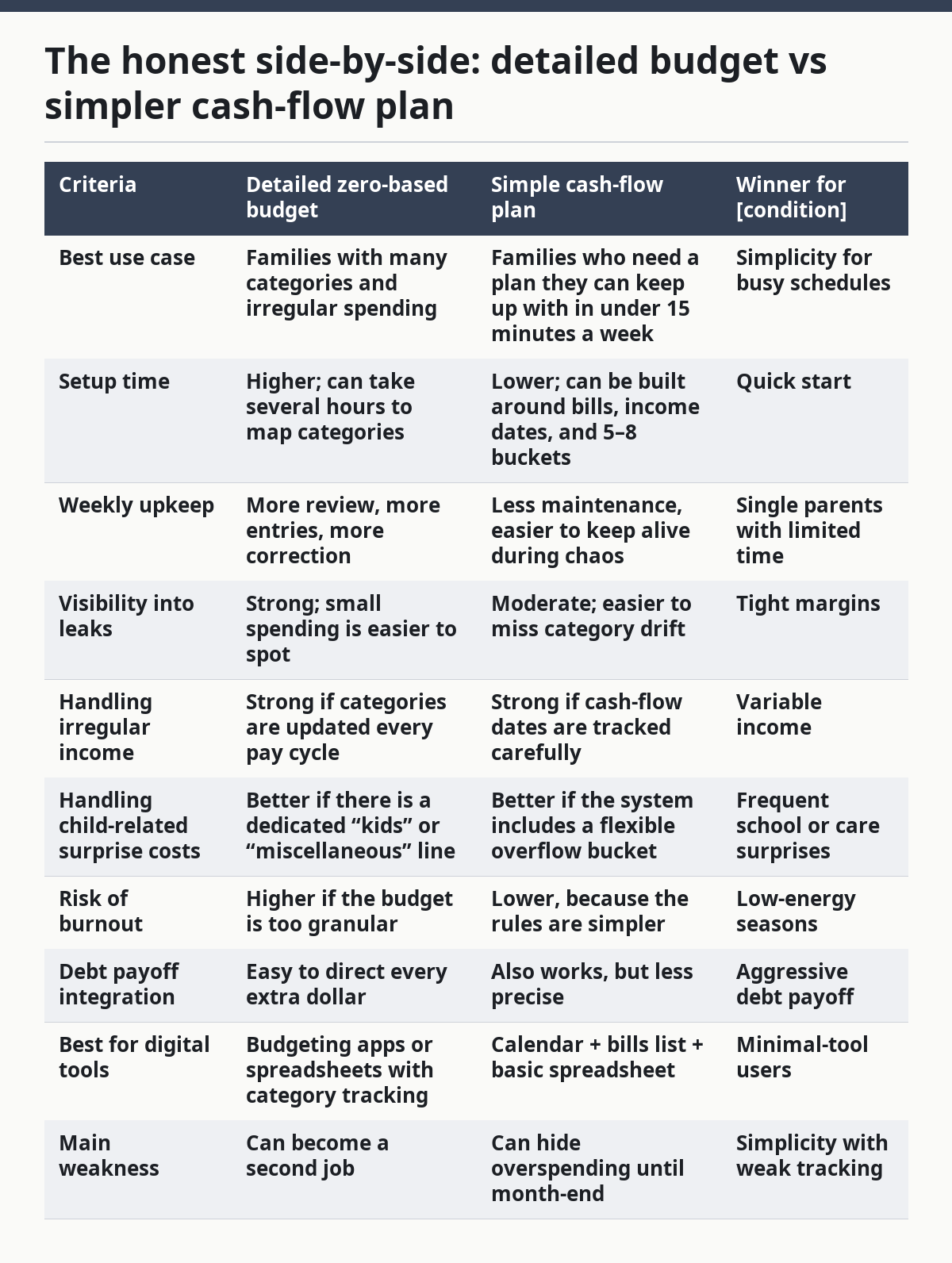
The detailed version is better if you have recurring “mystery” spending and need to know exactly where the money leaks. It is also the better choice if you are paying down debt and every extra $20 matters. The weakness is that it can become exhausting, especially if you are already managing school pickups, meals, and work shifts alone.
The simpler version is better if your biggest problem is staying organized enough to not miss rent, utilities, or child-care payments. It wins when your life is already too full for a heavy spreadsheet. The weakness is that it can look balanced on paper while hiding a slow drain in food delivery, convenience purchases, or school extras.
A lot of articles pretend these are philosophical choices. They are not. They are workload choices. If your brain is already maxed out, pick the system you will still use in month 4, not the one that looks smartest on day 1.
How do I budget when my income changes every week?
You budget by using a floor, not an average. Start with the lowest realistic monthly income you can count on, then build the budget around that number so the essentials are covered even in a weak month.
This is the single biggest upgrade for a single-parent budget with variable income. If you budget off your best month, the plan will fail the first time a shift disappears, a client pays late, or overtime dries up. The safer method is to identify your “base pay” from the last few months and treat anything above that as irregular income.
A resilient structure for variable income usually looks like this:
- Base income covers rent, utilities, groceries, transportation, minimum debt payments, and child care.
- Extra income goes to a prioritized order: past-due bills, buffer, sinking funds, debt principal, then nonessentials.
- One category should absorb the messiest surprises, often called “miscellaneous,” “household overflow,” or “kids.”
The honest drawback is that this system can feel restrictive in good months because it refuses to spend future money today. That is exactly why it works. A good month should improve stability, not create dependence on future good months.
This method is not for someone whose income is so unpredictable that even a floor is unclear. If pay varies week to week and there is no reliable minimum, the first move is to identify guaranteed income sources, emergency support, or temporary expense cuts. Budget systems cannot invent cash flow that does not exist.
The cleaner your floor, the more resilient your budget becomes. If you know that $2,400 is the number that actually shows up most months, build around $2,400. If you guessed $3,000 because it sounds better, the system will punish you for optimism.
Which bills should get paid first?
Rent or mortgage, utilities, food, transportation, child care, and minimum debt payments usually come first, in that order, because they keep housing, safety, and work intact. That order may shift if one bill carries an immediate shutoff or eviction risk, but the principle stays the same: protect the roof, then the basics, then the rest.
For a single parent, the biggest mistake is treating all bills as equally urgent. They are not. A streaming service can wait. A missed electricity payment or child-care balance can break the whole week. A resilient budget has a clear priority stack so you do not decide from panic every time money is short.
A simple order of operations helps:
- Housing.
- Heat, power, water, and internet if it is required for work or school.
- Child care and school-related essentials.
- Food and transportation.
- Minimum debt payments.
- Sinking funds for predictable annual or seasonal bills.
- Nonessential spending.
The trade-off is obvious: debt and savings get less money early on. That can feel frustrating, especially if you are trying to “catch up.” But a budget that protects housing and child care has a better chance of surviving long enough to improve debt later.
This is not the right priority stack if your housing is stable and your highest-risk problem is debt compounding at a very high rate. In that case, some debt may deserve a more aggressive attack once the core essentials are safe. Still, the floor comes first. A budget that pays extra debt while neglecting food or transport is not resilient; it is fragile with good intentions.
If you want a rule you can use when tired, use this one: pay the bill that causes the most damage if it fails, not the one that feels loudest in the moment.
The tools that help, and the tools that create more work
A spreadsheet wins for control, a budgeting app wins for speed, and a paper system wins for visibility when life is already noisy. The best tool is the one you will open twice a week, not the one with the most features.
A spreadsheet is the strongest choice if you want full control over categories, sinking funds, and cash-flow timing. It is also the easiest way to model a single-parent budget that changes every month. You can build columns for income date, category, due date, amount owed, amount paid, and remaining balance. The downside is that every manual entry takes time, and time is often the scarcest resource.
A budgeting app can reduce friction by linking accounts and tracking spending automatically. That can be useful when you have 15 minutes at night and no appetite for bookkeeping. The downside is dependence on account syncing and app design choices you do not control. If the categories are too rigid or the bank connection breaks, the system becomes less reliable at exactly the wrong time.
Paper works best when you need a visible reset. A wall calendar with due dates, a notebook with bill priorities, or an envelope system for cash categories can make the plan concrete. The downside is that paper is easy to lose and not ideal for families who pay most bills online.
The wrong tool is the one that creates more decisions than it removes. A parent juggling dinner, laundry, and a school form does not need a fancy dashboard. The right setup should lower mental load, not add to it.
When the system should change instead of being “fixed”
The budget system should change when the problem is structural, not behavioral. If the numbers do not work after a few months of disciplined tracking, the issue may be income, not discipline.
That distinction matters. A lot of generic budgeting advice assumes the main problem is willpower. For a single parent, that is often false. The real issue may be one of these:
- Child care costs too much relative to take-home pay.
- Transportation is non-negotiable because work and school are far apart.
- Income is too volatile to support the current bill load.
- Debt minimums are crowding out necessities.
- The budget is built for a lifestyle that no longer exists.
When that happens, the answer is not to “track harder.” The answer is to simplify, renegotiate, or cut structural costs. That might mean changing child care arrangements, reducing recurring subscriptions, asking providers about hardship options, or moving categories from monthly to seasonal planning.
A budget also needs a redesign after major life changes: a new job, a move, a custody shift, a school change, or a change in child-care hours. A resilient system is supposed to adapt. If it cannot survive a new schedule, it was never resilient; it was just stable for one chapter.
This section is the one most generic articles skip. They act as if every broken budget can be repaired with a better app or stronger discipline. Sometimes the right move is to admit the budget structure no longer fits the household.
The verdict: which system to choose and why
Choose a zero-based budget with a small buffer if your income is moderate to variable and you can spend 20 to 30 minutes a week keeping categories current. Choose a simpler cash-flow plan if your calendar is already overloaded and your main risk is missing due dates, not overspending inside categories. Neither if your income cannot cover essentials at all; in that case, the first job is emergency support, bill negotiation, or temporary expense reduction, not budget optimization.
That is the cleanest call I can make. The zero-based system is better for control. The simpler cash-flow system is better for survival when time is scarce. Both can work, but they solve different problems.
If the budget has been failing because money disappears in small amounts, pick the detailed version. If the budget has been failing because the system is too complicated to maintain, pick the simpler one. The goal is not to build the most elegant budget. The goal is to build the one that still works after a rough Tuesday.
What a resilient single-parent budget should include on day one
A resilient budget should include four numbers, two lists, and one rule. The four numbers are income floor, rent or mortgage, minimum essentials, and current buffer. The two lists are fixed due dates and flexible categories. The rule is simple: when money is tight, essentials are paid in priority order before anything optional.
Start with a one-page version if needed. Put the income floor at the top, then every bill with a due date next to it, then every flexible spending category below. Use actual due dates from the next 30 days, not a general monthly guess. If a bill hits on the 6th and your paycheck lands on the 10th, that timing gap has to be visible on paper or in the spreadsheet.
A small number of categories is better than a long one at the beginning. Too many buckets can make the system fragile because every purchase needs too much classification. A resilient starter budget often needs only seven to ten categories, not twenty-five.
The drawback is that a simple first draft will be incomplete. That is fine. A working budget gets refined after one or two months of real data. The point is to create a system you can maintain before you try to perfect it.
FAQ
How do I start if I have no savings at all?
Start by mapping the next 30 days of bills and cutting the plan down to essentials. Your first goal is to avoid overdrafts and late fees, even if that means pausing extra debt payments for a short period. Once the cash flow stops bleeding, begin with a small buffer rather than aiming for a large emergency fund immediately.
Should I use cash envelopes or a budget app?
Use whichever one you will actually check twice a week. Cash envelopes can help with hard spending limits on groceries or discretionary categories, while a budget app is better for bill tracking and automatic updates. If the system creates too much friction, it will not survive a month with child-related interruptions.
What if my income changes every week?
Base the budget on your lowest reliable income, not your average month. Put extra income into a clear order: overdue essentials, buffer, sinking funds, debt principal, then nonessentials. That keeps the plan from collapsing when one week is weak.
How much should I keep in a buffer?
Keep enough to cover common timing gaps without making the checking account so large that the money gets spent casually. The right amount depends on pay cycles, bill dates, and how often surprises hit, so the target should be based on actual monthly timing rather than a fixed rule. A financial professional can help if you are juggling debt, benefits, or irregular income.
What if the budget still doesn’t work after two or three months?
Then the problem may be the structure, not the discipline. Recheck housing cost, child care, transportation, debt minimums, and income floor before blaming yourself for every miss. If essentials still do not fit, the budget needs a redesign, not just more tracking.
Drafted with AI; not yet reviewed by a person.