Last updated: November 19, 2026
Quick Answer: For many families, the budget starts with the uncovered morning gap, and that means pricing the exact hours between home and school, not the whole day. Before-school care can strain a single-parent budget because it fills a short, expensive gap between your commute and the school bell. The right budget is usually the lowest-cost plan that covers that gap without making you late for work. The steps below show how to price the coverage you actually need, not the care you wish you didn’t have to buy.
Key takeaways
- Price the morning gap first, not the full school day.
- A school bus, early drop-off, or a before-school program each covers a different part of the morning.
- Ask what the fee buys: supervision, breakfast, transportation, or all three.
- A drop-in option can help with a 1- or 2-day problem, but it can cost more per day than a regular slot.
- Family help lowers cash outlay, but it can fail fast if the helper gets sick, works nights, or lives far away.
What before-school care actually has to cover

Before-school care covers the time between leaving home and the school start time, and that can be as short as 20 minutes or as long as 2 hours. Picture this: you leave for work at 7:00 a.m., school starts at 8:30, and your child can’t be alone yet. The budget problem is not “childcare” in the abstract; it’s the exact gap on a school-day clock in How to Budget for Before-School Care as a Single Parent.
The first thing to pin down is what your child needs in that window. A before-school program may offer supervised play, breakfast, and transport to school. A daycare center may offer early care but not school transport. A school bus may solve the ride, but it does not always solve the supervision problem if the bus comes after your work departure.
Use this quick split:
- Supervision only: Someone watches your child until school opens.
- Supervision + breakfast: Food is included, which can save one morning expense.
- Transportation only: The child is safe, but you still need coverage before pickup or after drop-off.
- Full morning coverage: Care, food, and the ride to school are bundled.
The fit depends on the clock, not the label. A program that sounds cheaper can still fail if it starts 15 minutes too late for your commute.
How do I figure out the real price gap?
You figure out the real price gap by subtracting the coverage you already have from the coverage your work schedule demands. Picture this: you have school drop-off handled by a relative twice a week, the bus the other days, and a work shift that starts before school opens. The budget gap is the part still uncovered on the calendar.
Start with a simple worksheet and fill in four items:
- Your work departure time
- School start time
- How your child gets there
- Which days that plan fails
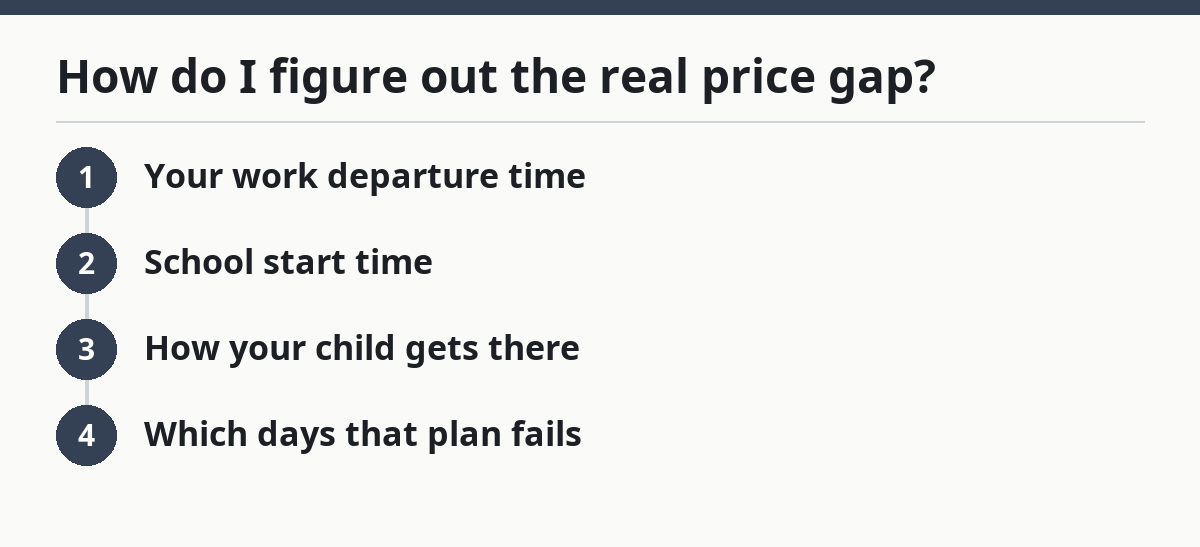
Then write the “gap” in minutes, not in vague terms. A 45-minute gap and a 90-minute gap are not the same budget problem. One may fit an early drop-off arrangement; the other may need a staffed before-school program or a daycare center with morning hours.
Next, mark the days that need paid care only. If Monday through Thursday are covered by a school bus, but Friday has no bus service, your budget should price one day, not five. Some single parents overspend because they price the worst week of the month instead of the normal week.
What this step should give you:
- A list of uncovered mornings
- A rough count of paid days per month
- A clear answer on whether you need transport, supervision, or both
If you can’t write that down in one minute, the problem is still too fuzzy to shop for.
Build the budget from the narrowest option upward

Build the budget from the cheapest option that truly works, then move up only if it fails the schedule. Picture this: you have three choices on paper—school bus, early drop-off, or a before-school program—and only one of them fits your commute without making you late.
Do this in order:
-
Check the school bus first.
Ask whether it runs before your work start and whether it drops your child close enough to school. A bus can cut cash spending, but it does not help if the route comes too late or does not run on your child’s grade level. -
Price early drop-off next.
Early drop-off often covers only the minutes before school supervision starts. That means you may still need a second plan if your commute begins long before the school doors open. If the fee includes breakfast, that saves a separate food cost; if it doesn’t, it only buys waiting time. -
Compare a before-school program.
This option usually buys staffed supervision, a set start time, and sometimes transport to class. The downside is that it may require a fixed schedule, and it may not accept drop-ins when your plans change. -
Check daycare center morning care.
A daycare center can be a fit if it opens early enough and sits on your route. It can also be the wrong fit if it is built for preschool hours rather than school-day handoff. The money often buys broader hours, not school-specific transport. -
Price drop-in care only for backup days.
Drop-in care is useful for a late meeting, a training day, or a one-off shift change. It is not a good base plan if you need it every weekday, because irregular coverage usually costs more per day than a steady slot.
The goal is not the lowest number on paper. It is the lowest number that still gets your child to school safely and gets you to work on time.
What does the money actually buy?
The money buys time, supervision, and sometimes transportation to school, but not always all three. Picture this: a program says “morning care,” and you assume breakfast, a ride, and a staffed room. Then you learn that transportation is separate, breakfast is optional, and pickup starts 20 minutes after your commute begins.
Ask each provider the same questions:
- Does the fee include morning supervision only, or supervision plus breakfast?
- Is the school bus part of the service, or do parents arrange transport?
- Does early drop-off start before your work shift?
- Can your child arrive 1 day a week, or do you need a fixed schedule?
- Are there late fees, registration fees, or a deposit?
A generic “before-school care” rate can hide a lot. A lower fee may buy only a short window and no ride. A higher fee may buy transportation plus supervised time, which is often cheaper than stitching together two separate services.
The biggest trap is paying for a service that does not solve the full morning chain. If you still need to drive across town after drop-off, the total cost includes gas, parking, and the time you lose on the road. If the school bus solves the ride but not the early gap, you still need a person or place to cover that first stretch.
A quick price-check list
- Base fee: recurring morning slot
- Transport fee: ride to school, if separate
- Food fee: breakfast, if separate
- Drop-in fee: backup care
- Change fee: switching days or schedules
If a provider won’t say what is included, treat that as a cost problem, not a service problem.
How can I keep the budget from breaking in a bad month?
You keep the budget from breaking by planning for the months when school hours, work shifts, and family help do not line up. Picture this: a holiday week shortens the school schedule, your job adds an earlier shift, and your backup helper is out. That is when a tight plan fails.
Build three layers into the budget:
- Base layer: the regular before-school care you need every week.
- Backup layer: one alternate plan for sick days, delayed buses, or a rare early meeting.
- Squeeze layer: a small cushion for weeks when you need extra coverage.
The squeeze layer does not have to be large to matter. Even a small set-aside can cover a drop-in day, a one-time early drop-off fee, or a temporary ride to the school bus stop. Without that cushion, one missed commute can force you to use credit or skip work.
Now, you might be wondering whether family help can replace paid care. It can lower the bill, but it is risky as a sole plan. A grandparent, sibling, or neighbor may be free on paper and unreliable in practice. If they cancel twice in one month, your “saved” budget turns into emergency costs.
Use family help as a backup, not the only leg of the plan, unless the person is truly steady and close enough to cover the same 30- to 60-minute window every time. If that is not realistic, price the paid option as the real budget and count family help as a bonus.
For more help with planning, the Childcare and school-cost planning for single parents hub can help you place this morning expense in the bigger picture. The guide to childcare expenses is useful when you want to compare recurring care costs. If school transport is part of your morning plan, the school transport cost guide can help you separate ride costs from supervision costs.
Common mistakes that cost single parents money
The biggest mistake is buying the wrong kind of coverage, and that mistake usually costs either late fees, lost wages, or both. Picture this: you choose a cheap early drop-off spot, then realize the school opens 25 minutes later and you still need another adult to bridge the gap.
Watch for these errors:
- Pricing the wrong days. If care is needed only 3 mornings a week, don’t budget for 5.
- Ignoring the commute. A provider that starts at 7:30 a.m. is useless if your work starts at 7:15.
- Assuming transport is included. Many plans cover supervision but not the school ride.
- Skipping backup care. One sick day can blow up a carefully thin plan.
- Choosing the cheapest option without checking rules. Some programs require fixed attendance, advance sign-up, or a minimum number of days.
The better move is to budget around the actual morning chain: home, care, transport, school. If one link is weak, the whole plan costs more in time and stress. A careful price check now beats a scramble every Tuesday.
For broader planning around school-related costs, the hub on Childcare and school-cost planning for single parents can help you place this morning expense in the bigger picture.
A simple way to keep the monthly number under control
You keep the monthly number under control by turning the weekly plan into a fixed line in your budget. Picture this: you know the care is needed every Monday, Wednesday, and Friday, but you still treat it like an “extra” expense. That’s how the money disappears.
Use this sequence:
- Count the paid mornings in a normal month.
- Add any transport fee or breakfast fee.
- Add one backup day if you regularly need one.
- Set the total aside on payday, not at month’s end.
This works best when the fee is predictable. If the before-school program bills monthly, divide the amount into each paycheck. If the fee changes by day, estimate a high month and budget to that number. The extra cushion is not waste; it is what keeps you from raiding groceries or rent money when school or work changes the plan.
If your income swings from week to week, keep the morning-care money in a separate envelope or account. That keeps the school gap from getting mixed into gas, food, or bills. The point is simple: the care is not optional when your work start time is fixed.
What a good budget should show
- The normal monthly cost
- The backup-day cost
- Which mornings are covered without you
- Which mornings still need a person, a ride, or both
If you can see those four lines clearly, you have a usable budget. If not, the plan is still too vague to trust.
do schools charge for before-school care?
Yes, many schools and school-run programs charge for before-school care, but the fee structure varies. Some charge a flat monthly amount, while others bill by day or by registration period. The money usually covers supervision and access to the program; transportation and breakfast may be separate, so always ask what is included.
how do i budget for morning care if my commute starts early?
Budget for the full time gap, not just the part before school opens. If your commute starts before the school day, price the combination of early drop-off, morning supervision, and transportation to school that actually closes that gap. Then put that amount into your regular paycheck plan so the cost is already spoken for.
can i combine before-school care with family help?
Yes, and that can lower your cash cost if the family help is reliable. The catch is consistency: a free plan that falls apart twice a month can cost more than a paid plan you can count on. Use family help for set days or as backup, not as the only plan unless the person can cover the same window every week.
Drafted with AI; not yet reviewed by a person.