Last updated: November 19, 2026
Key Takeaways
- Paying a nanny directly can make you a household employer, so wages may be only part of the total cost.
- Nanny payroll taxes shift part of the cost from cash pay to a reported employer expense.
- To estimate household employer taxes, start with expected wages and add the taxes your rules require.
- You usually need wage records, a W-2, and often Schedule H when reporting household employment taxes on your personal return.
Nanny payroll taxes can add a real cost to a single-parent budget, and How to Budget for Nanny Payroll Taxes as a Single Parent means planning for the employer side of the tax bill, not just the nanny’s wages.
This guide shows where those costs come from, how household employer taxes work, and what to check before you hire or file.
Information only: this is not financial advice. Your own tax situation can differ, so a qualified adviser should review it if you’re unsure.
What this budget needs to cover

If you pay a nanny directly, you may become a household employer, and that means the pay package can include more than hourly wages. Picture this: you’ve set aside money for care, then learn the tax bill comes on top of the paycheck. That’s the gap this budget has to close.
Start by separating gross wages from employer payroll taxes. Gross wages are the amount you agree to pay the nanny before any tax handling. Employer payroll taxes are the taxes tied to paying a household worker, such as Social Security tax, Medicare tax, and often state unemployment tax. Some families also have withholding obligations if they choose or are required to withhold from wages.
The key question is not “How much does a nanny cost?” but “What will I owe as the employer?” That answer depends on the country, state, and sometimes local rules. The federal rules in the U.S. are a common example, but tax rules change often and do not transfer neatly across borders.
For a single parent, the budget often needs a separate line for household employment. That line should sit beside childcare, food, housing, and transport—not inside the nanny’s hourly wage line. If you use a budget app, create a category called nanny payroll taxes and keep it distinct from regular care costs.
The most practical place to start is the IRS page for household employers and Schedule H, the form used to report certain household employment taxes on a personal return: IRS Publication 926 and Schedule H. These pages explain the U.S. framework, but local rules still matter.
How do nanny payroll taxes work?
Nanny payroll taxes work by shifting part of the tax burden from a cash payment to a reported employer expense. Picture this: you’re setting up a weekly paycheck, and the government wants the wages recorded, the taxes tracked, and the year-end forms filed. That’s the system.
In the U.S., a household employer may owe employer-side Social Security tax and Medicare tax on a nanny’s cash wages, and may also owe federal unemployment tax if the wage threshold is met under current rules. Some states add state unemployment tax, which is separate from federal payroll tax and has its own filing cycle. If you withhold any employee tax from the nanny’s pay, that withheld amount is not an extra cost in the same way, but it does change the payroll math and the records you must keep.
A common budget mistake is to treat payroll taxes as optional because the worker is “just a nanny.” That is not how household employment works, but the exact rules depend on where you live, so consult a tax professional or the relevant agency before you build the budget. Once you cross the rule set for a household employer, the recordkeeping follows from there. The exact thresholds and filing dates can change, so check the current rules before you build a yearly estimate. The IRS household-employer pages are the main federal reference point in the U.S. (Publication 926; Schedule H).
Use this as your working frame:
- Wages: the pay rate you agree to
- Employer taxes: the taxes you pay on top of wages
- Employee withholding: money you hold back from wages, if applicable
- Filing cost: software, a payroll service, or your own time
That last line matters. A budget should include the money cost and the time cost. If you are filing Schedule H yourself, you’ll still spend time collecting wage records, calculating the tax, and keeping copies of W-2 paperwork.
How to estimate household employer taxes step by step

You estimate household employer taxes by starting with expected wages, then layering in the tax types your rules require. Picture this: you have a monthly childcare target, but the tax bill is still a blank line. This is where you turn that blank line into a number you can live with.
- List the expected gross wages. Write down the nanny’s pay rate and the hours you expect to use in a week or month. Verify that you are using gross pay, not take-home pay. If the number only reflects cash handed over, the estimate is too low.
- Check the household-employer threshold rules. Look up the current federal and state rules for whether you owe household employer taxes at all. Verify the wage threshold and filing trigger for your location. If the rule set is unclear, the budget is not ready.
- Separate employer taxes from withholding. Mark which taxes you pay yourself and which taxes, if any, are withheld from the nanny’s wages. Verify that withheld employee tax is not counted twice as an employer expense. If you double count it, the budget is inflated.
- Add Social Security tax and Medicare tax. Use the current rates from the IRS or your local tax authority, then apply them to the taxable wages that count under the rules. Verify that you are using the right wage base and the right tax year. A rate from an old filing season will throw off the total.
- Check for state unemployment tax. If your state requires it, add it as a separate line item. Verify whether the state charges a new-employer rate, a wage cap, or a quarterly filing cycle. If you skip this, the budget misses a real expense.
- Plan for filing support. Decide whether you will do the payroll math yourself, use payroll software, or pay a service. Verify the fee schedule before you commit. A service may cost more than you expected, but it can also reduce filing errors and late forms.
- Set money aside each payday. Move the estimated tax amount into a separate savings bucket every time wages are paid. Verify that the balance grows with payroll, not at tax time only. If you wait until filing season, you risk a cash crunch.
- Recheck before year-end forms. Review wage totals before you prepare W-2 paperwork and Schedule H. Verify names, addresses, Social Security numbers, and year-to-date pay. Missing or wrong details can create filing problems and delay your return.
A practical budget uses a monthly reserve, not a once-a-year scramble. If your tax obligations are quarterly, you can still save monthly so the cash is there when the due date arrives. The point is not perfect precision on day one. The point is to avoid surprise debt.
What forms do I need for a nanny?
You usually need wage records, a W-2, and often Schedule H if you are reporting household employment taxes on your personal return. Picture this: the year ends, and all the pay stubs and notes have to line up before anything gets filed. That paperwork is the proof trail.
The main forms depend on your country and on whether you are required to withhold taxes. In the U.S., a nanny who is a household employee generally needs a W-2 if the reporting rules apply, and you may need to file Schedule H with your Form 1040 to report the household taxes. If state law applies, there may be a separate state employer account, state unemployment filings, or state withholding forms.
Keep these records in one folder for the full year:
- Name, address, and Social Security number or taxpayer ID, if required
- Start date and pay rate
- Hours worked and dates paid
- Gross wages
- Any employee tax withheld
- Any employer tax paid
- State account numbers, if your state issues them
The truth is, the form list gets messy fast if you wait until tax season. A monthly payroll log saves you from reconstructing the year from bank transfers. If you use a payroll service, it may generate W-2 forms and tax reports for you, but you still have to enter the correct data. The IRS and Social Security Administration explain the federal filing framework, and state agencies add their own rules where applicable (IRS Publication 926; SSA W-2 information).
One good rule: if you cannot explain where each dollar went, your records are not ready for filing. That is a budget problem and a tax problem at the same time.
How much should a single parent set aside each month?
A single parent should set aside a separate monthly amount for payroll taxes based on expected nanny wages, state rules, and filing method. Picture this: the paycheck leaves your account every week, but the tax bill arrives on a different clock. A monthly reserve keeps those clocks from colliding.
There is no single universal percentage that works everywhere, because rates and thresholds vary by country and state. That is why a budget should be built from your actual payroll, not a guess pulled from a forum. Use the current federal rates where they apply, then add any state unemployment tax and any payroll service fee you expect to pay. The IRS publication for household employers is the clearest federal starting point in the U.S. (IRS Publication 926).
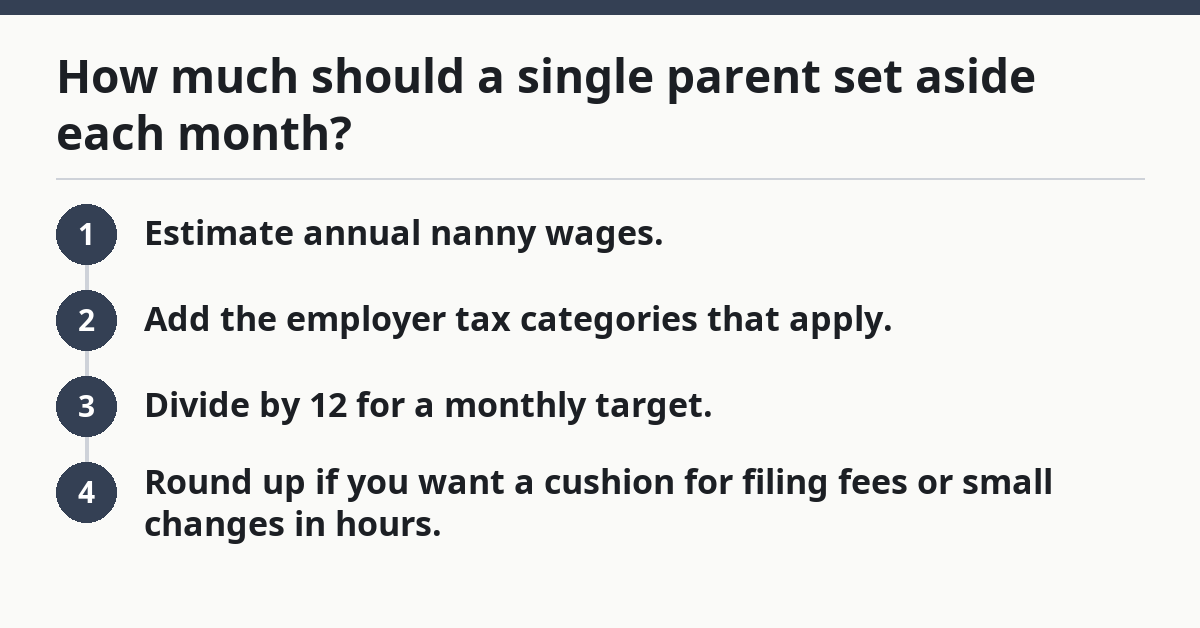
A clean way to build the reserve:
- Estimate annual nanny wages.
- Add the employer tax categories that apply.
- Divide by 12 for a monthly target.
- Round up if you want a cushion for filing fees or small changes in hours.
If your schedule changes often, use the highest likely monthly wage rather than the lowest. That keeps the budget from failing in the first busy month. If you expect summer hours, school breaks, or a temporary increase in care, build that into the reserve before it hits your account. A flat monthly transfer is easier to manage than a last-minute catch-up.
Here’s the catch: a lower monthly reserve can look fine for three months and still fail at year-end. The better number is the one that survives real payroll, not the one that looks tidy on paper. If that number feels hard to fit, the problem is not the math. It’s the size of the care plan.
The mistakes that blow up the budget
The biggest budget mistakes come from missing taxes, missing forms, or using the wrong wage base. Picture this: you think you’ve covered care, then the payroll bill lands and the gap is bigger than expected. That is how a small omission turns into a cash problem.
Common errors include:
- Treating nanny pay as a private transfer. The consequence is missed employer taxes and poor records. The better move is to budget as a household employer from the start; if you are unsure, consult a tax professional or the IRS household-employer guidance before you pay wages (IRS Publication 926).
- Forgetting state unemployment tax. The consequence is an underfunded budget, especially in states with separate reporting. The better move is to check state rules before the first paycheck.
- Mixing up employee withholding and employer tax. The consequence is double counting or undercounting. The better move is to separate each line in your payroll log.
- Skipping W-2 preparation until January. The consequence is rushed filing and errors in names, wages, or tax amounts. The better move is to collect data every pay period.
- Using old rates or thresholds. The consequence is a budget that is wrong on day one. The better move is to use the current tax year’s rules from the IRS or state agency.
- Failing to save after each payday. The consequence is a tax bill with no cash behind it. The better move is to move money into a tax reserve every time wages are paid.
A budget can survive a small estimate error. It usually cannot survive a total missing category. That’s the line between a workable plan and a scramble.
When does this approach stop working?
This approach stops working when your nanny arrangement is no longer a simple household payroll setup. Picture this: you want one clean budget, but the rules change under your feet. That is the moment to pause and recheck the structure.
You pay through an agency: the agency may handle payroll, taxes, or classification differently — confirm who the employer is before budgeting.
Your nanny works in more than one home: split-employer rules may change who owes what — do not assume one family handles all taxes.
Your state has its own employer filing system: state withholding or unemployment rules can add separate deadlines — check the state agency calendar.
You are unsure about worker classification: employee vs. contractor status changes the tax picture — do not build a budget on the wrong label.
Your pay schedule is irregular: variable hours can change the tax amount each month — use the highest realistic pay period as the budget anchor.
You are close to a filing deadline: rushed payroll setup increases the chance of errors — slow down and verify records before paying the next wage.
If any of those situations applies, the budget still matters, but it needs a fresh look. The numbers may be right and the structure may still be wrong. Because the employer setup drives the tax rules, the safest next step is to verify that setup first, then rebuild the tax line.
For broader childcare planning beyond payroll taxes, the hub page on childcare system planning for single parents is the right place to step back and map the whole picture.
What does a good budget look like?
A good budget keeps nanny wages, employer taxes, and filing costs in separate lines and updates them when pay changes. Picture this: you can look at the account and see the next payroll week already covered. That is what “good” looks like here.
A strong setup usually has four features:
- A separate savings bucket for household employer taxes
- A monthly reserve based on current wage levels
- A record of hours, wages, and withheld amounts
- A reminder for filing dates and W-2 preparation
If you want a simple check, ask three questions at the end of each month: Did I pay the nanny the right gross wage? Did I save enough for the taxes tied to that wage? Are my records ready for the next filing deadline? If any answer is no, the budget needs an update.
The goal is not perfection. It’s control. If the tax reserve is funded and the records are clean, the rest of the year is easier to manage.
Do I have to pay nanny payroll taxes?
Usually, yes, if you are the household employer under the rules that apply where you live. The exact trigger depends on country, state, and wage thresholds, so the answer is not universal. Check the current household rules before you decide not to budget for them.
Drafted with AI; not yet reviewed by a person.