Last updated: November 19, 2026
Key Takeaways
- Expense planning and category management keep money from disappearing into “miscellaneous” and show, month by month, what spending needs a cap.
- You set category limits by covering fixed bills first, then using the last 3 months of spending to set realistic caps.
- Some categories need tight limits, some can flex, and some deserve closer monitoring because they hide leaks.
- You manage categories by planning from your lowest safe income month and assigning money in layers instead of all at once.
Expense planning and category management is the job of deciding where every dollar goes before it disappears, so you can cover bills, stop category blowouts, and still leave room for savings. Expense planning and category management works best when it fits your income timing, your fixed costs, and the spending leaks you actually have. The sections below sort out the trade-offs, the order to do things in, and the situations where standard advice breaks.
What expense planning and category management actually solve
Expense planning and category management stop money from getting lost in “miscellaneous” and show you, month by month, which spending is safe and which spending needs a cap. If you only track total spending, you miss the real problem: one category can be fine while another quietly wrecks the month.
Because of that, it helps to think in categories instead of totals alone. Picture this: you have rent due on the 1st, groceries every week, a car payment on the 15th, and three subscriptions that renew on different days. If you plan by total balance alone, the timing of those bills can still sink you. If you plan by category, you can see the collision before it happens.
The useful version of this work is simple: assign money to a category before you spend it, then compare the planned amount with the actual amount. That lets you answer the main question here — what should I cut, cap, or protect this month?
| Situation | Best Path | Why Other Options Fail |
|---|---|---|
| Irregular income | Build category targets from your lowest reliable month | A flat monthly budget can break on a short-pay month |
| Tight cash flow | Prioritize fixed bills and high-variance categories first | Saving first can starve rent, utilities, or debt payments |
| Credit card spending | Track by statement cycle, not just calendar month | Calendar-only tracking hides the charge timing |
| Family or shared household | Split categories by purpose, not by person | Person-based tracking makes grocery and school costs harder to see |
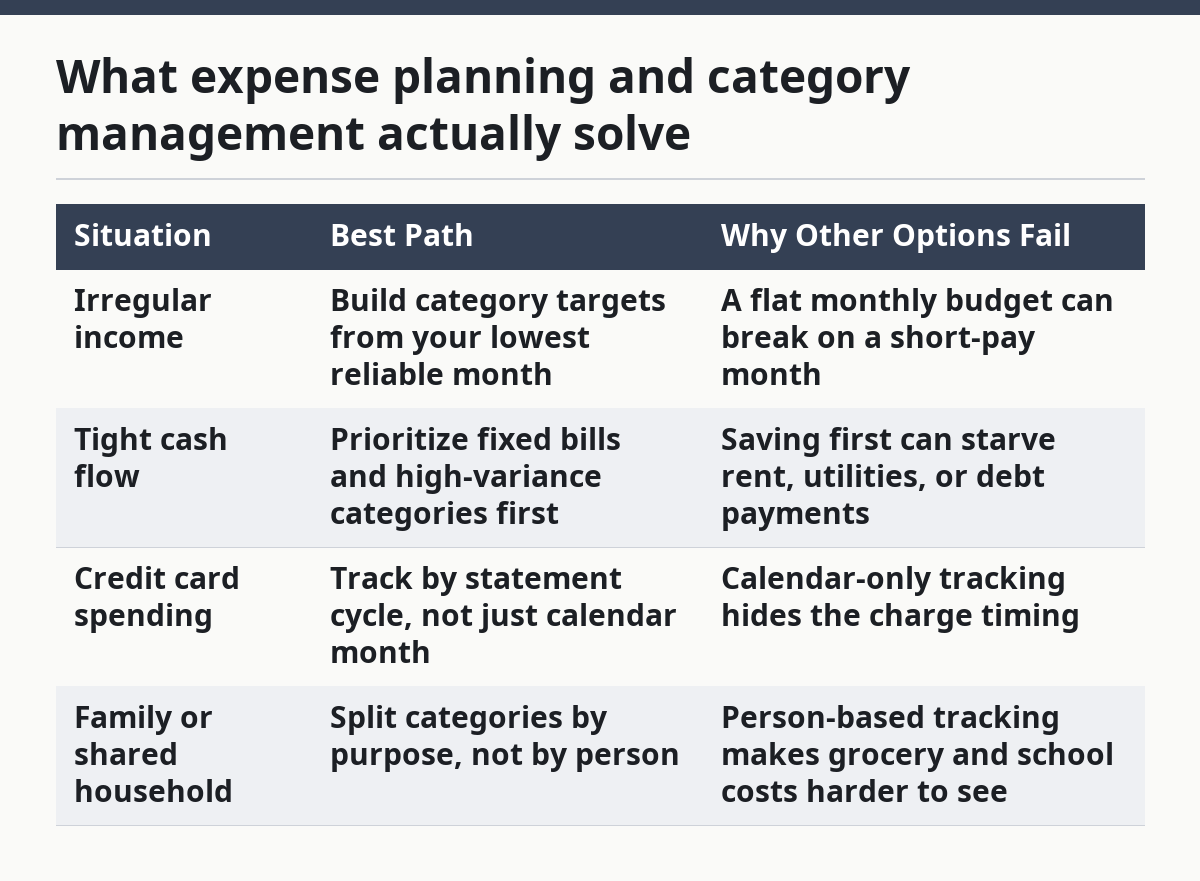
If your current system only tells you what you spent after the fact, it’s not really planning. It’s reporting, as the CFPB explains in its budgeting guidance. Quick check: if you can name your three biggest overspending categories without looking, your setup is already doing some work.
How do I set category limits without guessing?
You set category limits by starting with fixed bills, then using the last 3 months of spending to build realistic caps for the rest. If you guess from memory, the numbers tend to be too low in categories that flex, like food, transport, or household supplies.
As a result, the first job is to make the numbers honest. Picture this: you open a spreadsheet or budgeting app and see separate lines for rent, utilities, groceries, gas, dining out, medical, and subscriptions. The goal is not to make every category equal. The goal is to make each one honest enough that you stop raiding another category to cover it.
Use this order:
- List every fixed bill that repeats on a known schedule, like rent, insurance, loan payments, and phone service.
- Mark bills that change with usage, such as electricity, water, fuel, or credit card interest.
- Pull 3 months of spending from bank and card statements.
- Group each transaction into one category and total the last 3 months for each group.
- Divide each category total by 3 to get a starting monthly target.
- Raise the target for categories that run hot in certain months, like school supplies or holiday travel.
- Cut the target only where the data says there’s slack, not where you hope there is slack.
A lot of people get stuck because they try to budget every line perfectly on day one. That’s a mistake. A first-pass category plan should be good enough to survive one full month without constant repair, and the FDIC’s budgeting materials support that kind of practical starting point.
Use this 3-month rule for the first pass
For variable spending, a 3-month average gives you a cleaner starting point than a single paycheck or one “good” month. If your grocery spend was $540, $610, and $575, then $575 is a practical target, not a moral failure.
If a category swings hard by season, use a rolling average plus a buffer. Specifically, that applies to:
- heating or cooling bills
- back-to-school spending
- travel
- medical copays
- car maintenance
- gifts
On the flip side, some categories should stay fixed on purpose. Streaming, app subscriptions, and phone plans usually need a hard cap, not a moving target, because they don’t change much unless you let them.
Quick check: if your category limit came from one month of spending, it’s probably too brittle.
Which categories should be fixed, flexible, or watched closely?
Some categories should be capped tightly, some should float a little, and some need close watching because they hide leaks. The mistake is treating every category the same, because rent and restaurants do not behave the same way; when in doubt, consult a professional or a qualified financial counselor, and review guidance from the Consumer Financial Protection Bureau.
Because the categories play different roles, the structure has to reflect that. Picture this: you’re looking at your budget and trying to decide whether to give every category the same monthly rule. That sounds tidy. It usually breaks in real life because fixed bills, recurring commitments, and impulse spending have different jobs.
Use this structure:
- Fixed categories: rent, mortgage, insurance, debt payments, daycare, transit passes, subscriptions, and any bill that repeats at the same amount.
- Flexible necessity categories: groceries, utilities, gas, prescriptions, household goods, and school costs.
- Watchlist categories: dining out, takeout, hobbies, gifts, entertainment, delivery fees, and impulse buys.
- Sinking fund categories: car repairs, annual fees, travel, holiday spending, clothing, and medical out-of-pocket costs.
- Rare but large categories: taxes, home repairs, insurance deductibles, replacement electronics, and vet care.
Fixed categories get protected first because they keep the month from breaking. Flexible necessities come next because they can move a little without causing damage. Watchlist categories are where the leaks usually live.
A smart category plan doesn’t just say “spend less.” It tells you where to spend first and where to pause. If dining out is at 80% by the middle of the month, but groceries are at 60%, the fix is not generic restraint. The fix is to move the meal budget, or stop eating out for the rest of the cycle.
A common benchmark is to give your watchlist categories a firm ceiling and your necessity categories a small cushion. Not a blank check. A cushion. That difference matters when you’re comparing needs, wants, and timing.
Quick check: if you have categories that always run over, they should be monitored, not ignored.
How do I manage categories when income changes from month to month?
You manage categories by planning from your lowest safe income month and assigning money in layers, not all at once. If your pay varies, a standard monthly budget can lie to you because it assumes cash arrives evenly when it doesn’t.
Because the timing changes, the categories have to be funded in stages. Picture this: one month brings two big checks, the next month brings a lean stretch, and the due dates stay the same. If you assign spending too early, you can accidentally spend next month’s rent this month. That’s how people get caught by surprise on the 20th.
Use a layered system:
- Find your lowest reliable monthly income from the last 6 to 12 months.
- Fund the “must pay” list first: housing, utilities, food, transport, minimum debt payments, and insurance.
- Set aside money for any bill due before the next paycheck.
- Build one category buffer for the ugliest surprise you usually get, such as fuel spikes or a medical copay.
- Only then fund flexible wants, savings, and extra debt paydown.
- If a high-income month shows up, consider consulting a financial professional or following a written cash-flow rule before splitting the extra into next month’s categories; see the CFPB for budgeting guidance.
This is where cash flow planning beats pretty budget charts. A category is not just a spending bucket. It’s also a timing tool. If the car insurance bill lands once every 6 months, that money needs to sit in a sinking fund long before the renewal date.
The best path is often a two-layer system: one layer for available cash, one layer for future obligations, though the right setup depends on your situation and may benefit from professional advice. Many budgeting apps can do this, but a plain spreadsheet can too if you’re disciplined about dates. The tool matters less than the rule.
On the flip side, if your income is stable and your spending is messy, you do not need a complex cash flow model. You need tighter category caps and a weekly review.
Quick check: if you’ve ever had money on payday and still missed a bill later that month, this is the section that applies to you.
What should I do when a category blows up mid-month?
You should move money with a rule, not with guilt, and decide whether the overspend is a one-time event or a sign the category was underfunded. If you panic-reassign cash every time a category goes red, your budget stops meaning anything.
Because surprises happen, the point is to respond without breaking the whole plan. Picture this: groceries jump because prices rose, a tire blows out, or school fees hit all at once. The question is not “How do I avoid all overspending?” That’s not realistic. The real question is which category can absorb the hit without breaking your priorities.
Use this order when a category goes over:
- Check whether the overspend is a timing issue or a real overage.
- If it’s timing, move money only after confirming the upcoming bill can still be paid.
- If it’s real, cut from the least harmful category first, not the easiest one.
- Protect fixed bills and sinking funds before cutting savings goals.
- Record the reason for the overage so next month’s target improves.
- If the same category overruns for 2 or 3 months, raise the target or change the habit.
A good category system should let you ask: “What changed?” If the answer is inflation, a route change, a new school fee, or a higher utility bill, then the category was wrong, not you. If the answer is “I kept ordering delivery,” the category did its job and exposed the pattern.
Here’s a useful rule, with the usual financial caution: never treat all overspending as equal. A $40 grocery overrun is not the same as missing a minimum debt payment. One needs a category correction. The other needs an emergency fix. If the pattern is persistent, speak with a professional before changing the whole plan.
The truth is, the point of category management is not perfection. It’s faster detection and faster correction.
Quick check: if overspending makes you hide from the budget instead of adjusting it, the system is too rigid.
The 3 conditions that change everything
The right category structure changes if you share money, use credit cards for most spending, or need to plan for irregular but predictable costs. Those three conditions reshape the whole system.
Because the structure changes, the same budget template won’t always work. Picture this: you and a partner are sharing expenses, most purchases go on cards, and the car needs tires every couple of years. A plain “monthly budget” won’t answer the real questions. You need category rules that track timing, ownership, and future cost.
1) Shared money
If two people spend from one pool, then categories need clear owners or clear rules. Split categories by purpose — groceries, housing, travel, kids, gifts — instead of by who swiped the card. That prevents arguments over small transactions and makes joint planning easier.
2) Credit card spending
If you spend mostly on cards, then the statement cycle matters as much as the calendar month. A charge on the 30th may hit the budget before the bill is due, or after the month closes, depending on your system. That can make a category look healthy when it isn’t.
3) Irregular but predictable expenses
If a bill happens yearly, quarterly, or every 18 months, it belongs in a sinking fund. That includes renewals, repairs, travel, and annual subscriptions. If you wait until the bill lands, the category system failed before the expense even showed up.
Use this table to decide the structure:
| Situation | Best Path | Why Other Options Fail |
|---|---|---|
| Shared household spending | Use joint categories for shared needs | Person-based tracking turns into blame |
| Heavy credit card use | Track by statement date and payment date | Calendar-only tracking distorts category balances |
| Annual or quarterly bills | Build sinking funds monthly | Waiting until the bill arrives creates spikes |
| Lots of small subscriptions | Audit quarterly and cut dead weight | Ignoring them hides repeat drains |
| Frequent cash spending | Log it daily or it disappears | Weekly memory-based entry is too fuzzy |
A lot of people try to solve these with a prettier app instead of a clearer rule. That’s backwards. The rule comes first.
Quick check: if your biggest money fights are about timing, shared costs, or surprise bills, your category system needs structure, not motivation.
When the standard advice is wrong
Standard advice is wrong when it tells you to start with savings goals before you can reliably cover monthly bills, or when it treats every category as equally flexible. That advice sounds tidy and fails real people.
Therefore, the safer approach is to match the plan to the mess you actually have. Picture this: you’re told to “pay yourself first” while your rent, gas, and groceries are already unstable. Saving is a fine goal. It is not the first fix if your category plan can’t survive to the end of the month.
Here are the edge cases where the normal script breaks down:
-
You’re new to budgeting and have no history.
What changes: there’s no clean average to use.
What to do instead: start with the last 60 to 90 days of statements, then use conservative estimates for variable categories until you have 3 full cycles of data. -
Your income is highly seasonal.
What changes: one-month targets mislead you.
What to do instead: budget from the lowest season, then build reserve categories during stronger months. -
You have high medical or caregiving costs.
What changes: “miscellaneous” becomes a trap.
What to do instead: create separate categories for prescriptions, visits, supplies, rides, and out-of-pocket care. -
You use cash for some spending and cards for the rest.
What changes: spending visibility gets split.
What to do instead: log cash the same day or assign a small weekly allowance so it doesn’t vanish. -
You’re already behind on bills.
What changes: category optimization is not the first move.
What to do instead: stop discretionary spending, protect due dates, and use a bare-bones category plan until you’re current. -
Your categories keep growing because life changed.
What changes: last quarter is no longer a valid model.
What to do instead: rebuild the plan around the new normal, not the old one.
A normal budget assumes the only problem is discipline. Real life often says the problem is bad timing, incomplete data, or a category mix that no longer fits. That’s why the same advice doesn’t work for everybody.
Quick check: if your situation has medical bills, seasonal income, or debt arrears, you need a different path than a standard budget template.
A practical setup that actually holds up month to month
A working setup uses a small number of categories, clear due dates, and one review day each week. If you overbuild the system, you’ll stop using it. If you underbuild it, it won’t catch anything useful.
Because the system has to stay usable, simplicity matters. Picture this: you want a plan you can keep open in a tab, but you also want to finish it before the month runs away. That means fewer categories, clearer rules, and a review rhythm you can repeat without thinking too hard.
Start here:
- Create 10 to 15 categories, not 40.
- Separate fixed bills from flexible spending.
- Make one sinking fund for each expensive irregular cost.
- Set one weekly check-in, 15 to 20 minutes long.
- Match spending categories to account balances or app envelopes.
- Review the last 7 days of transactions and recategorize anything that was miscoded.
- Adjust one or two categories only, not the whole budget.
Good tools here include a spreadsheet, a budgeting app with category envelopes, or a bank view that lets you tag spending. The tool is less important than the habit of comparing plan to actual. If your app shows totals but not category movement, it only solves half the problem.
The best part? You don’t need a perfect system to get better results. You need a repeatable one. A plan that you actually touch every week beats a beautiful plan that sits untouched for 6 weeks.
One more thing: if you share money with someone else, build one rule for transfers. For example, all joint spending goes into joint categories, and personal spending stays personal. That keeps the plan from becoming a daily negotiation.
Quick check: if your budget only works when you stare at it all day, it’s too fragile.
What are the most common mistakes in expense planning?
The most common mistakes are using too many categories, underfunding the categories that move, and treating the budget like a punishment instead of a map. If any of those sound familiar, the fix is structural, not motivational.
Because the structure matters, the warning signs show up early. Picture this: you make a clean-looking budget in January, but by March you’re editing it every few days and calling that normal. It isn’t normal. It means the categories are not matching the way your money really moves.
Watch for these traps:
-
Too many categories.
You end up tracking noise instead of decisions. -
No sinking funds.
Big irregular bills hit like emergencies even when they were predictable. -
Using averages without seasonality.
A winter utility bill or holiday month blows up the plan. -
Ignoring due dates.
A category can look funded and still fail if the cash is needed earlier than expected. -
Never reviewing miscodes.
Small labeling errors pile up and distort the whole picture. -
Cutting food or transportation too hard.
Those categories often snap back, then the plan fails in the next cycle.
The cleanest budgets are not the most detailed. They’re the ones that help you make a decision fast: fund it, cut it, delay it, or move money from another category. That’s the real job.
Quick check: if your budget creates more confusion than clarity, the category list is probably the problem.
FAQ
How many categories should I have?
Start with 10 to 15 categories, then add only when a new spending pattern is big enough to matter. Too many categories make the plan hard to keep up with, and small mistakes start to look bigger than they are.
Should I budget by paycheck or by month?
If your income is steady, a monthly plan is fine. If your pay timing is uneven, budget by paycheck and make sure each check covers the bills due before the next one arrives.
What if my groceries and household costs keep changing?
Raise the category to match a 3-month average, then add a small buffer for price changes. If it still runs over every month, the problem is not the label — the target is too low.
Do I need a budgeting app for this?
No. A spreadsheet and a weekly review can do the same job if you use them consistently. An app helps when you want automatic transaction import, but the category rules still have to be set by you.
What should I do first if I’m behind on bills?
Protect the bills that keep you housed, powered, and able to get to work, then pause nonessential categories. Once the urgent bills are covered, rebuild the category plan around a bare-minimum month before adding savings back in.
Drafted with AI; not yet reviewed by a person.