Last updated: November 19, 2026
Key Takeaways
- Cover only the hours you work, because the bill changes when you do not need full-day care.
- Set a care cap, then match each break day to the safest low-cost option for those hours.
- The best fit depends on break length and how many hours need coverage.
- Choose the lowest-cost option that covers the needed hours, and reserve pricier care for true gaps.
School-break childcare can wreck a single-parent budget fast. How to Budget for Childcare During a School Break as a Single Parent starts with pricing the break before it starts, matching care to the hours you actually need, and building a backup line in your budget. The steps below show what to do, what to book, and what each choice really buys you.
Start with the school break dates and your work hours

Picture this: you’re staring at a calendar with a 5-day fall break, a 2-day teacher workday, and a winter break that runs across two weeks. You need coverage for work hours only, not the whole day, and that changes the bill.
Start with the school break dates first. Write down the exact days school is closed, the hours your job needs you, and any commute time you have to cover. If you work 8:00 to 4:30 and your child’s school day is normally 8:30 to 3:00, you are not budgeting for a full 12-hour day unless your job really needs it.
What worked: you have a clean list of dates, hours, and gaps.
What to look for: a schedule that separates fall break care, winter break care, spring break care, and teacher workday care. Each one may need a different plan.
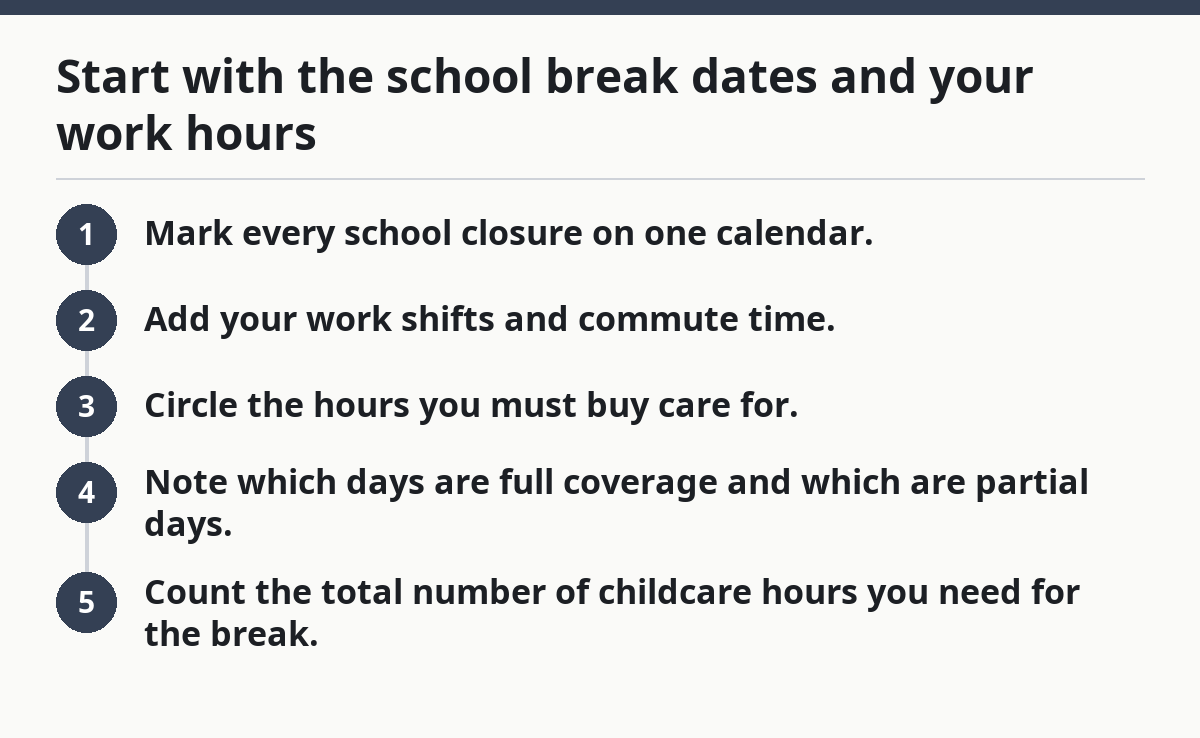
Use this short checklist:
- Mark every school closure on one calendar.
- Add your work shifts and commute time.
- Circle the hours you must buy care for.
- Note which days are full coverage and which are partial days.
- Count the total number of childcare hours you need for the break.
Here’s the catch: many parents overbuy care because they plan for “the whole break” instead of the work window. That mistake can push you into a camp or sitter plan you do not need. If you only need 6 hours a day, a full-day camp may be the wrong fit.
The school calendar plus your work schedule is the base. Without that, every later number is guesswork.
How do I budget for childcare during a school break as a single parent?
You budget for school-break childcare by setting a care cap, then assigning each break day to the cheapest safe option that covers the hours you need. The budget only works if you count the add-ons: registration, lunch, transport, late pickup, and backup care.
Picture this: you already know the break dates, and now you’re trying to keep the total under control without guessing. That means building the budget from the top down, not from a “best case” rate you hope will hold.
Use a simple order:
- Set your ceiling. Pick the highest amount you can spend without missing rent, groceries, or utilities. That number is your cap, not your wish.
- List every care option. Include a childcare provider, a camp, a family member, and a backup sitter.
- Price the real hours. Compare half-day, full-day, before-care, after-care, and late-pickup charges if they apply.
- Add the extras. Count lunch, snacks, rides, booking fees, and any deposit you must pay now.
- Reserve backup money. Keep a separate cushion for one sick day, a school closure extension, or a last-minute sitter.
What the money does buy: a block of time when your child is supervised and you can work. What it may not buy: free meals, transport, or flexible pickup unless the provider says so.
Once you assign each break day to a care type, the total becomes easier to see. You can check whether a 3-day camp works for spring break, whether a family member covers a teacher workday, or whether a sitter is only needed for one gap.
On the flip side, a “cheap” option with a 2-hour pickup window can cost more than a longer day rate once you add a late fee. Read the rules before you book. Good budgets fail on fees, not headline rates.
Which childcare option fits each kind of school break?

The right option depends on the length of the break and the hours you need covered. A camp fits longer stretches, a family member can cover short gaps, and a backup sitter keeps your plan from falling apart.
Picture this: you have a 1-day teacher workday on one end and a week-long winter break on the other. Those are not the same problem, so they should not get the same childcare plan.
Use this breakdown to match the break to the care:
- Teacher workday care: Best for 1 day or a single partial day. A family member, trusted neighbor, or sitter often makes more sense than a camp.
- Fall break care: Best for 2 to 5 days. A camp or day program can work if it matches your work hours.
- Winter break care: Best for a longer block with mixed coverage. Many parents mix a camp, family member support, and a sitter on the gap days.
- Spring break care: Best for a full week when school is closed but work keeps going. A camp often gives better structure than patching together several one-off sitters.
- School closure backup plan: Best for surprise closures, snow days, or a child who gets sent home early. This is not your first choice; it is the plan that keeps your job from being derailed.
A camp usually buys structure, supervision, and a known schedule. It may not include door-to-door transport, a flexible pickup time, or care outside the listed hours. A family member can buy flexibility and lower cost, but reliability can vary from day to day.
The truth is, the best plan is often mixed. A single parent may use 3 camp days, 1 family member day, and 1 backup sitter day during one school break. That is not messy. It is budgeting with reality in view.
How do I use a camp, family member, or backup sitter without blowing the budget?
You use the cheapest option that covers the exact hours, then save the more expensive option for the days that truly need it. The mistake is paying camp rates for days a family member could cover in 4 hours.
Picture this: your child’s school closes for a 4-day spring break, and your boss still expects you in the office. You do not need one perfect answer. You need the right mix of care, time, and cost.
A practical way to split the days:
- Use a family member first for short gaps. If someone can cover a teacher workday or a half-day closure, that is usually the lowest-cost option.
- Use a camp for the longest stretch. Camps make sense when you need a full block of care and a set schedule for 5 or more hours a day.
- Use a backup sitter for the holes. A sitter is for the day camp is full, the relative cancels, or pickup runs late.
- Avoid paying twice for the same hours. If a camp ends at 3:00 and you need coverage until 5:30, price the after-care gap before you book.
- Confirm transport early. If you must drive across town for drop-off, your hidden cost is time, fuel, and missed work.
What that money does buy: a covered gap in your day. What it does not buy: spontaneity. Once you book a camp or sitter, the schedule is usually fixed.
The biggest budget leak here is the “just in case” booking. Parents sometimes reserve a full week of care when they only need 2.5 days. That can tie up money that should have gone to bills. Book the smallest block that still covers your shift.
If you need a broader system for the year, the hub on Childcare and school-cost planning for single parents can help you connect this break plan to the rest of your budget.
What hidden costs should I count before I book?
You should count every extra charge that comes with the care, not just the daily rate. Hidden costs are what turn a workable plan into a scramble.
Picture this: you found a camp that fits your work hours, but the real bill still feels higher than expected. That usually means the price you saw was only part of the cost.
Watch for these add-ons:
- Registration or booking fees. These are paid once and can hit before the break starts.
- Deposits. Some providers want money up front to hold a spot.
- Late pickup fees. A 15-minute delay can cost more than you expect.
- Meals and snacks. Some programs require you to pack lunch; others do not include food.
- Transport costs. Driving across town 2 times a day adds fuel and time.
- Emergency backup care. A sitter for one missed day can save your work shift, but it belongs in the budget.
The trade-off is simple: lower headline cost can still mean a worse total cost if the schedule is tight. A family member may seem free, but if you need to pay for rides, groceries, or missed work time to make it work, the budget is not really free.
A useful habit is to write the “all-in” cost beside each option. Camp. Family member. Backup sitter. Then compare the whole number, not the first number you hear. If one option needs $0 in transport and another needs two round trips a day, that difference matters over a 5-day break.
This is also where a short school closure can be more expensive than a longer one. A 1-day closure may force you to pay a premium for a sitter because no camp is set up for that single day.
How do I build a school-closure backup plan that actually works?
You build a school-closure backup plan by naming one primary caregiver, one backup, and one rule for who you call first when school closes. The plan works when you can reach the right person in 5 minutes, not 5 hours.
Picture this: the school texts at 6:30 a.m. that classes are closed for the day. You still have to get to work, and the usual plan is gone. This is where a backup plan earns its place.
Use a three-layer setup:
- Primary care: the first option you book for the break, such as a camp or trusted childcare provider.
- Backup care: a family member or sitter who can take over on short notice.
- Emergency rules: who you call, when you call, and what hours each person can cover.
A good backup plan should answer these questions before the break starts:
- Who can take the child if the main care option falls through?
- Who has the house key, car seat, or pickup permission?
- What is the latest time you can still drop off or switch plans?
- Which days are too risky for a single backup person?
A backup plan also keeps one missed day from becoming a full week of chaos. If your sitter cancels on Wednesday, you know whether a family member can step in or whether you need to move to plan B.
The wrong move is hoping you’ll “figure it out” when the closure happens. That can mean higher rates, rushed bookings, and a missed shift. A written backup list takes 10 minutes and can save you from paying the most expensive last-minute option.
Common budgeting mistakes that cost single parents the most
The most expensive mistake is budgeting for the cheapest child care idea instead of the one that actually covers your hours. That gap usually shows up as late fees, missed work, or last-minute sitter rates.
Picture this: you pencil in a family member for winter break, but they can only help on 2 of the 5 days. Now you’re scrambling for the other 3, and every rushed choice costs more.
The mistakes that show up most often:
- Ignoring partial days. A 3-hour gap can be hard to fill if you only shop for full-day care.
- Forgetting fees. A camp spot may look affordable until the booking fee and lunch add up.
- Assuming a relative can cover every day. Good intentions do not guarantee availability.
- Leaving no backup money. One canceled day can force a more expensive option.
- Waiting too long. The best-fit care for fall break or spring break can book out before the break starts.
Here’s the rule that saves money: if a care option can’t cover the exact hours you need, it is not a real option. It is a maybe.
I’d also be careful with any plan that depends on one person for the whole break. If that person gets sick, works overtime, or changes their mind, you need a second path already lined up. That is not pessimism. It is budget protection.
FAQ
What counts as a school break for childcare planning?
A school break is any day school is closed or your child leaves earlier than your work schedule allows. That includes fall break, winter break, spring break, teacher workdays, and short school closures. For budgeting, count the hours you need covered, not just the number of calendar days.
How do I budget for a one-week school closure?
Budget for a one-week school closure by pricing the full 5 school days, then adding one backup day’s worth of care. A one-week closure can be handled by a camp, a family member, or a sitter, but the cheapest option is the one that covers every work hour without late fees or transport surprises.
Should I use a camp or a sitter during breaks?
Use a camp when you need a full block of daytime care and a sitter when you need flexible, short-notice coverage. A camp usually makes more sense for spring break or a longer winter break; a sitter can be the better fit for a teacher workday or a single gap day.
Drafted with AI; not yet reviewed by a person.